Francis Lawrence’s prequel gives the young Snow a face, a cracked concrete arena and a singer to fall for, and for two acts it holds. Then it leaves the Capitol, and the last forty minutes cost it much of what it earned.
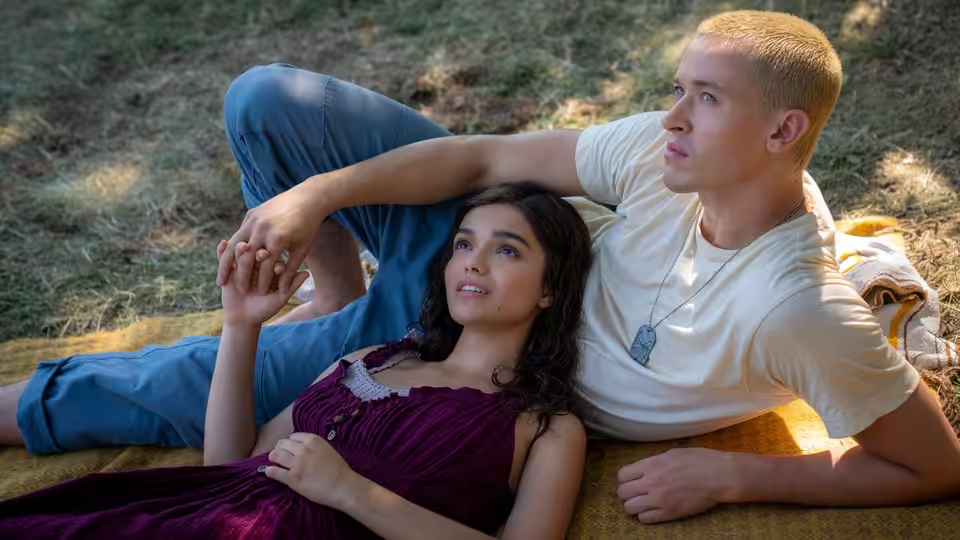
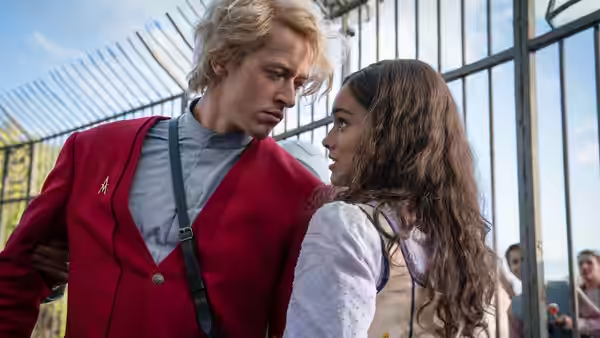
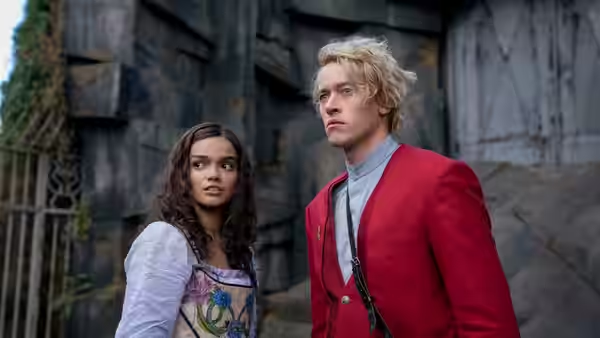
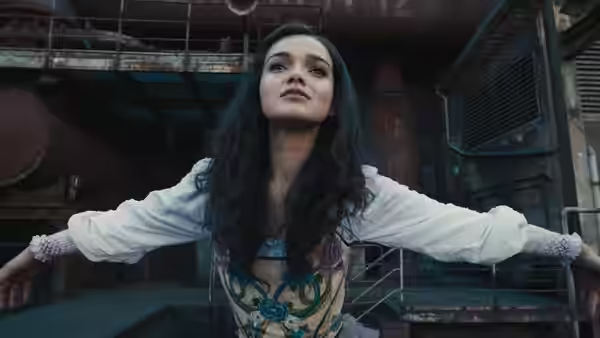
Francis Lawrence, who directed the last three Katniss films, goes back to the tenth Hunger Games and to a Coriolanus Snow who is eighteen, poor and hiding it. Tom Blyth plays him as a Capitol boy with a good coat and nothing under it: the family money is gone, the flat is cold, and his grandmother (Fionnula Flanagan) carries on as if none of that were true. The Games are a shabby, poorly watched affair, and the Academy assigns its brightest students to mentor the tributes and make them worth watching. Snow draws the girl from District 12, Lucy Gray Baird (Rachel Zegler), who answers her reaping by dropping a snake down a rival’s dress and singing to the cameras. He is told she is his way back to money, and the film watches him work out what else she might be.
That is a good setup, and for two acts the film honours it. Michael Lesslie and Michael Arndt, adapting Suzanne Collins’s novel, keep the Capitol scenes short and unkind, and the unkindness is domestic: a dean who despises his pupils, a head gamemaker who feeds them to her ideas, a best friend (Josh Rivera’s Sejanus Plinth) whose conscience is a danger to everyone standing near him. Uli Hanisch builds a Capitol that has not yet learned to enjoy itself, grey stone and long tables and one gilded hall, and Trish Summerville dresses it in reds and blacks cut like uniforms. The arena is the film’s best idea: a bombed sports ground with the concrete still cracked, rubble in the stands and no camera clever enough to follow the killing. Jo Willems shoots it in flat daylight, so we see everything and none of it looks arranged.
Blyth is good at the hard part, which is being likeable and untrustworthy in the same shot. He listens with his whole face and you can watch him file what he hears for later. Zegler sings several times, in a clear country voice with nothing behind it, and the first time she did it we noticed we had stopped taking notes. It is a plain, unguarded thing in a film where everyone else is guarding something, and it is the reason the romance works for as long as it does. Viola Davis plays Dr Gaul as a scientist who gave up on other people some years ago and is cheerful about it, and Jason Schwartzman’s Lucky Flickerman hosts the Games like a weatherman filling airtime, checking his notes to see how many children are left. He made us laugh, and then we heard ourselves laughing and stopped. Peter Dinklage’s Dean Highbottom drinks and glowers and has one scene of real bitterness that the film does too little with.
James Newton Howard’s score is quieter than the series has trained us to expect, brass held back for the arena and strings for Zegler, and it leaves room for the songs, which is the right call. Mark Yoshikawa cuts the fighting clean and fast; you always know where the tributes are and which of them are hurt.
Then the film leaves the Capitol. Collins wrote the novel in three parts and the film keeps that shape, so the third act takes Snow out to District 12 and slows to a walk. What had been a study of a boy choosing what he is becomes a run of conversations in which people tell him what he is. The romance, built on a handful of sharp scenes and a song, is asked to carry an hour it was never written for. We looked at our watch, and then felt bad about it, because the actors were still working. Snow arrives where the older films tell us he must, but the road is so heavily signposted that arriving is a formality.
At 157 minutes it is half an hour longer than it needs to be, and the spare half-hour is all in one place. Against the series’ own record it sits below the 2012 original, which trusted its arena more and its speeches less, and above the two-part Mockingjay, which had a worse case of padding and nobody to sing through it.
We would send anyone who liked the books, and anyone who enjoys watching a good actor be quietly awful. Watch it at home, with the kettle on around the two-hour mark; a cup of tea will not hurt the third act and may help your patience. It carries a 12A, which given what happens in that arena is about right.