Steven Soderbergh tells a true story of corporate price-fixing as a 1960s caper and hands Matt Damon a whistleblower who cannot keep his mind on the job. Damon is superb. The film around him is clever, brisk and slighter than it thinks.
Mark Whitacre is a biochemist and a rising executive at ADM, an agricultural giant in Decatur, Illinois, and in the early 1990s he tells an FBI agent that his employers have been meeting their competitors in hotel rooms to fix the price of lysine, an additive for animal feed. He agrees to wear a wire. Steven Soderbergh, working from a screenplay by Scott Z. Burns, tells this as a comedy, and has put an exclamation mark on the title in case we were in any doubt. It is a smart, brisk, frequently funny 108 minutes, and it rests almost entirely on Matt Damon. He carries it. What is built around him is thinner than it looks.
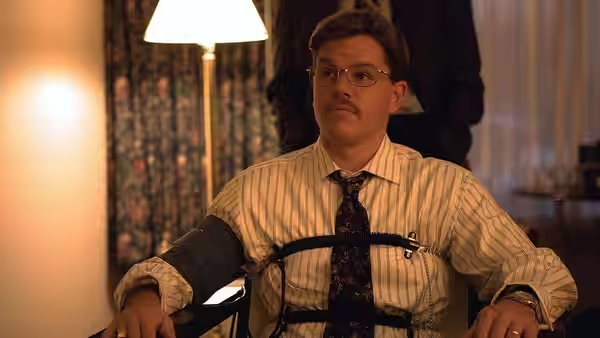
Damon plays Whitacre padded, moustached and bespectacled, with a toupee he is touchy about and a smile that arrives a second too early. Burns’s best idea is the voiceover. While the agents brief him on how to hold a briefcase so the camera inside it points the right way, Whitacre is thinking about ties, about the Japanese word for working yourself to death, about whether polar bears know their noses are black. Damon delivers all of it in the same bright, helpful tone, a man who wants to be liked by everyone around him, including the people he is recording. It is a performance with no vanity in it at all, and it is the reason to see the film.
Soderbergh shoots it himself, and he has drained every image to mustard, orange and brown, so that a film set in the 1990s looks as if it had been left in a drawer since 1974. Doug J. Meerdink gives the executives wood-panelled offices and hotel conference rooms with jugs of iced water, and Shoshana Rubin puts the men in short-sleeved shirts and ties that are too wide. Stephen Mirrione cuts fast and starts the voiceover in the middle of scenes, so we often hear Whitacre’s mind wander while his mouth is still saying something incriminating. Marvin Hamlisch’s score, all xylophone, brass and bossa nova, announces at every turn that this is a caper. For an hour it is right. After that it is the sound of a film nudging us in the ribs.
The supporting cast is largely comedians playing it straight, and the trick works. Scott Bakula’s Brian Shepard is a decent, patient FBI man who believes his informant because it has not occurred to him not to. Joel McHale, as his partner Robert Herndon, spends most of the film wearing the face of someone doing sums in his head. Melanie Lynskey plays Ginger Whitacre, who pushes her husband to go to the bureau in the first place, and gives her a warmth the script does not always earn. Tom Papa, Rick Overton, Tony Hale and Allan Havey turn up as executives, lawyers and supervisors, and each gets one moment of open-mouthed disbelief.
We laughed a great deal in the first hour, mostly at the distance between what Whitacre is doing and what he is thinking about while he does it. Then, somewhere past the hour, Shepard begins to learn things about his informant that we will not describe, and we stopped laughing. The film did not. Bakula’s face in a late interview, tired and quiet and no longer amused, is the truest thing in the picture, and Hamlisch keeps the xylophone going underneath it. We came out unsure whether Soderbergh found Whitacre funny, or sad, or simply useful.
The price-fixing itself barely registers. We are told what the scheme was, but never shown anyone it hurt, and ADM stays a set of offices rather than a force. Soderbergh’s Erin Brockovich (2000) made a contamination case clear enough to be angry about; this one treats the crime as a backdrop for the liar standing in front of it. Damon justifies that choice for long stretches, but it leaves the second half with only one thing to do, which is reveal more of Whitacre, and each reveal lands a little softer than the last.
See it for Damon, who has rarely been this loose or this careless of his own dignity, and for the pleasure of watching serious men in beige rooms slowly realise what they have signed up for. It is fine at home, where the colours look less deliberate and the score can be lived with. It carries a 15 certificate and runs 108 minutes, which is about right. The exclamation mark is doing a lot of work, and by the end it is doing most of it.