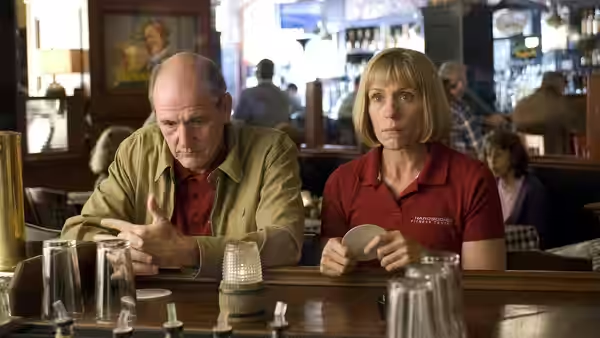
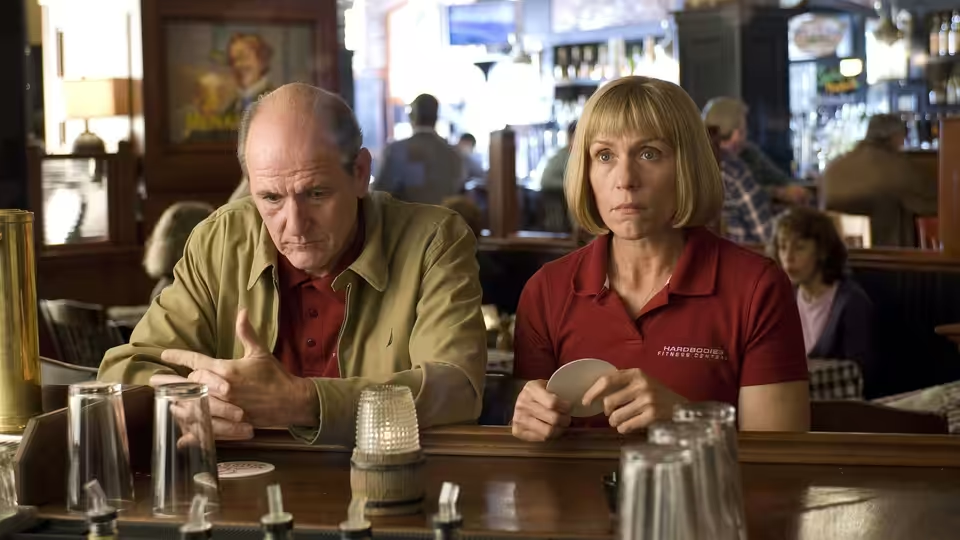
Ted (Richard Jenkins) and Linda Litzke (Frances McDormand) sit together at a bar
Film review

Burn After Reading

2008 · Directed by Ethan Coen, Joel Coen · 1h 36m · MPA R

In a sentenceSeveral stupid people chase a disc of nothing while Carter Burwell scores it like the end of the world

Washington, DC, the present day. Osborne Cox (John Malkovich), a CIA analyst, is moved off the Balkans desk and quits in a rage, announcing he will write his memoirs. His wife Katie (Tilda Swinton), a paediatrician, wants a divorce and quietly copies his financial records onto a disc. The disc ends up on the floor of Hardbodies, a gym where Linda Litzke (Frances McDormand) is trying to pay for four cosmetic procedures her insurance will not cover and Chad Feldheimer (Brad Pitt) is a trainer who has seen too many thrillers. Chad decides the disc is secret intelligence and that Cox should pay to get it back. Meanwhile Harry Pfarrer (George Clooney), a Treasury marshal who is sleeping with Katie, keeps meeting women online. One of them is Linda. The gym manager, Ted (Richard Jenkins), watches all this and says nothing.

Plays from YouTube when you press play; nothing loads from them until then.

Fi1m review

The Coens follow their bleakest film with their silliest: a Washington farce in which a disc of personal finances is mistaken for a state secret and ruins everyone who touches it. It is fast, mean and often funny, and it does not like a single person in it.

Joel and Ethan Coen have made a comedy about intelligence in a city with none. Osborne Cox (John Malkovich) loses his post at the CIA, quits in a rage and sits down to dictate his memoirs. His wife Katie (Tilda Swinton) is already planning to leave him and copies his bank records onto a disc. The disc gets lost, a gym trainer Chad Feldheimer (Brad Pitt) finds it, and Burn After Reading follows from Chad’s conviction that he is holding something the government would kill for. It is frequently funny and it thinks every person in it is a fool. That is the joke and, by the end, the limit.

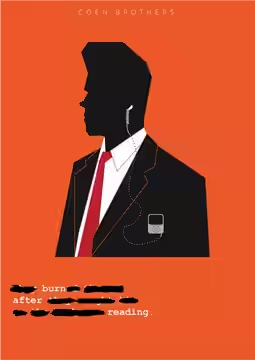
Pitt is the reason to see it. He plays Chad with a bleached quiff, an earpiece he never takes out and the open-mouthed confidence of a man who has been told he is a people person. His phone call to Cox, in which he tries to sound like a blackmailer and ends up sounding like a customer service agent, had us laughing, and the laugh came from how badly Chad wanted to be good at this. Frances McDormand’s Linda is the sadder half of the pair. She wants a new body because she has decided it is the only thing between her and a decent man, and McDormand plays the want straight, so that the scene where the insurance company says no is painful before it is amusing.

Malkovich swears as if he has been waiting twenty years for permission. His Cox is a man in a bow tie who believes he is the last serious person in Washington, and Malkovich gives him enough wounded dignity that the insults land on something. Swinton’s Katie is a paediatrician who tells crying children to stop it, and does the same to everyone else. Richard Jenkins, as the gym manager Ted, is in love with Linda and is the only character who behaves well; the film shows him no kindness for it.

The craft plays it straight. Emmanuel Lubezki opens from a satellite’s view of the earth and drops down onto the CIA’s headquarters, then lights the rest of Washington in the flat daylight of a federal brochure. Carter Burwell writes drums and low brass for a woman trying to afford a tummy tuck, so that every drive across town sounds like a coup. Jess Gonchor gives Cox a wood-panelled Georgetown house full of books nobody reads and Hardbodies an orange-and-blue brightness that makes everyone in it look ill. Mary Zophres dresses Chad in gym clothes a size too tight and Cox as if he had got dressed in 1962 and seen no reason to stop.

The Coens cut it themselves and cut it hard. The plot is coincidence piled on coincidence and moves fast enough that you have no time to object. Where it slows, it is around Clooney. Harry Pfarrer is a twitchy, sex-obsessed marshal who jogs the same block and checks the floors for the agency he is sure is watching him, and Clooney commits, but it is one note held for 96 minutes and the note tires. The scenes where a CIA officer (David Rasche) reports the mess to his superior (J.K. Simmons) are among the funniest in the film, and also where the Coens tell us that none of this means anything. It is a good joke. It also lets the film off having to mean anything.

Most critics liked it; a few found it cold and pointless, and we see why, because we felt it too. In the last twenty minutes we were still laughing and noticed that the people we were laughing at had been built to lose, with nobody to make the loss cost something. Fargo had Marge Gunderson. The Big Lebowski had a Dude you could warm to. This has nobody, by design, and a design can be a fault as well as a choice.

See it for Pitt, for Malkovich’s language, for Burwell’s drums and for the pleasure of watching expensive actors play idiots with care. It carries a 15 and most of that is Malkovich’s vocabulary. Do not expect to like anyone, and do not expect the film to mind.

Critical consensus AI synthesised

63
Positive
14
Mixed
4
Negative
4

Most critics come away amused, if not quite satisfied. The praise clusters on the cast: Brad Pitt’s clueless gym employee and John Malkovich’s irascible Osborne Cox are singled out again and again, with Frances McDormand’s comic turn and George Clooney not far behind. Several reviews admire the precision with which the farce escalates into violence, and a few find the bleakness oddly cathartic, a portrait of paranoia and grasping foolishness with a political sting.

The spread is wide. The middle of the pack calls it slight, second-shelf Coens, with a loose plot, no strong protagonist and characters who are difficult to love. The dissenters go much further: The Guardian finds it a strained, chaotic failure, The New Yorker thinks the misanthropy freezes the comedy, and Paste complains that the actors play quirks rather than people. Even the harshest reviews, though, stop to admire Malkovich or Pitt.

Little White Lies
16 October 2008 · 5/4/5 · Kevin Maher
80

Maher finds the film funny, cruel and faintly depressing, praising its thrillingly barmy ensemble farce. He singles out the characters’ desperate emptiness and the precision with which the plot spirals into grisly violence.

Read the full review →
Radio Times
★★★★ · Stella Papamichael
80

The critic praises the Coens’ skill at blending sophistication with silliness. John Malkovich’s over-the-top performance is singled out for praise.

Read the full review →
Time Out
14 October 2008 · ★★★★ · David Jenkins
80

The review gives the film four out of five stars. The visible text calls it another Coen brothers concoction, but the article body is unavailable, so no specific praise or complaint can be identified.

Read the full review →
The AV Club
11 September 2008 · B · Keith Phipps
77

Phipps finds the film funny but a second-shelf Coen comedy, with its loose plot and lack of a strong protagonist holding it back. He praises the cast’s broadly comic performances, which are almost uniformly funny.

Read the full review →
Empire
25 May 2007 · Ian Nathan
75*

Nathan finds the film initially abrasive but ultimately rewarding, with its offbeat wit lingering after viewing. He particularly praises the precision of its escalating farce and the performances, especially Brad Pitt and George Clooney.

Read the full review →
Los Angeles Times
9 October 2008 · Carina Chocano
75*

Chocano finds the bleak farce bitterly cathartic. She praises its mordant portrayal of paranoia and the grasping, murderous foolishness of its characters.

Read the full review →

Straight answers AI written, from our review

Is Burn After Reading worth watching?
Burn After Reading is worth watching for anyone who enjoys a fast, mean farce and does not need to like a single person in it, and we scored it 72. Brad Pitt's gym trainer and John Malkovich's swearing analyst are the reasons to see it. Expect to laugh and to feel a little cold about it afterwards.
How long is Burn After Reading, and what is it rated?
Burn After Reading runs 1h 36m and is rated R by the MPA in the US. It is a comedy and drama film.
Where can I watch Burn After Reading in the US?
Burn After Reading is available to rent from Amazon Prime Video from $3.99. Availability is checked daily; the links above go straight to each service.
How violent or frightening is Burn After Reading, and is it suitable for children?
Burn After Reading carries a 15 certificate in the UK, and most of that is Malkovich's vocabulary rather than anything frightening. It is a comedy of adultery, blackmail and foul language, not a thriller, so there is little to alarm the squeamish. It is not for children, and younger teenagers will find the swearing is most of the point.
How does Burn After Reading compare to In the Loop?
Burn After Reading is the sillier and colder of the two, and In the Loop is the angrier and the funnier. The Coens' film treats its Washington idiots as fools built to lose; Iannucci's treats his Westminster and Washington idiots as people whose wounded pride could start a war. Choose In the Loop for the swearing and the point, Burn After Reading for Pitt and Malkovich.
What should I watch after Burn After Reading?
After Burn After Reading, try In the Loop (2009, Fi1m 86): Westminster and Washington idiots start a war; the swearing is even better. Then A Fish Called Wanda (1988, Fi1m 83): A heist farce in which everyone double-crosses everyone and nobody is bright; and Dr. Strangelove (1964, Fi1m 93): The original comedy about serious men in rooms who should not be trusted.

Cast

If you liked this, try…

  1. In the Loop (2009, Fi1m 86)Westminster and Washington idiots start a war; the swearing is even better.

  2. A Fish Called Wanda (1988, Fi1m 83)A heist farce in which everyone double-crosses everyone and nobody is bright.

  3. Dr. Strangelove (1964, Fi1m 93)The original comedy about serious men in rooms who should not be trusted.

  4. Wild Tales (2014, Fi1m 83)Six Argentinian stories of ordinary people escalating past the point of return.

  5. Fargo (1996, Fi1m 91)The Coens’ earlier crime-gone-wrong, with one decent woman at the centre of it.