Sean Durkin’s film about the Von Erich wrestling family is sincere, well cast and quieter than its story, and it hurries through griefs it should sit with. It is worth an evening for the brothers, for Efron, and for one late scene that undid us.
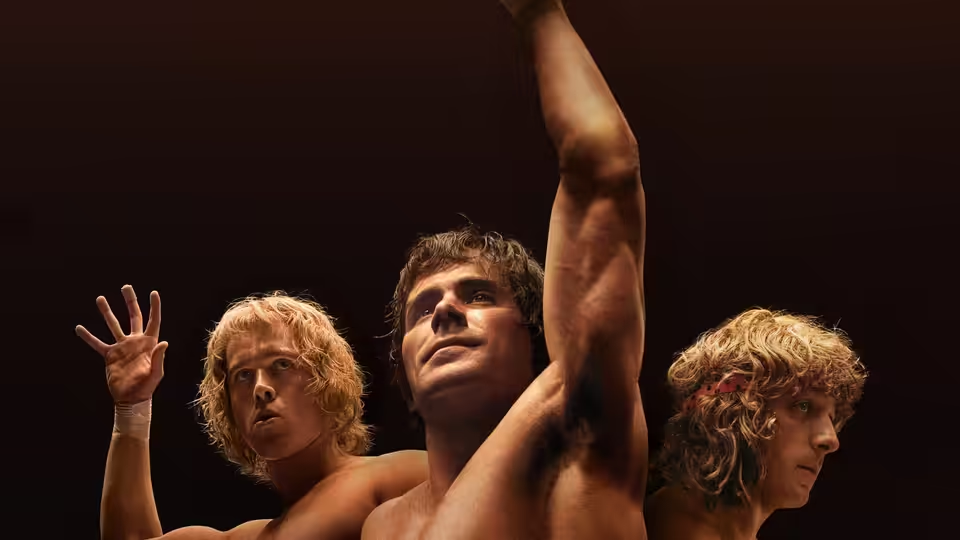
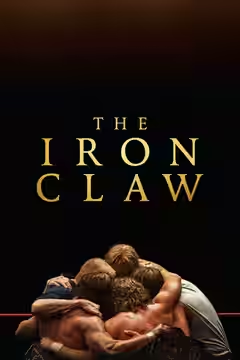
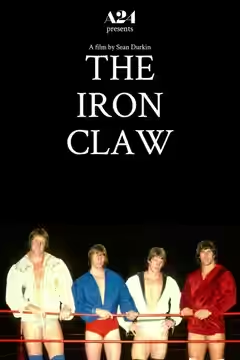
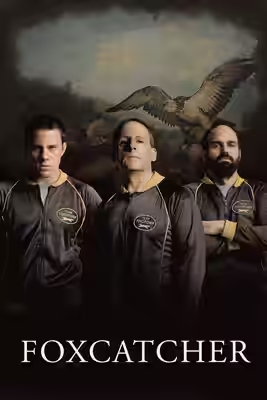
Sean Durkin’s third film, after Martha Marcy May Marlene and The Nest, tells the story of the Von Erichs, a Texas wrestling family run by a father who never won the belt he wanted and has four sons to win it for him. Kevin (Zac Efron) narrates. David (Harris Dickinson) can talk, Kerry (Jeremy Allen White) can throw, and Mike (Stanley Simons) would rather be in a band. What follows is a run of misfortune the family came to call a curse. Durkin tells it plainly and with care, and he tells it too fast. It is a good film with a better one inside it.
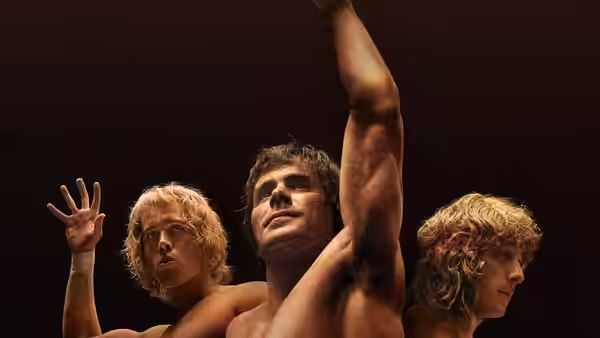
The brothers are the reason to see it. Efron has made himself into a shape that looks uncomfortable to stand in, all neck and shoulder and tiny trunks, and he plays Kevin as a boy inside that body, a man who can throw another man across a ring and still cannot hold his father’s eye. He says little and does most of his acting with his mouth shut. Dickinson gives David the ease of the son who knows he is liked, and White plays Kerry as someone who has decided to be happy and is working at it. Simons’s Mike is the one who visibly does not belong in the ring, and the film is gentle with him. When the four of them are together, wrestling on the lawn, piling into a car, sitting on a bed too small for them, the film is at its best.
Holt McCallany’s Fritz is a large, courteous, frightening man who ranks his sons at the breakfast table and tells them the rankings can change. He never raises his voice, which is the point. Maura Tierney’s Doris says almost nothing and gets up from the table when the men start talking, and the film lets us decide what she knows. Lily James’s Pam is the only person in the house who says what she thinks, and her scenes with Efron have a lightness the rest of the film could have used more of.
Mátyás Erdély shoots the Sportatorium under flat white light, so the ring sits like a lit table in a dark hall of folding chairs, and the family ranch in amber lamps and wood panelling, where everyone looks slightly tanned and slightly tired. James Price’s sets have the right tattiness: tin roof, painted plywood, a dressing room with one mirror. Jennifer Starzyk’s costumes put the boys in cowboy shirts and their father in a suit that is always a shade too formal for the occasion. Richard Reed Parry’s score is mostly held notes and low hum, and it is used sparingly, which we were grateful for.
The trouble is pace, and it starts in the second half. Matthew Hannam cuts the first hour with patience, but once the misfortunes begin the film moves from one to the next before we have finished with the last, and the effect is not grief so much as a list. Durkin’s script raises the idea of the curse, as superstition, as bad luck and as something Fritz might have brought on himself, and then declines to take a view. The wrestling is staged as work, which is honest, and the matches rarely thrill because of it. And the real family had a fifth brother, Chris, who is simply not in the film; nothing is said about this, and anyone who knows the story will notice the gap.
Here is what we felt. For long stretches we admired the film from a slight distance, the way you might a well-kept grave. Then, late on, there is a scene involving Kevin that we will not describe, and it moved us more than anything in the previous hour had led us to expect. Efron does it with his face and a couple of lines. It made us cross, briefly, that the film had spent so much of its length hurrying past the moments that might have earned it sooner.
The Nest was a small film about a family in which nothing much happened and everything did. This is a big film about a family in which everything happens, and Durkin keeps the same cool distance, which suits a marriage going quietly wrong better than it suits four brothers going loudly under. Still, the performances are all good and two are better than that. Take it in on a night when you have someone to talk to afterwards. It runs 133 minutes and carries a 15.