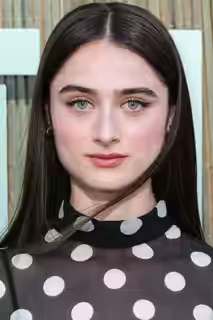
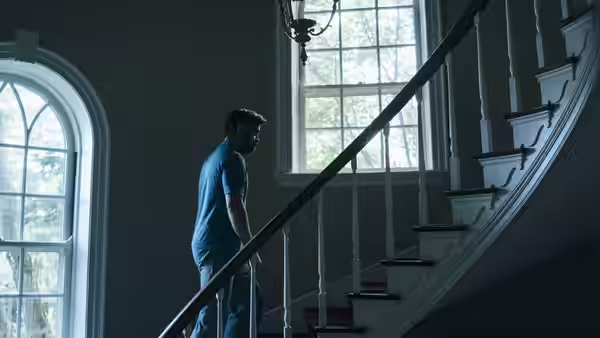
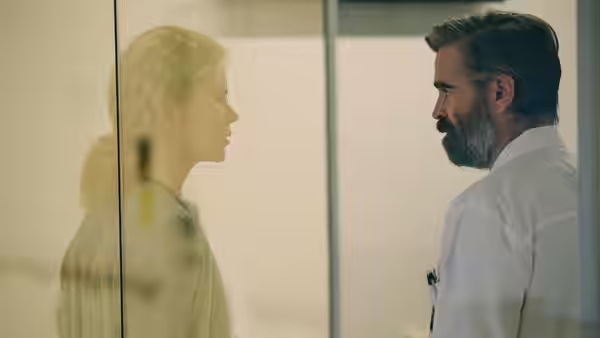
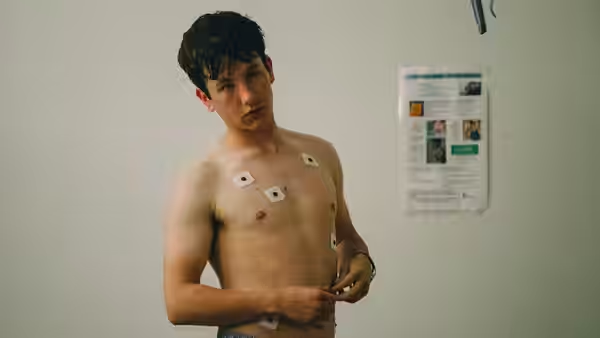
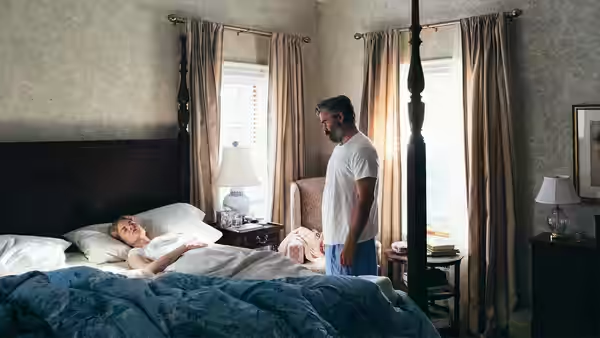
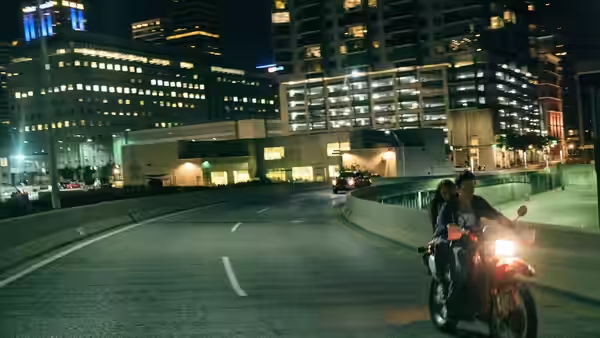
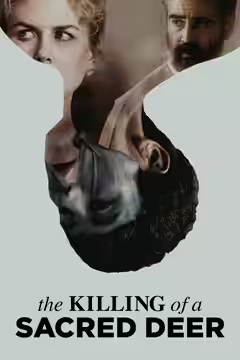
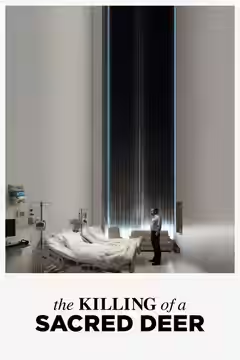
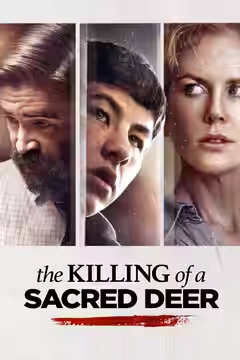
A scene from The Killing of a Sacred Deer
Film review

The Killing of a Sacred Deer

2017 · Directed by Yorgos Lanthimos · 2h 01m · Statens medieråd NR

In a sentenceA surgeon, a teenager, a debt, and a family who all speak as if reading the terms and conditions aloud

Steven Murphy (Colin Farrell) is a cardiac surgeon with a large house, a wife, Anna (Nicole Kidman), and two children, Kim (Raffey Cassidy) and Bob (Sunny Suljic). He also meets, in diners and hospital corridors, a teenage boy called Martin (Barry Keoghan), buys him an expensive watch and tells his colleague Matthew (Bill Camp) that the boy is a schoolfriend of his daughter’s. He is not. Martin’s father died on Steven’s operating table. Steven invites Martin to dinner with the family; Martin returns the invitation, and his mother (Alicia Silverstone) is waiting. Then Bob wakes up unable to move his legs, the hospital can find nothing wrong with him.

Plays from YouTube when you press play; nothing loads from them until then.

Fi1m review

Yorgos Lanthimos brings his flat voices and long corridors to America and builds a revenge tragedy of sickening force, with Barry Keoghan remarkable in it. It is controlled to the last frame and runs out of things to do before it runs out of film.

Yorgos Lanthimos’s second film in English, after The Lobster (2015), opens on a human heart, beating, filmed from directly above during open surgery while a choir sings. The hands belong to Steven Murphy (Colin Farrell), a cardiac surgeon with a beard, a large house and a wife, Anna (Nicole Kidman), who agrees with most of what he says. He also has a teenage friend called Martin (Barry Keoghan), whose father died on his table, and he is not telling anyone why they meet. Then Martin explains what Steven owes him, and the film spends its second hour collecting. It is as controlled a piece of work as Lanthimos has made, and it is worth your evening if you can bear it. We are less sure it is more than an exercise.

Thimios Bakatakis shoots the hospital and the house on wide lenses from low down or high up, so ceilings press on people and corridors run away to nothing. His camera drifts in behind Steven as he walks, then zooms slowly from a great distance, as if something at the far end of the ward were watching and had all day. Jade Healy’s Murphy house is glass, pale wood and long empty landings, big enough that the family are always a room apart. Nancy Steiner dresses them in clean, expensive neutrals and gives Martin the same shabby clothes in every scene, so he looks like a mark on the furniture. Nobody raises their voice for two hours, and the pressure builds anyway.

Farrell and Kidman speak the script by Lanthimos and Efthimis Filippou as if reading it off a form. Steven tells colleagues at a party that his daughter has just had her first period, in the tone he would use for the weather. Anna lies still on the bed and offers him a general anaesthetic. Kidman is doing something precise and quite frightening here: she plays a woman who has organised her life as a series of correct answers, and then watches the questions change. Bill Camp, as Steven’s colleague Matthew, gets the one scene in which two men argue about blame and the deadpan almost cracks, and he plays it well.

Keoghan is the reason to see it. Martin lists what will happen to the Murphys, one symptom after another, in the hospital cafeteria with a plate of chips in front of him, in the voice of a boy giving directions to the shops. He apologises. He means it, or he does not, and Keoghan never lets you settle. It is a performance built out of politeness, and the politeness is the horror.

We should say what it did to us. The first of Martin’s predictions comes true within the hour, and Lanthimos films the child’s body failing in long, level shots from the far end of the ward while his father stands and watches. We felt sick, then angry at the film for making us watch, then aware that this was exactly the reaction it wanted and that being right about it did not make us like it more. Yorgos Mavropsaridis holds shots long past the point of comfort and cuts away only when we have stopped hoping he will. The music is borrowed rather than written for the film, choral and string pieces that scrape and swell, and it is mixed to hurt.

The trouble is what comes after the announcement. The film states its rules and then must keep them, and there is no move left except the one the title promises. The title points at Euripides and Agamemnon’s dead deer, and the script mentions Iphigenia in case we miss it. The second hour repeats the first at a lower volume: another examination, another refusal, another calm conversation about who should die. Because the children talk in the same flat voice as the adults, we never quite believe in them as children, and the stakes thin out exactly when they should be unbearable. Dogtooth (2009) used the same manner and had a whole family under it; The Lobster had jokes. This has a curse and a clock. Alicia Silverstone appears for one scene as Martin’s mother, it is the funniest scene in the film, and then she is gone.

It runs 121 minutes and carries a 15 certificate, and both feel about right. See it in a cinema if you can, in the dark, with no distractions, because at home you will reach for your phone during the slow zooms and the film needs you not to. Bring no one you would like to eat with afterwards.


Critical consensus AI synthesised

68
Positive
22
Mixed
6
Negative
5
The Telegraph
2 November 2017 · ★★★★★ · Robbie Collin
100

The review calls it the weirdest, most mesmerically unsettling film of the year, highlighting its discombobulating opening shot and the cast’s sadistic finesse in playing with audience expectations. It notes the film’s effect lingers even on a second viewing.

Read the full review →
RogerEbert.com
20 October 2017 · Brian Tallerico
90*

Lanthimos crafts a mesmerizing thriller that traps viewers in an impossible moral dilemma with no good answers. The critic singles out the uniformly great performances and Lanthimos’ stunning visual compositions for particular praise.

Read the full review →
The Hollywood Reporter
22 May 2017 · festival review · David Rooney
90*

The film is a masterfully realized hypnotic tale of guilt and retribution inspired by Greek tragedy. It features riveting performances, especially from Colin Farrell, Nicole Kidman and Barry Keoghan, along with impressive rigor of craft and startling originality.

Read the full review →
Empire
30 October 2017 · Andrew Lowry
85*

This is another piece of proof for the theory that Farrell is quietly one of our finest actors when stretched by the right director. More than anything, The Killing Of A Sacred Deer is an unforgettably unnerving experience.

Read the full review →
Evening Standard
8 December 2017 · Charlotte O'Sullivan
85*

This tale of revenge orchestrated by teen Martin against Dr Murphy’s family is one of the year’s best vengeance tales. Nicole Kidman’s turn is a sneakily subtle tour de force.

Read the full review →
Little White Lies
1 November 2017 · 4/4/4 · Trevor Johnston
80

Lanthimos delivers a confident psycho-thriller that overlays mythology on everyday circumstances to imbue every moment with inexplicable doom. The sheer all-of-a-piece execution, from pacing and composition to performances and use of music, holds the viewer in its steely grip.

Read the full review →

Straight answers AI written, from our review

Is The Killing of a Sacred Deer worth watching?
The Killing of a Sacred Deer is worth watching for anyone who can sit through two hours of quiet, deliberate dread, and we scored it 72. Barry Keoghan is the reason to see it, polite and terrifying, and the film is controlled to the last frame. The second hour repeats the first at a lower volume, and we are not sure it adds up to more than an exercise.
How long is The Killing of a Sacred Deer, and what is it rated?
The Killing of a Sacred Deer runs 2h 01m and is rated NR by the Statens medieråd in Sweden. It is a drama and thriller film.
Where can I watch The Killing of a Sacred Deer in Sweden?
The Killing of a Sacred Deer is streaming on Amazon Prime Video in Sweden, and it is also available to rent from Apple TV and Amazon Prime Video from kr 39.00. Availability is checked daily; the links above go straight to each service.
How violent or frightening is The Killing of a Sacred Deer, and is it suitable for children?
The Killing of a Sacred Deer carries a 15 certificate in the UK, and that feels about right; it is not for children. There is little blood, but it opens on open-heart surgery, discusses a teenager's first period at a dinner party, and watches a child's body fail in long, level shots. We felt sick and then angry at being made to watch, which is what the film intends.
How does The Killing of a Sacred Deer compare to Funny Games?
The Killing of a Sacred Deer and Funny Games both set polite young men loose on a comfortable family and refuse to raise their voices. Haneke's victims stay painfully human, so the dread lands harder; Lanthimos has everyone speak in the same flat voice, which makes his film stranger but its stakes thinner. Choose Haneke for fear, Lanthimos for craft and Keoghan.
What should I watch after The Killing of a Sacred Deer?
After The Killing of a Sacred Deer, try Funny Games (1997, Fi1m 74): Haneke’s polite young men arrive at a lakeside house and stay for the night. Then The Exterminating Angel (1962, Fi1m 87): Buñuel’s dinner guests cannot leave the drawing room, and nobody can say why.

Cast

Awards

European Film Award for Best Actor, 2017

Nominated
European Film Award for Best Actor

European Film Award for Best Director, 2017

Nominated
European Film Award for Best Director

European Film Award for Best Screenwriter, 2017

Nominated
European Film Award for Best Screenwriter

If you liked this, try…

  1. Dogtooth (2009) · not on Fi1m yetLanthimos’s earlier family kept behind a fence, same flat voices, more underneath them.

  2. Funny Games (1997, Fi1m 74)Haneke’s polite young men arrive at a lakeside house and stay for the night.

  3. Teorema (1968) · not on Fi1m yetPasolini sends a beautiful stranger into a Milanese family and lets it come apart.

  4. Cure (1997) · not on Fi1m yetKiyoshi Kurosawa’s detective follows a soft-spoken young man who leaves murders behind him.

  5. The Exterminating Angel (1962, Fi1m 87)Buñuel’s dinner guests cannot leave the drawing room, and nobody can say why.

The Killing of a Sacred Deer (2017) review: cold, exact and hard to sh (Sweden) | Fi1m