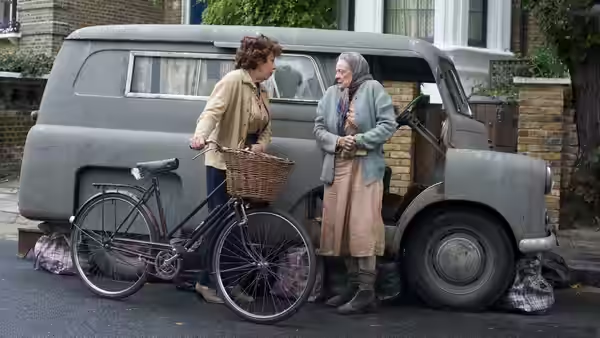
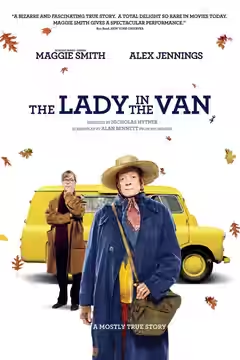
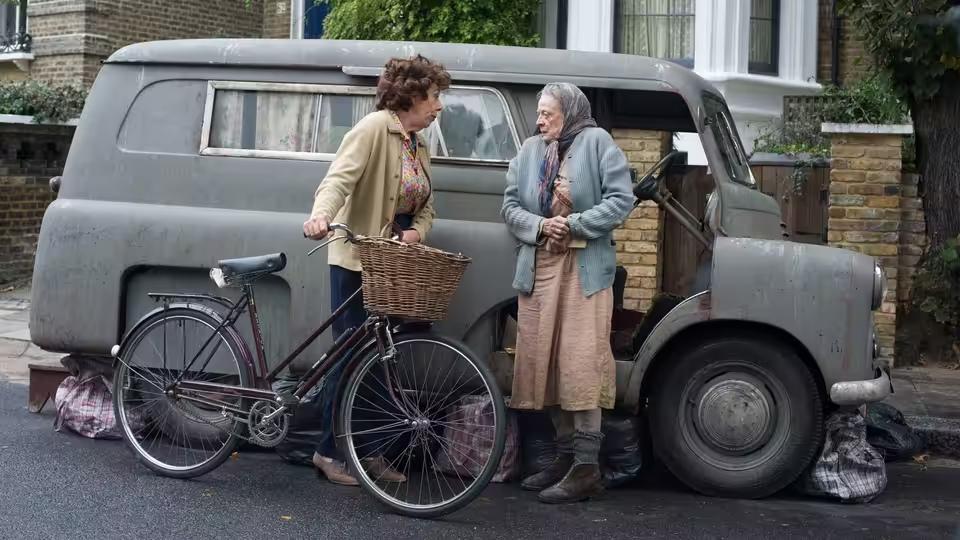
Alan Bennett (Alex Jennings) speaks with Miss Shepherd (Maggie Smith) beside her van and a bicycle
Film review

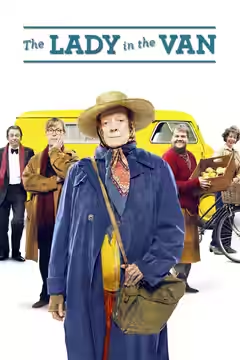
The Lady in the Van

2015 · Directed by Nicholas Hytner · 1h 44m

In a sentenceMaggie Smith moves into the drive and Alan Bennett writes it down twice

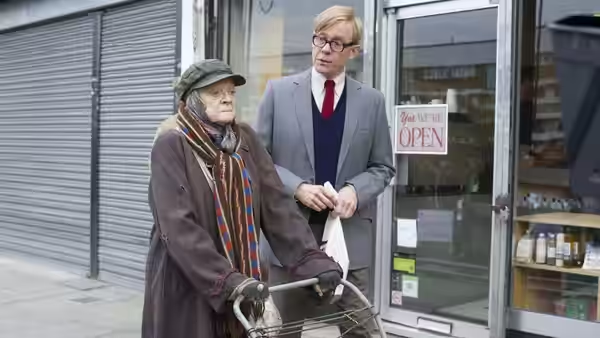
Camden Town, the early 1970s. The writer Alan Bennett (Alex Jennings) moves into a house on Gloucester Crescent and finds a van already parked in the street, home to Miss Shepherd (Maggie Smith), an elderly woman with firm instructions from the Virgin Mary and no patience for anyone’s kindness. The crescent is full of liberal households, Ursula Vaughan Williams (Frances de la Tour) and Rufus (Roger Allam) among them, who leave food at the van door and quietly wish it gone. When parking restrictions arrive, Bennett offers her his drive for a few months. She moves in, van and all, and shows no sign of leaving. Bennett, who is also visiting his failing mother (Gwen Taylor) in Yorkshire, writes it all down, and argues with himself about whether he should.

Plays from YouTube when you press play; nothing loads from them until then.

Fi1m review

Maggie Smith is magnificent as the woman who parked in Alan Bennett’s drive and stayed fifteen years. The film around her is gentle, tidy and rather pleased with itself, and it explains every feeling the moment she has made it plain.

Alan Bennett has been telling this story for a long time, first on the page and then on the stage, where Nicholas Hytner directed Maggie Smith in it in 1999. Now the three of them have made the film, and the tagline calls it “a mostly true story”, which is fair warning. A homeless woman called Miss Shepherd parked her van outside Bennett’s house in Gloucester Crescent, Camden; he let her move it into his drive for a few months; she stayed fifteen years. Smith is reason enough to watch. The rest is pleasant, soft and far more comfortable than it needs to be.

She plays Miss Shepherd without a flicker of appeal for our sympathy. The voice is clipped and certain, the eyes dart for the next advantage, and she takes every kindness as a right and every question as an impertinence. She smells, and the film says so, and she is cross about being told. What makes it more than a turn is the stillness in between, a woman sitting alone in the van who has plainly been somebody else and is not going to tell us who.

Alex Jennings plays Bennett as two men who share a study, the one who lives the life and the one who writes it down, and they bicker about which of them is the coward. Jennings has the voice exactly, the Leeds vowels sanded flat, the hands that never know what to do. For twenty minutes the device is a good joke about the writer’s guilt. Then the film starts using it to tell us what we have just seen. Meanwhile Bennett’s mother (Gwen Taylor) is failing in Yorkshire, visited out of duty, and the film draws the line between the two old women and then has Bennett say it aloud in case we missed it.

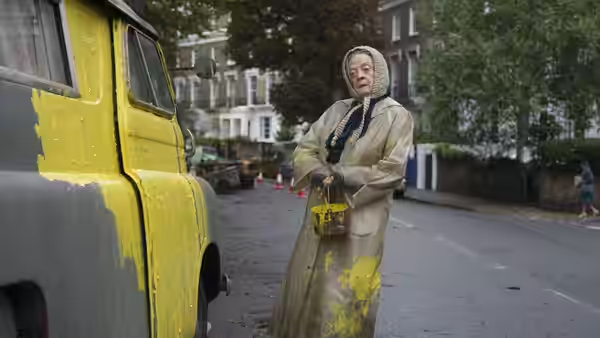
Andrew Dunn shoots the crescent in soft, warm light that makes Camden look like a village, and the van, which Miss Shepherd repaints herself with a brush and a tin of yellow, is the only loud thing in any frame. John Beard fills its interior with carrier bags in layers like rock strata. Natalie Ward dresses Smith in coats that look slept in, which they have been, with a hat on top like an afterthought. George Fenton’s score is piano and strings and does not push. Tariq Anwar cuts the two Bennetts’ conversations so that they feel like one man thinking, which is a harder trick than it looks.

The moment that got us was not a large one. Early on, Bennett watches from his window as Miss Shepherd settles herself in the van for the night, and Smith, with nobody left to perform for, lets the certainty drain out of her face for a few seconds before the door shuts. We were moved more than we expected to be, and a little annoyed that the film had not trusted us with more of that and fewer of the jokes about the lavatory.

The street is full of good actors with nothing to do. Frances de la Tour, as the composer’s widow Ursula Vaughan Williams, and Roger Allam, as a neighbour called Rufus, are there to be liberal and embarrassed, and they do it well, but they are a sketch. Jim Broadbent turns up at night as Underwood, a man who taps on the van and wants money, and the film lets him be frightening twice before setting him aside. Several of the young cast of The History Boys, Dominic Cooper and James Corden among them, pass through in parts the size of a postage stamp, which will please anyone who saw that film and puzzle everyone else.

The last ten minutes take a flight we will not describe and did not believe. Against Hytner and Bennett’s earlier films together, The Madness of King George (1994) and The History Boys (2006), this is the slightest, the one most content to be charming. It runs 104 minutes and carries a 12A, and it is a good evening for anyone who wants to watch Maggie Smith be impossible at length. Just do not expect it to let her be sad for long.

Critical consensus AI synthesised

60
Positive
7
Mixed
7
Negative
4

The reviews split almost down the middle, with a slight lean towards approval, and on one point there is no argument at all: Maggie Smith. Every critic who reaches a verdict praises her Miss Shepherd, mostly for comic irascibility that gives way to something sadder, and several call her the main reason to watch. Those who like the film find it a warm, sharp comedy about an unlikely bond that deepens as it goes.

The reservations gather around tone. Many find it twee or cosy, several say the stage origins show, and the whimsical final scene is faulted even by critics who otherwise enjoy themselves. The spread is wide, from four-star notices to outright dismissals. The harshest come from American outlets: Vulture calls it a tedious distortion of Bennett’s diaries, Slant finds it glib and emotionally distant, and The Wrap thinks Bennett himself takes up too much of the story. Even they exempt Smith.

The Guardian
12 November 2015 · ★★★★ · Peter Bradshaw
80

Bradshaw finds the film very enjoyable and poignant. He singles out Maggie Smith’s terrifically good performance as Miss Shepherd for praise.

Read the full review →
Time Out
12 September 2015 · ★★★★ · Cath Clarke
80

The review finds the film a cosy, comic success. It particularly praises Maggie Smith’s performance.

Read the full review →
Evening Standard
13 October 2015 · festival review · David Sexton
75*

Sexton considers the film the definitive version of Bennett’s story, despite an indulgent final scene. He singles out Maggie Smith’s glorious performance as its chief strength.

Read the full review →
Los Angeles Times
3 December 2015 · Rebecca Keegan
75*

Keegan finds the film a sharp, charming comedy whose stage-to-screen translation occasionally feels unnatural. She especially praises Maggie Smith’s layered portrayal of Miss Shepherd and her contradictory qualities.

Read the full review →
Empire
2 November 2015 · Ian Nathan
70*

Nathan finds the film a fine, moving comedy that gradually deepens into an exploration of human bonds. He particularly praises Maggie Smith’s comic yet perceptive portrayal, which gives Miss Shepherd emotional depth.

Read the full review →
Radio Times
23 December 2019 · Barry Norman
70*

The review presents the film as an appealing comedy about human connection. It singles out Maggie Smith as ideal in the central role.

Read the full review →

Straight answers AI written, from our review

Is The Lady in the Van worth watching?
The Lady in the Van is worth watching for anyone who wants to see Maggie Smith be impossible at length, and we scored it 64. She plays Miss Shepherd without asking for sympathy, and the film around her is gentle, tidy and too keen to explain its feelings. Go for her, not for the story.
How long is The Lady in the Van, and what is it rated?
The Lady in the Van runs 1h 44m. It is a comedy and drama film.
Where can I watch The Lady in the Van in Iceland?
The Lady in the Van is streaming on Netflix in Iceland. Availability is checked daily; the links above go straight to each service.
How violent or frightening is The Lady in the Van, and is it suitable for children?
The Lady in the Van carries a 12A and is a mild comedy-drama with no violence to speak of. The only unsettling presence is Jim Broadbent as Underwood, a man who taps on the van at night and wants money, and the film lets him be frightening twice. Older children will be fine; younger ones will mostly be bored.
How does The Lady in the Van compare to The History Boys?
The Lady in the Van is the slighter of the two films Nicholas Hytner and Alan Bennett made together with this cast, and The History Boys is the one we recommend. The earlier film is talkier, funnier and gives Dominic Cooper and James Corden proper parts rather than postage-stamp cameos. Watch the van for Maggie Smith; watch the schoolroom for the writing.
What should I watch after The Lady in the Van?
After The Lady in the Van, try The History Boys (2006, Fi1m 67): Hytner and Bennett at their best, with the same young cast given proper parts. Then Harold and Maude (1971, Fi1m 81): Another impossible old woman teaching a buttoned-up man how to live, with better music; and Umberto D. (1952, Fi1m 91): De Sica’s pensioner and his dog; poverty and dignity without a single joke to soften it.

Cast

If you liked this, try…

  1. The History Boys (2006, Fi1m 67)Hytner and Bennett at their best, with the same young cast given proper parts.

  2. Talking Heads (1988) · not reviewed yetBennett’s television monologues; lonely people in small rooms, no explaining, far sharper.

  3. Harold and Maude (1971, Fi1m 81)Another impossible old woman teaching a buttoned-up man how to live, with better music.

  4. Umberto D. (1952, Fi1m 91)De Sica’s pensioner and his dog; poverty and dignity without a single joke to soften it.

  5. Philomena (2013, Fi1m 82)Judi Dench and a prickly writer on the road; the same odd couple, more at stake.