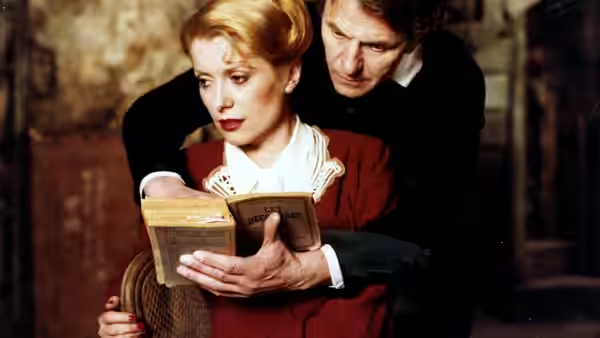
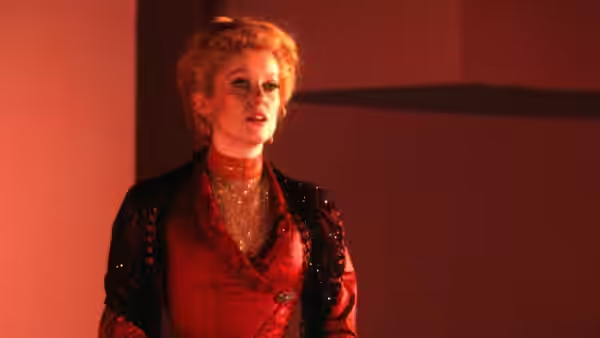
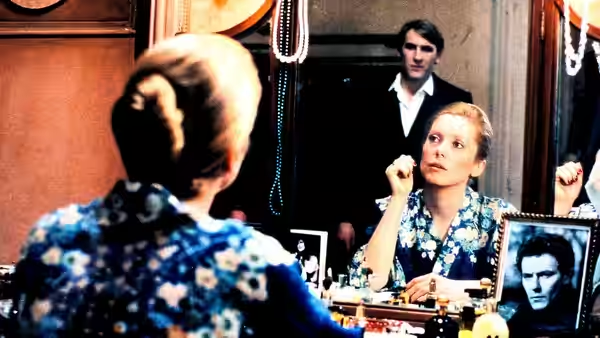
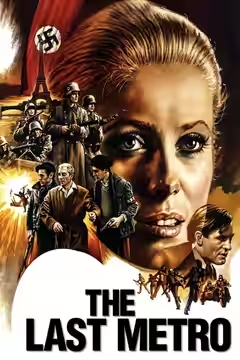
Marion Steiner (Catherine Deneuve) and Bernard Granger (Gérard Depardieu) read together
Film review

The Last Metro

1980 · Directed by François Truffaut · 2h 11m · Eirin G

In a sentenceThe husband is in the cellar, the collaborator is in the stalls, and the play goes on

Paris, 1942. The city is occupied, the curfew is fixed and the audience must catch the last metro. At the Théâtre Montmartre, Marion Steiner (Catherine Deneuve) runs her husband’s company. Lucas Steiner (Heinz Bennent), the Jewish director, is said to have fled abroad. He has not: he is in the cellar, and only Marion knows. Upstairs she must open a new play with Jean-Loup Cottins (Jean Poiret) directing in Lucas’s place, a new leading man, Bernard Granger (Gérard Depardieu), hired from the Grand Guignol, and Daxiat (Jean-Louis Richard), the collaborationist critic, sitting in the stalls. Bernard flirts with the designer, Arlette Guillaume (Andréa Ferréol), and slips out on errands he does not explain. Marion has to keep the theatre open, the play on and the cellar door shut.

Fi1m review

Truffaut’s Occupation film is warm, handsome and well acted, and it keeps the war at the far end of the street. Deneuve holds it together; the fear never quite gets into the building. Good company for an evening, and never frightening.

François Truffaut sets his one film about the German Occupation inside a Paris theatre, and that decision tells you most of what you need to know. The Last Metro is about the war as it reached the people who kept working through it: a company putting on a new play in 1942 while the curfew empties the streets and the critic who could close them sits in the front row. It is warm, handsome and well acted. It is also gentle to a fault. We liked it a good deal, and we were never once afraid for anyone in it, and in a film about this subject the second fact has to count against the first.

Jean-Pierre Kohut-Svelko’s Théâtre Montmartre is the film’s real subject and its best set: a shabby, handsome house of red plush and bare corridors, with a cellar underneath where the heating pipes run up through the floor of the stage. Néstor Almendros lights the whole thing in browns and ambers, as though the city were running on a ration of lamplight and nobody could spare a second bulb. The stage is the only bright place in Paris; the wings, the street and the cellar are dimmer versions of the same colour. Liselle Roos puts Catherine Deneuve in a succession of hats and belted coats that make Marion look like the one person in the building with somewhere to be, and Georges Delerue’s score stays small and slightly sad, a few bars at a time.

Deneuve plays Marion as a woman who has decided not to be frightened, and you can watch the deciding. Her face gives little away, which is exactly what the film needs, because everyone else in the theatre is looking at her to know how worried to be. Gérard Depardieu’s Bernard is big, restless and never quite still, a man who cannot pass a woman without trying his luck and cannot stand in a doorway without checking the street. Jean Poiret’s Jean-Loup is smooth and kind and on friendly terms with people he should not be, and Poiret lets us see that he knows it.

The best scenes are in the cellar. Heinz Bennent’s Lucas, the director who is supposed to have left the country, sits in the dark and listens to his own play through the heating pipe, mouthing the lines and writing notes for his wife to carry upstairs as if they were her own. We found this more moving than we expected to, and it is the plainest thing in the film: a man directing a play he cannot see, through the one person who is allowed to see him. When Marion comes down after a performance and tells him how it went, the film has a tenderness it does not manage anywhere else.

The trouble is Daxiat. Jean-Louis Richard plays the collaborationist critic as a sweating, sneering menace, and Truffaut, who was a critic before he was anything else, has plainly enjoyed writing him. But he is the only real threat in the film and he is a cartoon, so the danger the whole story hangs on never quite convinces. The Germans are barely seen. The round-ups happen somewhere else. A soldier ruffles a small boy’s hair in the street and his mother marches him straight home to wash it, and that is about as close as the menace comes to the audience. Martine Barraqué cuts everything at the same even, unhurried pace, and a search that ought to stop the breath is over before we had time to hold it.

Against Truffaut’s own work this is the comfortable one. Day for Night (1973) put a film crew through the same kind of backstage muddle and had more mess and more spite in it. Here everyone but Daxiat is forgiven, in the Renoir manner Truffaut loved, and the result is that the one man the film condemns is the one it made too easy to condemn. The last ten minutes pull a trick we will not describe; it is a piece of theatre in the plainest sense, and we admired the nerve of it more than we believed a word.

Watch it at home on a winter evening, with the lights low to match Almendros. It runs 131 minutes and carries a PG. Nothing in it would trouble a child. In a film about Paris in 1942, that is the problem.

Critical consensus AI synthesised

66
Positive
4
Mixed
3
Negative
1

Most critics are fond of The Last Metro, though the affection stops short of a rave. The praise gathers around Truffaut’s restraint: the danger of Occupied Paris is kept at the edges of the frame rather than shouted, and several reviews find the film’s warmth and humanity its chief strength. Catherine Deneuve’s Marion is singled out repeatedly, and Variety picks out her scenes with Heinz Bennent and Gérard Depardieu in particular. The theatre company’s stubborn commitment to putting on a play is admired as much as the plot around it.

The reservations cluster on the same restraint seen from the other side. Slant finds the portrait of the Occupation tasteful to the point of sanitised, and The New Yorker notes a plot that leans on coincidence and narrow escapes. Eye for Film calls the romance too muted and the theatricality a drag on tension. The spread is wide: Time Out goes furthest, arguing that Truffaut’s crowd-pleasing instinct threatens to swallow his talent.

The AV Club
25 March 2009 · A- · Keith Phipps
90

Phipps praises the film’s warmth and humanity amid the peril of wartime occupation. He singles out Truffaut’s restrained depiction of danger and the theater company’s artistic commitment.

Read the full review →
Variety
31 December 1979 · Variety Staff
85*

The review calls the film richly satisfying, romantic, and uplifting while also finding it a fascinating portrait of life under occupation. It singles out the restrained direction and praises Catherine Deneuve’s performance, especially in her scenes with Heinz Bennent and Gérard Depardieu.

Read the full review →
Empire
1 January 2000 · David Parkinson
70*

Parkinson presents the film as a humanist, personal take on Occupation-era Paris, while noting its nostalgic portrait drew criticism. He singles out Truffaut’s belief that everyone has their reasons as the film’s central strength.

Read the full review →
The New Yorker
70*

The capsule presents the film as a vivid, historically grounded memory piece, though its plot balances on coincidences and narrow escapes. It praises Truffaut’s evocation of wartime Paris through firsthand details of the city and its pervasive antisemitism.

Read the full review →
The New York Times
12 October 1980
64*

The URL identifies a New York Times article titled “The Last Metro: A Melodrama of Sorts.” The page returned only an access prompt, so the critic’s verdict and specific praise or complaint could not be verified.

Read the full review →
Slant Magazine
24 March 2009 · ★★½/4 · Fernando F. Croce
62

Croce finds the film charming and crowd-pleasing, but limited by fuzzy-centered nostalgia. He praises its warm performances and deft cinematography while faulting its tasteful, sanitized portrayal of Occupied Paris.

Read the full review →

Straight answers AI written, from our review

Is The Last Metro worth watching?
The Last Metro is worth watching for anyone who wants a warm, handsome, well-acted drama about a Paris theatre keeping a play on under the Occupation, and we scored it 75. Catherine Deneuve holds it together and the cellar scenes with Heinz Bennent are the plainest and most moving thing in it. Anyone expecting the fear of wartime Paris will find the war kept at the far end of the street.
How long is The Last Metro, and what is it rated?
The Last Metro runs 2h 11m and is rated G by the Eirin in Japan. It is a drama and romance film.
Where can I watch The Last Metro in Japan?
The Last Metro is not on any streaming or rental service in Japan at the moment. It is available in 5 other countries; change your country at the top of the page to see where. Availability is checked daily.
How violent or frightening is The Last Metro, and is it suitable for children?
The Last Metro is a PG and is not violent or frightening at all; nothing in it would trouble a child. The Germans are barely seen, the round-ups happen elsewhere, and the one search that ought to stop the breath is over almost before it begins. The subject is the Occupation, so younger children may need it explained, but there is nothing on screen to upset them.
How does The Last Metro compare to To Be or Not to Be?
The Last Metro is the gentler and more forgiving of the two, and Lubitsch's To Be or Not to Be is the sharper. Both put a theatre company up against the Nazis, but Lubitsch plays it for laughs with real unease underneath, while Truffaut keeps the menace to a single cartoonish critic. Choose Truffaut for warmth and Deneuve; choose Lubitsch for wit and nerve.

Cast

Awards

Academy Awards, 1981

Nominated
Best International Feature Film

César Award for Best Actor, 1981

Won
César Award for Best Actor

César Award for Best Actress, 1981

Won
César Award for Best Actress

César Award for Best Cinematography, 1981

Won
César Award for Best Cinematography

César Award for Best Director, 1981

Won
César Award for Best Director

César Award for Best Editing, 1981

Won
César Award for Best Editing

César Award for Best Film, 1981

Won
César Award for Best Film

César Award for Best Music Written for a Film, 1981

Won
César Award for Best Music Written for a Film

César Award for Best Original Screenplay or Adaptation, 1981

Won
César Award for Best Original Screenplay or Adaptation

César Award for Best Production Design, 1981

Won
César Award for Best Production Design

César Award for Best Sound, 1981

Won
César Award for Best Sound

César Award for Best Supporting Actor, 1981

Nominated
César Award for Best Supporting Actor

César Award for Best Supporting Actress, 1981

Nominated
César Award for Best Supporting Actress

David di Donatello for Best Foreign Actress, 1981

Won
David di Donatello for Best Foreign Actress

International Submission to the Academy Awards, 1981

Nominated
International Submission to the Academy Awards

Golden Globes, 1980

Nominated
Best Non-English Language Film

If you liked this, try…

  1. To Be or Not to Be (1942, Fi1m 87)Lubitsch’s Warsaw actors outwit the Nazis; the same idea played for laughs, and sharper.

  2. Children of Paradise (1945) · not on Fi1m yetMade under the Occupation itself, about a Paris theatre; the thing Truffaut is remembering.

  3. Army of Shadows (1969) · not on Fi1m yetMelville’s Resistance film, where the fear is real and nobody catches the last metro.

  4. Lacombe, Lucien (1974) · not on Fi1m yetMalle on a boy who joins the collaborators; the film Truffaut is too kind to make.

  5. Mephisto (1981) · not on Fi1m yetA German actor thrives under the Nazis; ambition on stage with the lights left on.