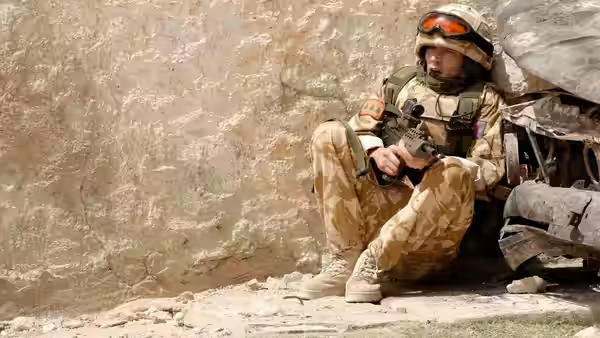
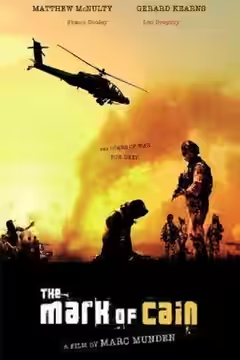
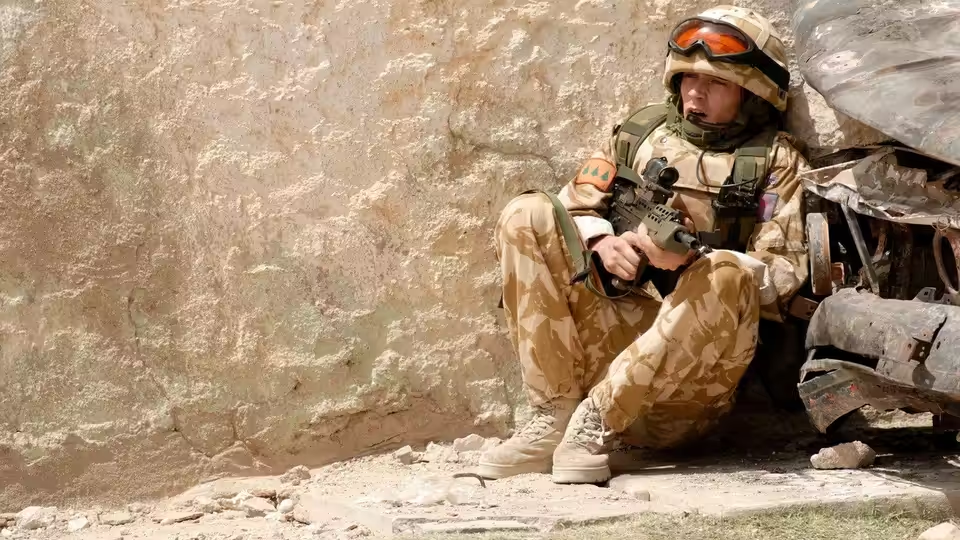
A soldier sits against a stone wall, holding his rifle in dusty combat gear
Film review

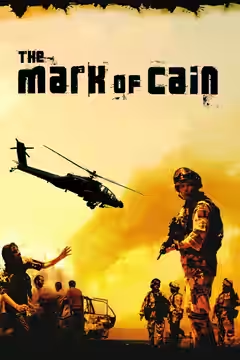
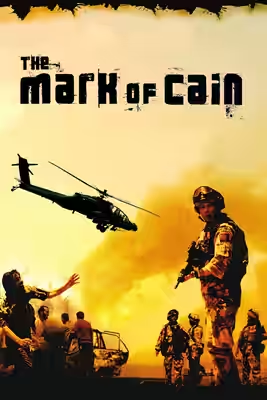
The Mark of Cain

2007 · Directed by Marc Munden · 1h 27m

In a sentenceEighteen-year-olds in body armour, told to soften up the prisoners, and nobody with pips on his shoulder anywhere in sight

Basra, in the months after the 2003 invasion. Mark Tate (Gerard Kearns), called Treacle by everyone, and his mate Shane Gulliver (Matthew McNulty) are eighteen-year-old privates on their first tour, patrolling streets where every doorway and rooftop might hold a gunman. Their section is run by Lance Corporal Quealey (Leo Gregory), who has done this before and wants the lads to toughen up; above him sits Worriss (Elliot Cowan), the captain, who gives orders in language that leaves nothing on paper. After a roadside bomb kills one of their own, the unit rounds up local men and takes them back to the base. The prisoners are to be kept awake and on their feet overnight. Treacle and Shane are told to help.

Plays from YouTube when you press play; nothing loads from them until then.

Fi1m review

Tony Marchant’s drama about two young British soldiers in Iraq is angry, closely acted and only 87 minutes long, and it knows exactly who it blames. The second half says so more often than it needs to, but Gerard Kearns makes the first half hard to shake.

Tony Marchant’s script takes two eighteen-year-old privates to Basra in the months after the 2003 invasion and asks what happens when the men with rank want something done and do not want to be seen asking for it. The Mark of Cain is a short, angry drama and for most of its length a good one. It is at its best in the first half, when it shows us what it thinks. In the second it starts telling us, and it tells us the same thing more than once.

Gerard Kearns plays Mark Tate, known as Treacle, as a boy who has not yet decided what sort of man he is going to be. He watches, he goes along, and he keeps a face so still you can see the thinking happening behind it. Matthew McNulty’s Shane Gulliver is the louder of the two, the one who talks himself into things, and the pair have the easy rhythm of lads who have known each other since school. Leo Gregory’s Lance Corporal Quealey is the sergeant-figure every war film needs, except that Gregory plays him not as a sadist but as a tired man passing on what was passed to him. Elliot Cowan’s Worriss, the captain, gives his orders in sentences that could be read out at an inquiry without a word of them being wrong.

Marc Munden directs the Iraq scenes with real nerve. Matt Gray shoots the Basra streets handheld and over-exposed, so the white light flattens every face and the shadows in the doorways go completely black, and we spent the first patrol scanning the frame for a rifle the way the soldiers do. Luana Hanson’s base is breeze-block, tarpaulin and a bare holding cell under a strip light, and the cell looks as cheap as the decision that filled it. Ben Bartlett’s score mostly keeps out of the way, which is right. Philip Kloss cuts the night with the prisoners in short, ugly pieces, so that we are never allowed to settle into watching it.

That night is where the film earned our attention and then made us feel ill. It was not the blows, which Munden keeps at the edge of the frame or out of it altogether. It was Kearns, standing against a wall with his hands at his sides, looking from the men on the floor to Quealey and back, and the half-second before he moved. We had thought we knew which way he would go. We were wrong, and we sat with that for the rest of the film.

The trouble begins when the story comes home. Heather Craney’s Brenda Tate and Brendan Coyle’s Davey Gulliver are given scenes whose job is to say out loud what the Iraq half had already made plain: that the boys were used, that somebody higher up should answer, that the Army looks after its own. Coyle, who can do more with a glance than most actors manage with a page, is handed the page anyway. Shaun Dingwall’s Major Godber and Pip Torrens’s Colonel Hampton are written as the sort of officers who exist to be disliked, and both actors play them better than that. The plotting in the final third also leans on a coincidence we will not describe, and the film needs it more than it should.

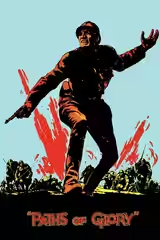
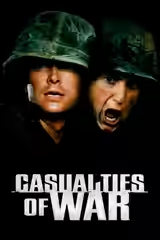
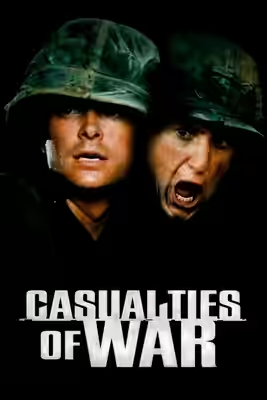
The standard here is Paths of Glory (1957) and Casualties of War (1989), both of which let the audience work out who the guilty men were before anybody in the film did. Marchant does not trust us that far. By the end nearly every character has made a speech, and the speeches all point the same way. We agreed with them. We would have agreed more if we had been left to say them ourselves.

Still, it runs 87 minutes, which is the right length for this kind of fury, and the first forty of them are as good as any British screen drama about that war. Watch it for Kearns, and for Gregory, and for that strip-lit cell. Then go and read what happened at the real camp, because the film is in no doubt that you should.
Critical consensus AI synthesised

2 of 6
Positive
1
Mixed
1
Negative
0

With only 2 reviews in so far, the early response is mildly favourable but thin. Both critics find a topical, well-acted drama about British soldiers in Iraq and the moral corners they are pushed into. Screen Daily is the warmer of the two, calling it gripping and praising the political focus of the writing. Variety agrees the Iraq sequences are tense and that the cast, Gerard Kearns in particular, is strong, but finds the script preachy and contrived in places. Whether the writing is the film’s strength or its weakness is the only real disagreement, and it is enough to keep the pair apart.

Screen Daily
31 January 2007 · Jonathan Romney
80*

Romney calls it a gripping, timely drama about moral dilemmas surrounding British forces in Iraq. He singles out its politically focused writing as a strength.

Read the full review →
Variety
27 February 2007 · festival review · Jay Weissberg
60*

Weissberg finds a topical, well-played drama weakened by preachiness and contrivance. He praises Munden’s paranoid Iraq scenes and Kearns’s performance.

Read the full review →

Straight answers AI written, from our review

Is The Mark of Cain worth watching?
The Mark of Cain is worth watching for anyone who can take an angry, short British drama about soldiers in Iraq, and we scored it 70. Gerard Kearns and Leo Gregory carry the first half, which is the strongest part; the second half keeps repeating its point in speeches that the Iraq scenes had already made plain.
How long is The Mark of Cain, and what is it rated?
The Mark of Cain runs 1h 27m. It is a drama and war film.
Where can I watch The Mark of Cain in Türkiye?
The Mark of Cain is not on any streaming or rental service in Türkiye at the moment. It is available in 1 other country; change your country at the top of the page to see where. Availability is checked daily.
How violent or frightening is The Mark of Cain, and is it suitable for children?
The Mark of Cain has no UK certificate and an R in the US, and it is not for children. The violence against prisoners is kept mostly at the edge of the frame or out of it, but the night in the holding cell is cut short and ugly, and it left us feeling ill; squeamish viewers and younger teenagers should think twice.
How does The Mark of Cain compare to Paths of Glory?
The Mark of Cain shares the anger of Paths of Glory at officers who let the men beneath them pay for their orders, but Kubrick's film is the better of the two. It trusts the audience to work out who is guilty, where Marchant has nearly every character say it aloud; Kubrick's is the one to see first.
What should I watch after The Mark of Cain?
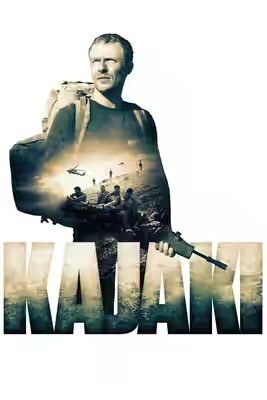
After The Mark of Cain, try Paths of Glory (1957, Fi1m 93): Kubrick’s trench drama on the men who are shot so the generals need not be. Then Kajaki (2014, Fi1m 77): British soldiers in an Afghan minefield; no politics, just the wait for a helicopter.

Cast

If you liked this, try…

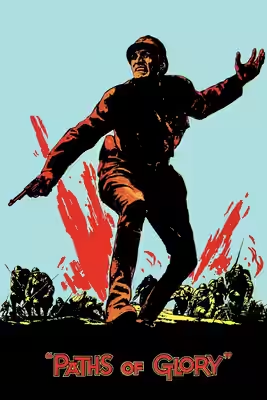
  1. Paths of Glory (1957, Fi1m 93)Kubrick’s trench drama on the men who are shot so the generals need not be.

  2. Casualties of War (1989) · not reviewed yetDe Palma’s Vietnam patrol, and the one private who will not join in.

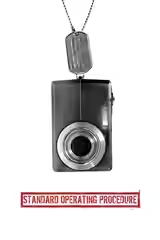
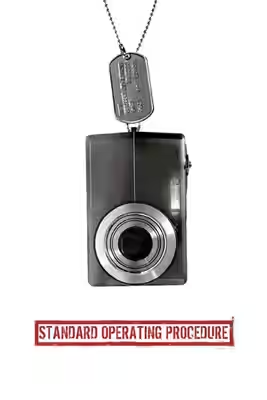
  3. Standard Operating Procedure (2008) · not reviewed yetErrol Morris interviews the soldiers who took the Abu Ghraib photographs.

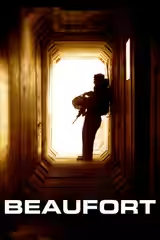
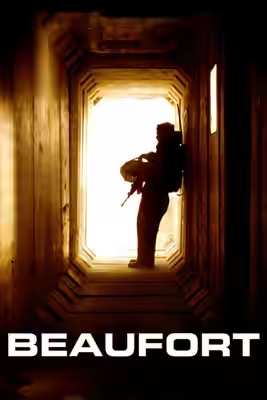
  4. Beaufort (2007) · not reviewed yetIsraeli conscripts waiting to abandon a Lebanese fort nobody above them will explain.

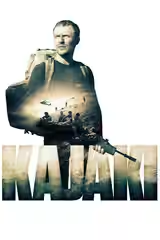
  5. Kajaki (2014, Fi1m 77)British soldiers in an Afghan minefield; no politics, just the wait for a helicopter.

Free account

Know what to watch tonight

Two lists that know where things are streaming, collections you can share, your own score beside ours, and Discover that remembers what you have seen.

  • Want to see, sorted by what is streaming now
  • Seen, with your score out of ten
  • No adverts, ever