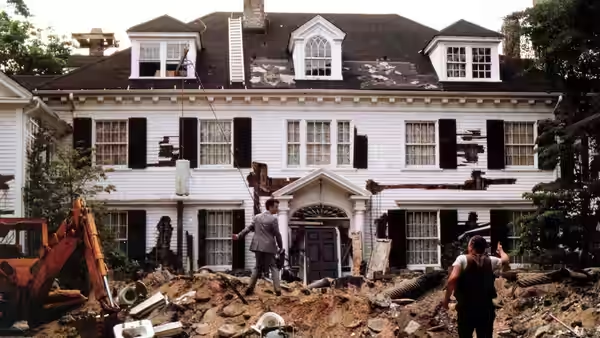
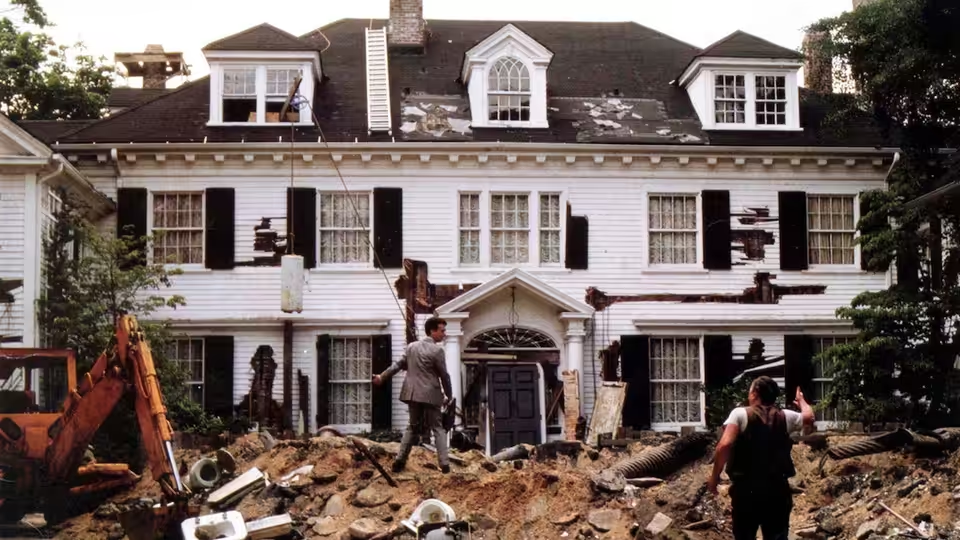
Walter Fielding and workers stand amid rubble before the dilapidated house
Film review

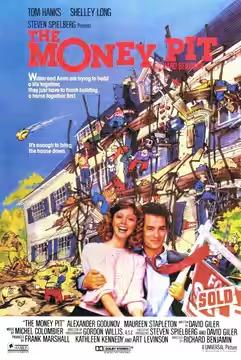
The Money Pit

1986 · Directed by Richard Benjamin · 1h 31m

In a sentenceTom Hanks discovers how long a house can take to finish falling down

Walter Fielding, Jr. (Tom Hanks) moves into a house that promises more trouble than shelter. As he tries to settle in, the building begins to come apart, turning domestic life into a succession of physical disasters. Anna Crowley (Shelley Long) and Max Beissart (Alexander Godunov) feature alongside Walter in a comedy about love, debt and a home that will not stay in one piece. The house keeps demanding attention, and the ordinary business of living there becomes a matter of coping with whatever goes wrong next.

Plays from YouTube when you press play; nothing loads from them until then.

Fi1m review

Tom Hanks earns some laughs amid the collapsing house, but Richard Benjamin lets the disasters become repetitive. The romance cannot sustain the quieter stretches, leaving a capable cast with too little to play.

The useful thing about a house falling apart is that it requires little explanation. We can see the problem, understand the expense and enjoy being somewhere else. Richard Benjamin builds The Money Pit around that pleasure, and for a while the destruction is funny enough to justify the attention it gets. But the joke wears out before the film stops repeating it. At 91 minutes, this is a modest comedy that manages to feel overextended.

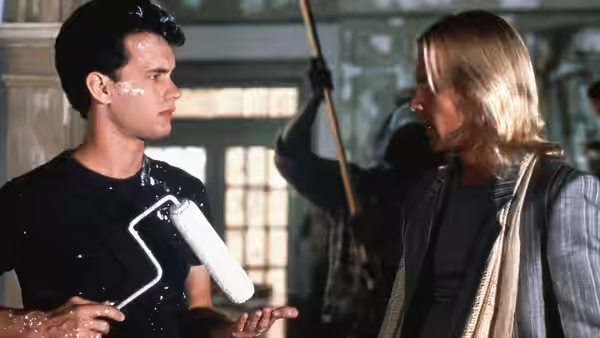
Tom Hanks plays Walter Fielding, Jr., the man moving into this uncooperative property, and he is the strongest reason to persevere. He gives the physical comedy a human scale, making it possible to care about an indignity that would otherwise be merely another excuse for something to break. We laughed at his helplessness as the house came apart; his response makes the damage funny. The director keeps finding fresh trouble for him, though the performance occasionally needs more breathing space between disasters.

The romantic comedy is much less assured. Shelley Long, as Anna Crowley, and Alexander Godunov, as Max Beissart, are capable comic performers, but David Giler’s screenplay gives them too little to sustain our interest between catastrophes. There is pleasure in their company, without much concern for what happens to their characters. The writing needs to make their difficulties worth following even when the building is behaving itself, and it seldom manages that. The quieter passages consequently feel like time spent waiting for the next accident.

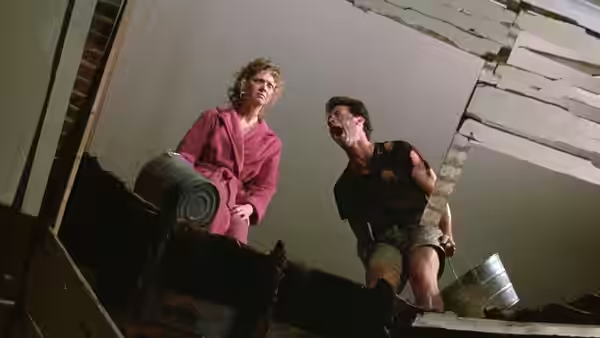
Patrizia von Brandenstein’s production design is a substantial advantage, giving the house enough character to compete with the cast. The staircase is a particularly effective piece of comic construction, and the inventiveness of the destruction deserves credit even when its frequency becomes tiring. Gordon Willis’s cinematography lets us read the physical damage clearly, so that the effort put into these elaborate gags registers. The trouble is that looking forward to another structural failure can become the main reason to keep watching.

Jacqueline Cambas’s editing gives the individual calamities a momentum that the film as a whole cannot maintain. The repeated escalation makes the sequence of jokes increasingly predictable, however much effort has gone into the next mishap, and the interruptions for romance do not supply enough contrast. Michel Colombier’s music helps maintain the cheerfulness, but that tone begins to work against a comedy that needs its frustrations to sting. A little more discomfort might have made the characters’ problems feel worth our attention when nothing is breaking.

The premise touches a useful domestic fear: a home is meant to provide security, and instead it demands more than its occupants can manage. A sharper farce would keep that anxiety present through the commotion, so that we had a reason to worry as well as laugh. Here the destruction grows so busy that it becomes difficult to feel much beyond anticipation of the next gag. Anyone looking for a romantic comedy should be prepared to spend a considerable amount of the evening watching a building.

Critical consensus AI synthesised

44
Positive
0
Mixed
2
Negative
2
RogerEbert.com
25 April 1986 · Roger Ebert
63*

The page could not be accessed, so its verdict cannot be reliably stated. No praise or complaint from the critic could be verified.

Read the full review →
The New York Times
26 March 1986
63*

The review’s verdict and specific praise or complaint cannot be determined from the page provided. The page content is inaccessible, so its assessment cannot be summarized reliably.

Read the full review →
Los Angeles Times
26 March 1986 · Kevin Thomas
30*

Thomas finds the comedy intermittently hilarious but increasingly mechanical and less satisfying than it should be. He praises the cast, especially Tom Hanks, Shelley Long, and Alexander Godunov, while criticizing the escalating effects and piled-on catastrophes.

Read the full review →
Empire
28 July 2006 · Ian Nathan
20*

The critic finds the comedy largely unsuccessful, with little charm or sympathy in the performances. They praise the inventive, escalating destruction of the house, especially the staircase’s final collapse.

Read the full review →

Straight answers AI written, from our review

Is The Money Pit worth watching?
The Money Pit earns a mixed verdict from us at 54/100: Tom Hanks supplies some good physical comedy, but the collapsing-house routine grows repetitive. It offers more for admirers of his comic helplessness than for anyone seeking a satisfying romance, since the quieter scenes give the capable cast too little to play.
How long is The Money Pit, and what is it rated?
The Money Pit runs 1h 31m. It is a comedy and romance film.
Where can I watch The Money Pit in Slovenia?
The Money Pit is not on any streaming or rental service in Slovenia at the moment. It is available in 44 other countries; change your country at the top of the page to see where. Availability is checked daily.
How violent or frightening is The Money Pit, and is it suitable for children?
The Money Pit carries a UK 15 certificate, so it is not suitable for children under 15 despite its comic premise and US PG rating. The house’s collapse supplies repeated physical disasters played for laughs rather than fear; we would not take that light tone as a reason to disregard the UK age guidance.
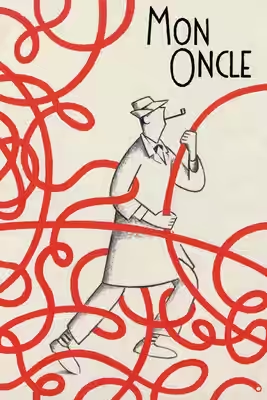
How does The Money Pit compare to Mon Oncle?
The Money Pit is the broader, more repetitive comedy; we recommend Mon Oncle for its more patient attention to the ways a house can make ordinary life exhausting. Tom Hanks makes the physical disasters funny, but Jacques Tati’s automated house keeps supplying fresh jokes where the destruction in The Money Pit starts to feel predictable.
What should I watch after The Money Pit?
After The Money Pit, try Mon Oncle (1958, Fi1m 82): Domestic convenience becomes an elaborate nuisance, with more patience for the details. Then The Ladykillers (1955, Fi1m 86): A houseful of criminals discovers the limits of its collective competence.

Cast

If you liked this, try…

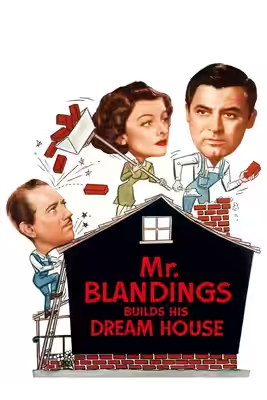
  1. Mr. Blandings Builds His Dream House (1948) · not reviewed yetA gentler account of building costs, marital friction and misplaced confidence.

  2. Mon Oncle (1958, Fi1m 82)Domestic convenience becomes an elaborate nuisance, with more patience for the details.

  3. Mouse Hunt (1997) · not reviewed yetAnother house suffers for its occupants, with sharper and nastier physical jokes.

  4. The Ladykillers (1955, Fi1m 86)A houseful of criminals discovers the limits of its collective competence.

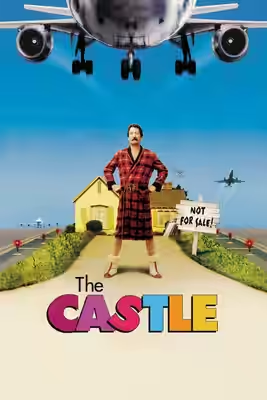
  5. The Castle (1997) · not reviewed yetProperty anxiety gets warmer treatment, with a family worth spending time beside.

Free account

Know what to watch tonight

Two lists that know where things are streaming, collections you can share, your own score beside ours, and Discover that remembers what you have seen.

  • Want to see, sorted by what is streaming now
  • Seen, with your score out of ten
  • No adverts, ever