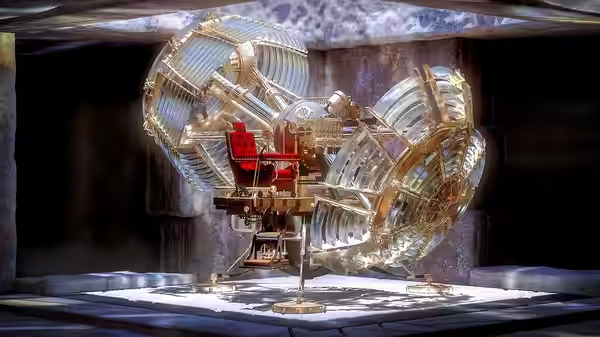
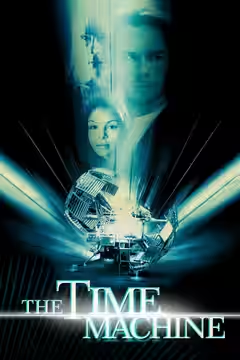
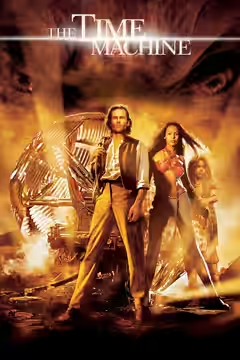
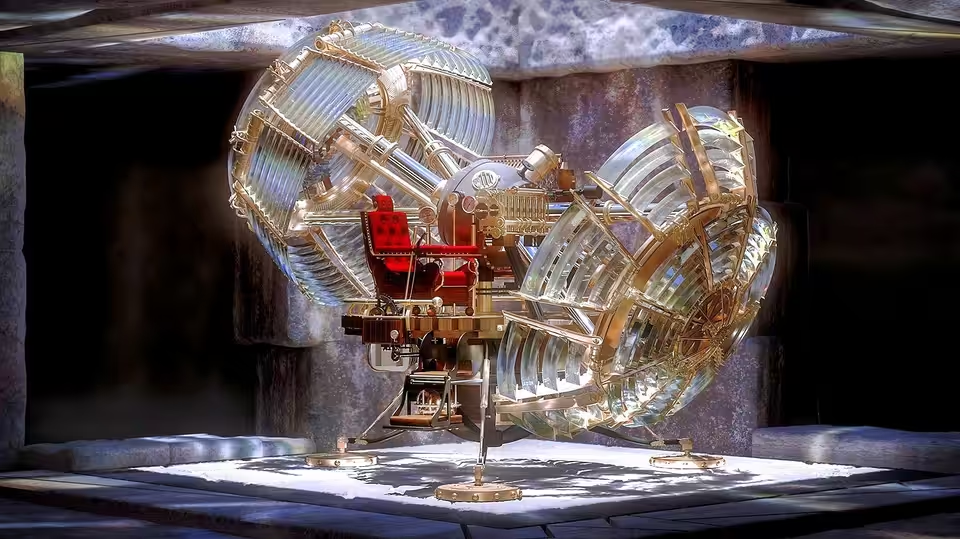
An ornate brass time machine with twin rotating rings stands on a stone platform
Film review

The Time Machine

2002 · Directed by Simon Wells · 1h 36m

In a sentenceEight hundred thousand years into the future and the best thing on screen is still the chair he arrived in

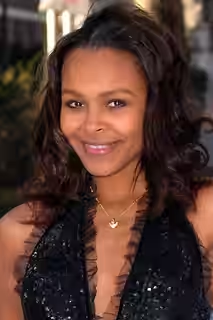
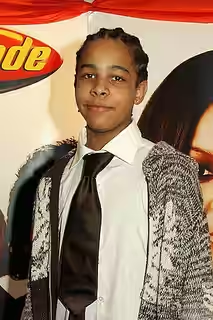
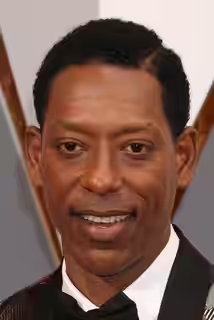
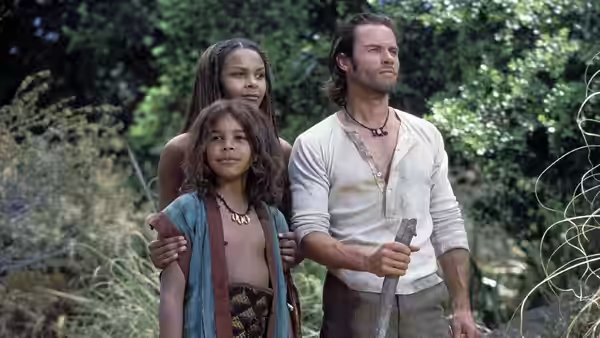
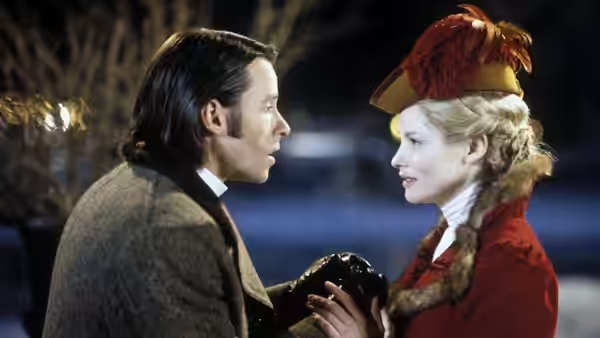
New York, 1899. Alexander Hartdegen (Guy Pearce) teaches at a university and spends his evenings in a workshop, with his friend David Filby (Mark Addy) telling him to get out more. He proposes to Emma (Sienna Guillory) in Central Park, and that same night a mugger shoots her for the ring. Hartdegen shuts himself away for four years and builds a machine of brass and spinning glass to go back and stop it. When that does not work, he goes forward instead: to 2030, where a holographic librarian, Vox (Orlando Jones), answers questions he has not asked, and on to the year 802,701, where the Eloi, among them Mara (Samantha Mumba) and her brother Kalen (Omero Mumba), live in woven dwellings on a cliff face.

Plays from YouTube when you press play; nothing loads from them until then.

Fi1m review

Simon Wells gets the brass, the gaslight and the first giddy run through the centuries right, then lands in a future with nothing to say and a chase to fill it. Pearce and Jones deserved a longer, stranger film.

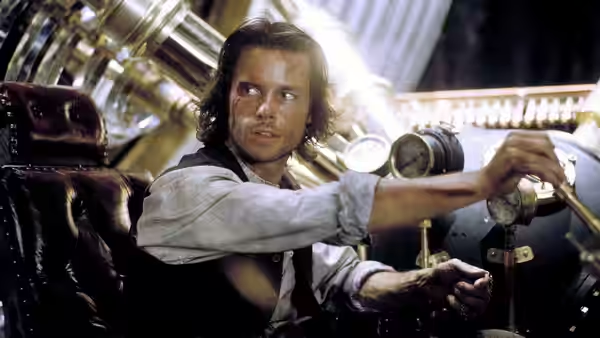
Alexander Hartdegen (Guy Pearce) teaches at a university in New York in 1899 and would rather be in his workshop. One night in Central Park a mugger shoots his fiancée Emma (Sienna Guillory), and he spends the next four years building a machine to go back and stop it. That is the first twenty minutes, and it is the clearest the film ever is about what it wants. John Logan, credited alongside David Duncan, has taken H. G. Wells’s 1895 novel and given its nameless traveller a name, a grief and a reason, and Simon Wells, the author’s great-grandson, directs. A man who can go anywhere in time and wants only one afternoon back is a good idea. The film has it for twenty minutes and then forgets it.

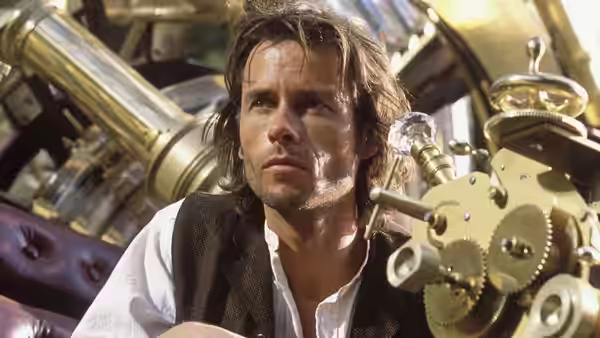
The early stretch is well made. Donald McAlpine shoots the city in snow and gaslight, brown rooms and yellow windows, and Oliver Scholl’s machine is a proper object: a brass seat under a frame of spinning glass discs that throw light across Pearce’s face as he winds it up. When it first moves, the windows of the workshop frost and clear as winters flicker past; then Wells takes the machine outside, and the skyline rises and falls, glaciers come down the valley and go back, and the rock is carved out from under it as the centuries pass. We felt, for perhaps three minutes, the thing the whole film is after, which is plain wonder at the size of time. Nothing else in it comes close.

Orlando Jones is the other reason to sit through it. He plays Vox, a holographic librarian in a public library in 2030, lit from inside a glass panel, who answers questions nobody has asked and quotes from things he has catalogued. Jones plays him as a man delighted to have someone to talk to, and the scenes are quick and funny in a way the rest of the script is not. Pearce, gaunt and chalk-dusted, plays loss as irritation; he is decent, and he is given almost nothing to say once he leaves 1899. Mark Addy has two warm scenes as his friend David Filby, and Phyllida Law a few lines as the housekeeper Mrs. Watchett, and both are gone before the half-hour.

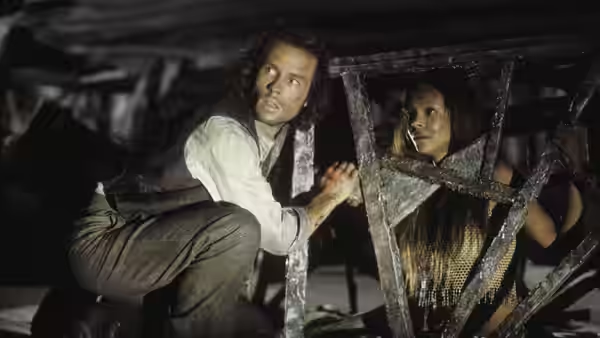
Then the machine stops in the year 802,701, and the film stops with it. The Eloi live in woven dwellings pinned to a cliff face, which Scholl has designed with care, and Deena Appel and Bob Ringwood dress them in earth-coloured cloth and beads. Mara (Samantha Mumba) teaches Hartdegen to speak and her brother Kalen (Omero Mumba) follows him about, and Mumba is calm and likeable, but the script gives her explanation where it should give her a person. The Morlocks, when they come, are grey, hunched things that bound on all fours and burst out of the sand, performers in suits rather than drawings, and the first attack is a real jolt. After that Wayne Wahrman cuts the film as a chase, and Klaus Badelt’s choir sings over every yard of it.

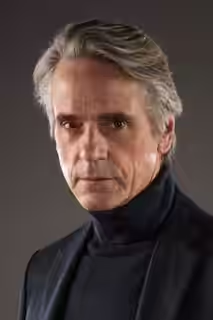
Jeremy Irons arrives late as the Über-Morlock, white as a candle, with his spine on the outside, and speaks in a murmur. He has one scene. In it the two men sit and talk, and we will not describe what is said, except that it is cut short so that they can hit each other. We were cross about that, and we stayed cross to the end, because that one scene is the only stretch of the film with an idea in it, and the film treats it as something to get through.

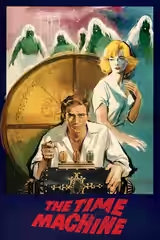
The 1960 version, directed by George Pal, was slower and cheaper and is still the one people remember, because it kept Wells’s point: that the Eloi and the Morlocks were the two halves of one society, grown apart until one preyed on the other. This one keeps the names and swaps the argument for a rescue. At 96 minutes it is short, and the future still feels padded, which tells you where the thought went.

See it for the brass and for Jones, and for three minutes of glaciers. It is a PG, and a child who has not read the book will have a perfectly good time with the Morlocks. The machine is the best character in it.

Critical consensus AI synthesised

48
Positive
0
Mixed
6
Negative
4
Screen Daily
11 March 2002 · Emanuel Levy
64*

The review text is behind a registration wall, so its verdict cannot be determined. No specific praise or complaint is visible in the accessible material.

Read the full review →
The New York Times
8 March 2002
64*

The page could not be accessed, so the critic’s verdict and specific praise or complaint cannot be verified. The URL identifies a film review, but provides no review text to summarize.

Read the full review →
Time Out
· TJ
57*

The review’s standfirst expresses concern about the retooled version. It singles out the 1960 George Pal adaptation as the point of comparison.

Read the full review →
Slant Magazine
6 March 2002 · ★★/4 · Ed Gonzalez
50

Gonzalez finds the film an uneven, ultimately disappointing mix of jokes and schlock. He singles out the brevity of Jeremy Irons’s cameo as especially tragic, alongside stiff direction and ineffectual effects.

Read the full review →
The AV Club
29 March 2002 · Keith Phipps
50*

Phipps finds the film engaging but not gripping, criticizing its lack of ideas. He praises the frightening Morlocks and the lyrical time-travel sequences.

Read the full review →
Radio Times
★★ · Andrew Collins
40

The critic finds the remake dull, philosophically muddled and too reliant on digital effects and action-movie conventions. They fault its inability to tell the familiar story without resorting to standard heroics.

Read the full review →

Straight answers AI written, from our review

Is The Time Machine worth watching?
The Time Machine (2002) is a mixed effort we scored 47: a well-made first half hour of brass, gaslight and flickering centuries, followed by a future with nothing to say and a chase to fill it. Guy Pearce and Orlando Jones are worth seeing, and a child who has not read the book will enjoy the Morlocks. Anyone after the novel's ideas should look to the 1960 version.
How long is The Time Machine, and what is it rated?
The Time Machine runs 1h 36m. It is a science fiction and adventure film.
Where can I watch The Time Machine in Croatia?
The Time Machine is not on any streaming or rental service in Croatia at the moment. It is available in 20 other countries; change your country at the top of the page to see where. Availability is checked daily.
How does The Time Machine compare to Primer?
The Time Machine (2002) is the handsome, hollow one and Primer the plain, dense one; the earlier film is the better of the two by some distance. Simon Wells spends his money on a brass machine and a Morlock chase, while Shane Carruth puts two engineers in a garage and follows the consequences. Choose Wells for spectacle you can watch with children, Carruth for a puzzle you will need to work out.
Is The Time Machine based on a true story or a book?
The Time Machine (2002) is based on H. G. Wells's 1895 novel, not a true story, and is directed by the author's great-grandson, Simon Wells. The adaptation gives the nameless traveller a name, a dead fiancée and a motive, then drops Wells's argument about the Eloi and Morlocks for a rescue plot. Knowing the book is not required, though readers may miss its point.

Cast

Awards

Academy Awards, 2003

Nominated
Best Makeup and Hairstyling

If you liked this, try…

  1. The Time Machine (1960) · not reviewed yetGeorge Pal’s version, slower and cheaper, and the one that keeps Wells’s argument intact.

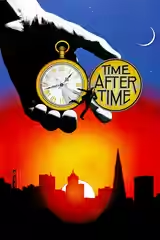
  2. Time After Time (1979) · not reviewed yetH. G. Wells himself chases Jack the Ripper into 1979 San Francisco; wittier about the man.

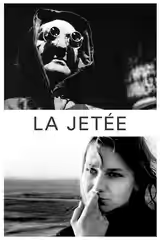
  3. La Jetée (1962) · not reviewed yetTwenty-eight minutes of still photographs about a man sent back to one remembered afternoon.

  4. Primer (2004, Fi1m 79)Two engineers in a garage build one by accident; no brass, no glass, all consequence.

  5. Timecrimes (2007) · not reviewed yetA Spanish thriller that takes one hour of time travel and tightens it until it hurts.