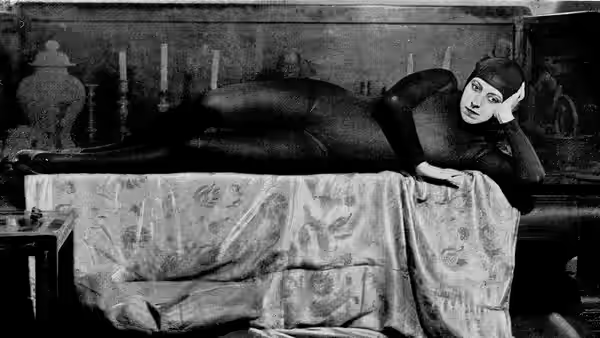
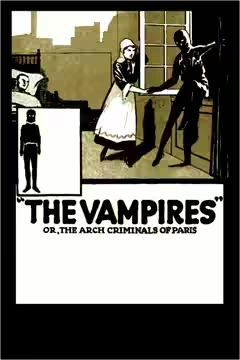
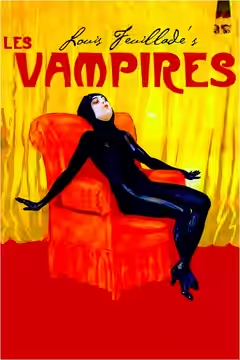
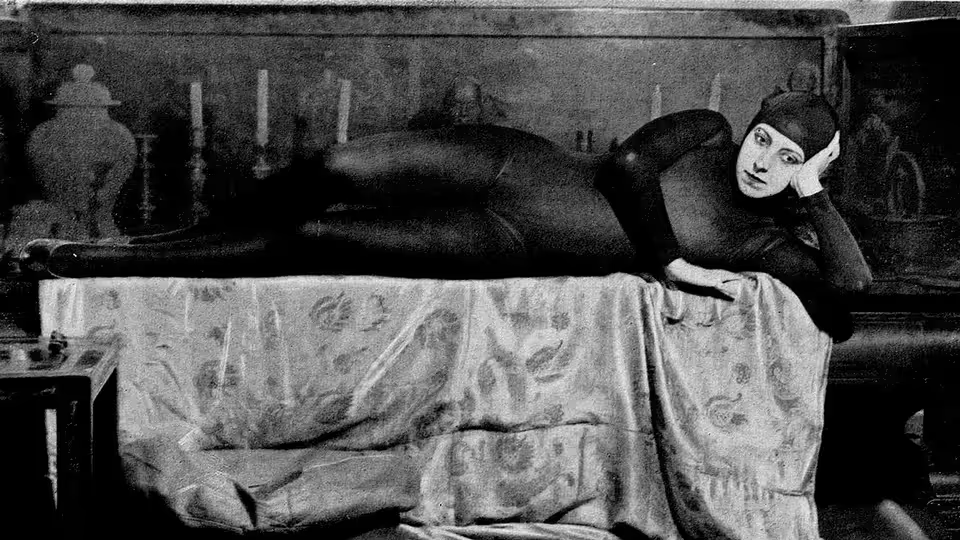
Irma Vep (Musidora) in a black catsuit lies across a bed in a furnished room
Film review

The Vampires or, The Arch Criminals of Paris

1915 · Directed by Louis Feuillade · 7h 02m

In a sentenceSeven hours of well-dressed Parisians climbing out of windows, and the one in black silk gets away with it every time

Paris, 1915. Philippe Guérande (Édouard Mathé), a reporter, is investigating the Vampires, a gang of thieves and killers who leave the city’s police looking foolish. The case opens when a detective’s severed head turns up in a box. Guérande lives with his mother, Madame Guérande (Florense Simoni), and is engaged to the dancer Marfa Koutiloff (Stacia Napierkowska). Mazamette (Marcel Lévesque), a small-time crook on the gang’s payroll, switches sides and attaches himself to Guérande as an unlikely partner. Against them stand the Great Vampire (Jean Aymé), who runs the gang from behind a run of false identities, and Irma Vep (Musidora), a cabaret singer whose name rearranges into something more telling, and who does the climbing and the getting away.

Fi1m review

Feuillade’s ten-episode Paris crime serial is a century old, seven hours long and looser than it should be, and it is still more alive than most thrillers made since. Musidora’s Irma Vep is the reason people remember it; the rooftops are the reason we do.

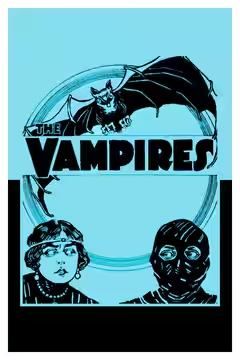
Nobody in Les Vampires is a vampire. The name belongs to a gang of thieves and murderers who work Paris in top hats and black hoods, and Louis Feuillade’s serial, ten episodes shot for Gaumont across 1915 and 1916 while a good part of the city’s men were away at the front, follows one reporter’s attempt to bring them down. The whole thing runs 422 minutes. We would not ask you to sit through it in a day. We would ask you to sit through it, and gladly, because a hundred years on it still moves faster than most things made with a plan.

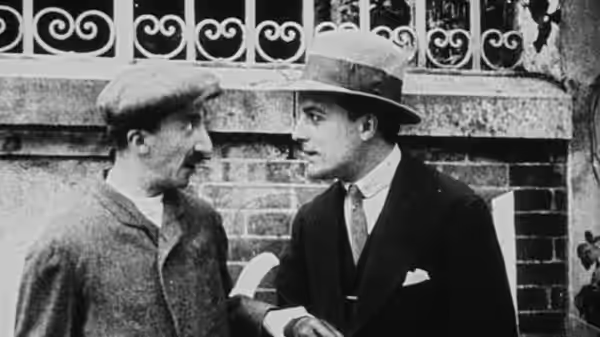
Feuillade, who wrote as well as directed, made it up an episode at a time, and it shows in a way we came to enjoy. There is no grand design. There is Philippe Guérande (Édouard Mathé), a hat-stand of a hero who looks at cryptograms and frowns; there is his ally Mazamette (Marcel Lévesque), a crook who has changed sides; and there is the gang, headed by the Great Vampire (Jean Aymé) and run in practice by Irma Vep (Musidora), a cabaret singer whose name is an anagram. Each episode invents a new trick, a poison ring, a cabinet with a false back, a room that empties through the floor, and gets out before you can ask how it was paid for.

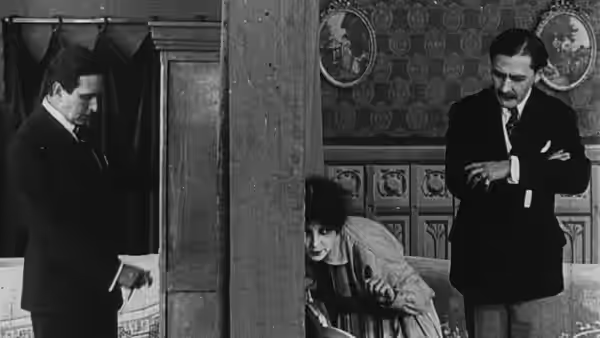
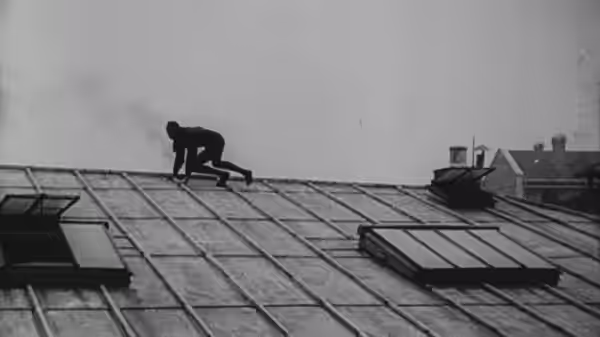
The cinematographers, Manichoux and Georges Guérin, keep the camera still and at chest height and let the rooms play out in depth, so that a drawing room shows you its door, its window and the man behind the curtain in one shot. That would be theatre, except that they then carry the same fixed camera out onto real streets and real roofs in flat Paris daylight, and because the camera never cheats, you believe the roofs. When a figure in black runs along a mansard six storeys up, that is a person on a roof. Robert-Jules Garnier built the interiors, and he built them with too many doors: flats whose wardrobes open into the next building, hotel rooms with a panel behind the bed. Most critics who like the serial praise these spaces, and they are right to.

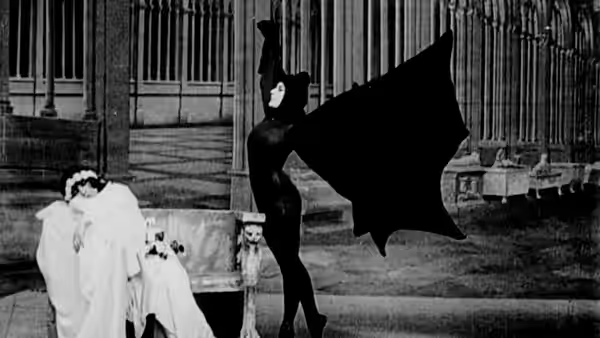
Then there is Musidora. Irma Vep spends much of her time in ordinary dresses, playing a maid or a secretary or a guest, and the first time she strips down to the black silk body stocking and goes over a balcony we sat up as if we had been caught at something. It is a century old and it still lands as a shock: a woman’s body, moving with purpose, in a film where every other body stands about waiting for an intertitle. She is on screen less than memory insists. It does not matter. Lévesque is the other performer alive in it, a rubber face who mugs straight at the lens and is the only one allowed to know we are there, and we laughed at him more than we expected to, and more than his material deserved.

The rest of the cast is stiff in the manner of the period, and the women other than Musidora are there to faint. Mathé’s Guérande spends a good deal of the serial being rescued. Somewhere around the fourth hour the episodes start to rhyme, capture and escape and capture, and we were bored, and then annoyed with ourselves for being bored when the next instalment produced something we had never seen a film do. The gang’s leadership changes hands more than once along the way; we will not say how, only that Feuillade treats it as briskly as a change of hats.

He had done this before with Fantômas in 1913 and would do it again with Judex in 1916. Fantômas is the tighter film. This is the looser one, and the more enjoyable, and it is the one that stuck: the Surrealists adored it, and Olivier Assayas built a whole film, Irma Vep (1996), around the difficulty of remaking it. You can see its fingerprints on every thriller that has since put a woman in black on a roof.

Watch it at home, one episode an evening, with a week between them if you have the patience, which is how Paris saw it. The cliffhangers were designed for the gap.
Critical consensus AI synthesised

78
Positive
2
Mixed
2
Negative
0
Slant Magazine
9 May 2003 · ★★★★/4 · Ed Gonzalez
100

The critic calls the serial a towering, radical work and finds its nearly 400-minute storytelling exhilarating. He particularly praises its serpentine, claustrophobic interiors and the way its visual style builds a mesmerizing sense of danger.

Read the full review →
The New York Times
14 September 1965 · festival review
64*

The accessible page does not reveal the critic’s verdict. It provides no praise or complaint to attribute.

Read the full review →
Time Out
· BBa
64*

The page presents the film as a diversion in the form of a ten-episode serial about a band of robbers. The review text is unavailable, so its verdict and any specific praise or complaint cannot be determined.

Read the full review →
Eye for Film
14 November 2024 · Donald Munro
85*

The critic calls the serial a striking and entertaining work that pushes boundaries despite limited technical innovation. Musidora’s performance and physicality as Irma Vep stand out for praise.

Read the full review →

Straight answers AI written, from our review

Is The Vampires or, The Arch Criminals of Paris worth watching?
The Vampires or, The Arch Criminals of Paris is worth watching for anyone with patience for a silent serial, and we scored it 82. It runs 422 minutes and sags around the fourth hour, so take it one episode an evening rather than in a sitting. Musidora's Irma Vep and the real Paris rooftops are what make it still move faster than most modern thrillers.
How long is The Vampires or, The Arch Criminals of Paris, and what is it rated?
The Vampires or, The Arch Criminals of Paris runs 7h 02m. It is a drama and thriller film.
Where can I watch The Vampires or, The Arch Criminals of Paris in Ecuador?
The Vampires or, The Arch Criminals of Paris is not on any streaming or rental service in Ecuador at the moment. It is available in 2 other countries; change your country at the top of the page to see where. Availability is checked daily.
How violent or frightening is The Vampires or, The Arch Criminals of Paris, and is it suitable for children?
The Vampires or, The Arch Criminals of Paris has no certificate, being a silent film from 1915, and its violence is stated rather than shown. The gang are thieves and murderers, a detective's severed head turns up in a box early on, and there is a poison ring, but nothing is graphic by modern standards. Older children who can read intertitles and sit still will be fine; younger ones will be bored long before they are frightened.

Cast

If you liked this, try…

  1. Fantômas (1913) · not on Fi1m yetFeuillade’s earlier serial, tighter and nastier, with a villain who is always someone else.

  2. Irma Vep (1996) · not on Fi1m yetAssayas tries to remake this one and finds out why nobody can.

  3. Judex (1963) · not on Fi1m yetFranju’s remake of Feuillade’s next serial, all masks, doves and quiet menace.

  4. Dr. Mabuse, the Gambler (1922) · not on Fi1m yetLang takes the master-criminal serial to Berlin and makes it paranoid.

  5. Out 1 (1971) · not on Fi1m yetRivette’s thirteen-hour Paris conspiracy, for anyone who felt seven hours was short.