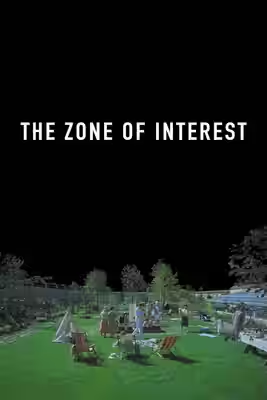
The Zone of Interest poster

The Zone of Interest

2023 · Directed by Jonathan Glazer
1h 45mDramaHistoryWar12A
91
Fi1m score
89
Critics · 23
Audience · not yet

Where to watch in the UK

Checked 10 September at 22:28. Prices and availability change; the service’s page is the last word.

Plays from YouTube when you press play; nothing loads from them until then.

Synopsis

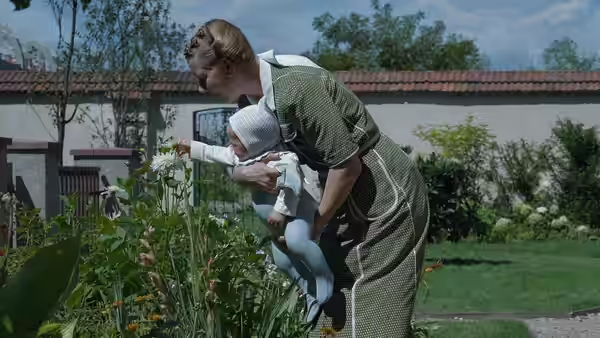
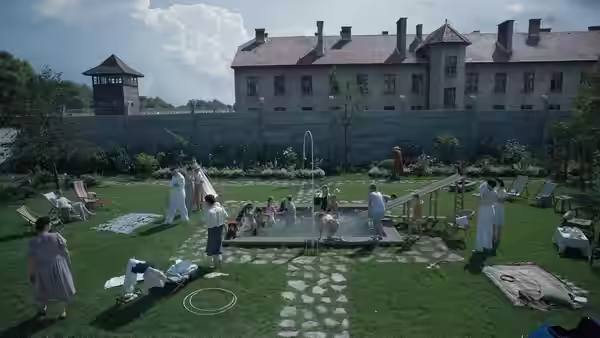
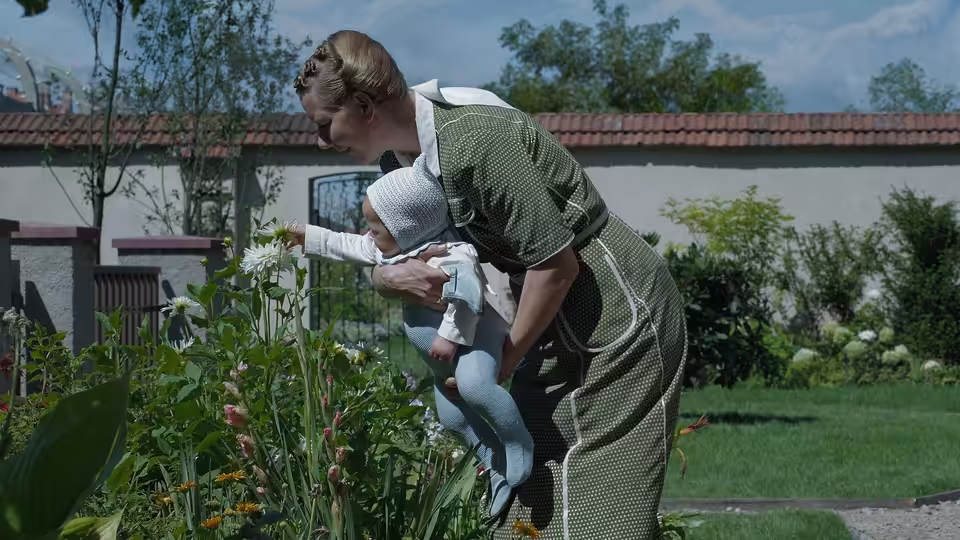
Rudolf Höss (Christian Friedel) runs Auschwitz and lives with his family in a villa whose garden backs onto the camp wall. His wife Hedwig (Sandra Hüller) tends the flowers, manages the Polish servants and has her friends round for coffee, while their five children swim in the pool and play in the grounds. Höss leaves for work each morning through the gate, meets engineers about the camp’s equipment and comes home for dinner. Nothing beyond the wall is shown. Jonathan Glazer writes and directs, taking his title from Martin Amis’s novel, with Mica Levi providing the music and Łukasz Żal photographing the house and garden in fixed, distant shots.

Fi1m review

In a sentenceThe lilacs are out, the children are in the pool, and the screaming is somebody else’s problem

Jonathan Glazer’s film about the Auschwitz commandant and his family stays in their house and garden and never enters the camp. What it does with sound instead is the most frightening thing we have seen in years, and we would tell a stranger to see it.

Jonathan Glazer’s film is set in a comfortable house with a large garden. The man who owns it is Rudolf Höss, the commandant of Auschwitz, and the far wall of the garden is the wall of the camp. Glazer, who wrote the script as well as directing it, has taken Martin Amis’s novel and kept the title and little else. What remains is a summer of family routine, filmed as if the family were unremarkable, and it frightened us more than any film about the Holocaust we can remember. We would tell a stranger to see it. It runs 105 minutes, carries a 12A certificate, and shows no violence at all.

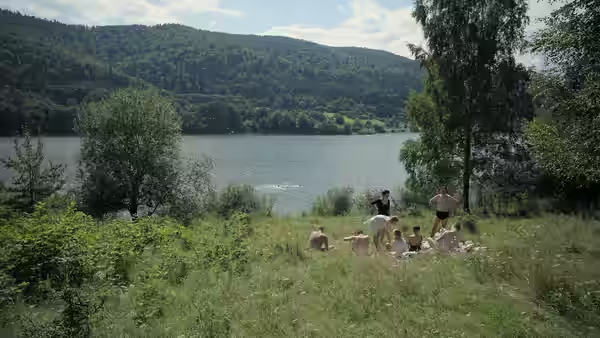
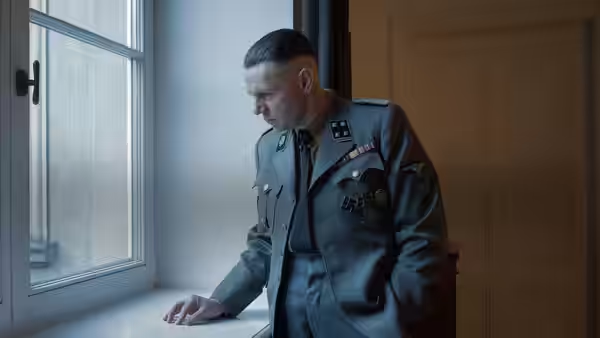
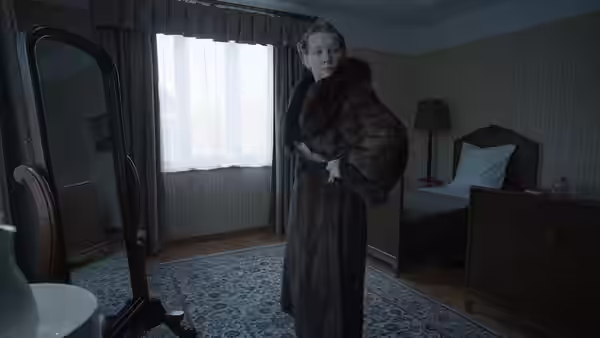
Christian Friedel plays Höss as a man who likes things done properly. He reads to the children, checks the doors at night, and listens to two engineers pitch a more efficient crematorium with the polite nods of a man buying a boiler. Sandra Hüller’s Hedwig is worse, because she is happier. She has the garden, the greenhouse, the Polish servants and a fur coat that has arrived from somewhere, and Hüller gives her the settled contentment of a woman who has got what she wanted. The five children swim, squabble and are sent to bed, and Glazer films them as children, which is harder to watch than if he had made them sinister.

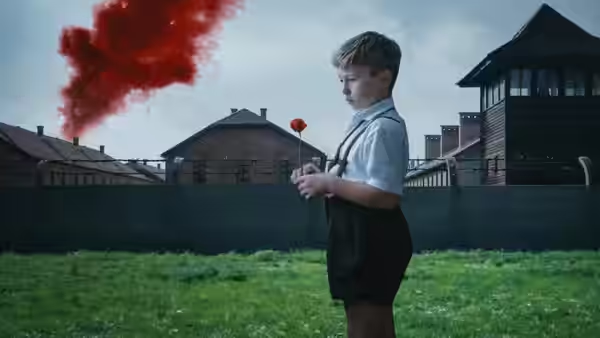
Łukasz Żal keeps the camera still and a long way back. Scenes are shot wide, in flat daylight, from about the height of someone standing in the doorway, and nobody is given a close-up. It looks like security footage of a happy home. Chris Oddy’s production design gives the villa cream walls and tiled floors, and a garden thick with flowers, with a whitewashed wall, a run of wire and a chimney beyond it, in shot for most of the film and mentioned by nobody. Małgorzata Karpiuk dresses the family in white cotton and floral prints, so they look like an advertisement for the countryside. Paul Watts cuts each scene short, usually before anyone in it has had time to react.

Then there is the sound, and that is what got us. About ten minutes in we realised the low rumble under the birdsong had been there since the first scene, and that the shout we had just half heard was not one of the children in the pool. After that we could not stop listening: a single shot, a dog, a train arriving at night, an orange light moving across a bedroom ceiling. Nobody in the house turns their head. Mica Levi’s music is used sparingly, a long churning drone over a black screen before the first image and a few short passages after, and the music credit is shared with Joseph Wulf. Everything else you hear is the camp.

We have two reservations. At night the film switches to thermal imaging to follow a Polish girl who cycles out to the work sites and leaves apples in the earth for the prisoners. She is white against a black world, and hers are the only scenes in which anyone is kind. They are the one place where Glazer tells us how to feel; the rest of the film has trusted us to manage. A few critics have asked whether a film this carefully composed is making something handsome out of the worst thing that happened, and there were moments, watching the light in Hedwig’s garden, when we asked it too. We think the coldness is the point. We understand anyone who thinks it is an excuse.

Glazer’s previous film, Under the Skin (2013), also had music by Levi, and also watched something inhuman move through ordinary streets while nobody looked twice. Here the inhuman thing has a wife, five children and a well-run kitchen, and the streets are its own. It is a smaller, stricter film than that one, and a better one.

Watch it with the sound up and nothing else running. At home, wait until the house is quiet, because a dishwasher in the next room would be enough to spoil it. The family on screen managed to ignore a good deal more.

Critical consensus AI synthesised

89
Positive
22
Mixed
1
Negative
0

The reviews are close to unanimous, and they agree on why. Nearly every critic describes the same film: the Höss family’s sunlit domestic routine beside Auschwitz, the camp never shown, its horror carried by sound. The sound design is the department praised most often and most specifically, with Mica Levi’s score named alongside it as part of what makes this unlike other Holocaust dramas. Glazer’s detachment, the static, surveillance-like camera and the refusal to show violence are read as the point rather than a limitation. Sandra Hüller and Christian Friedel are singled out repeatedly for playing functionaries rather than monsters. The reservations are few but pointed. Sight and Sound wonders whether replicating the perpetrators’ perspective so coldly, and choosing this story at all, is the right call. The Guardian is the lone mixed voice, calling it technically brilliant while asking whether it revives arguments about making slick cinema out of historical horror. The spread is otherwise narrow.

Little White Lies
31 January 2024 · 5/5/5 · Hannah Strong
100

Glazer’s stark film about the Höss family’s domestic routine next door to Auschwitz is a colossal, profoundly disturbing achievement. It highlights the banality of evil through mundane family life juxtaposed with the unseen horrors just over the wall.

Read the full review →
Radio Times
★★★★★ · Max Copeman
100

The review describes the film as a striking and deeply disturbing depiction of the banality of evil, focusing on the Höss family's life next to Auschwitz without showing the atrocities directly. It singles out Glazer's artful cold remove and Mica Levi's score as making it a unique Holocaust drama.

Read the full review →
Time Out
20 May 2023 · ★★★★★ · Dave Calhoun
100

Glazer delivers a bold, experimental and provocative take on the Holocaust that honours the facts without treading familiar ground. The film’s power lies in the tension between the family’s crisp, sunlit domestic idyll and the unseen industrial horror next door.

Read the full review →
Los Angeles Times
14 December 2023 · Justin Chang
95*

The critic calls it a masterpiece that explores evil without glamorizing it, transmuting the mundane into something mesmerizing. He singles out the sound design for praise, noting how it conveys the horrors next door without showing them.

Read the full review →
The AV Club
15 December 2023 · A · Manuel Betancourt
95

Glazer's Auschwitz-set drama is a staggering cinematic achievement and instant classic, a discomfiting and horrifyingly mundane portrait of the Höss household that forces viewers to confront the banality of evil through its observational style.

Read the full review →
Empire
29 January 2024 · Alex Godfrey
90*

Glazer's unique and striking film is a study of moral vacuity and the attitude towards atrocity, made all the more upsetting by its detachment and sound design. It singles out the everyday dismissal of camp noises by the family and the subtle, haunting imagery (such as the mother's nighttime glimpse of the chimney) as what gets under the skin.

Read the full review →

Cast

Christian Friedel
Rudolf Höss
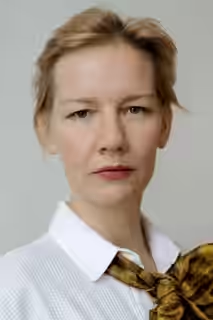
Sandra Hüller
Hedwig Höss
Johann Karthaus
Claus Höss
Luis Noah Witte
Hans Höss
Nele Ahrensmeier
Inge-Brigit Höss
Lilli Falk
Heideraud Höss
Anastazja Drobniak
Annagret Höss
Cecylia Pekala
Annagret Höss

Stills

Awards

Robert Award for Best Non-American Film, 2025

Won
Robert Award for Best Non-American Film

Academy Awards, 2024

Nominated
Best Picture
Won
Best International Feature Film

BAFTA Film Awards, 2024

Nominated
Best British Film
Nominated
Best Film Not in the English Language

Golden Globes, 2024

Nominated
Best Motion Picture – Drama
Nominated
Best Non-English Language Film

National Society of Film Critics Award for Best Director, 2024

Won
National Society of Film Critics Award for Best Director

European Film Award for Best Film, 2023

Nominated
European Film Award for Best Film

Gilde Film Price, 2023

Won
Gilde Film Price

If you liked this, try…

Son of Saul poster

Son of Saul

2015 · The same camp from the other side of the wall, shot in close-up.

Come and See poster

Come and See

1985 · The occupation of Belarus through a boy’s eyes; the film Glazer’s is answering.

The Act of Killing poster

The Act of Killing

2012 · Mass murderers re-enact their crimes cheerfully; the banality without the distance.

The White Ribbon poster

The White Ribbon

2009 · A German village before the war, and the children who will grow up in it.

Under the Skin poster

Under the Skin

2013 · Glazer and Levi’s earlier film, in which the predator is the one we follow.