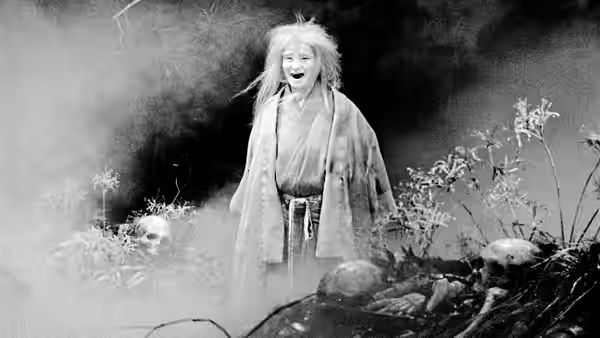
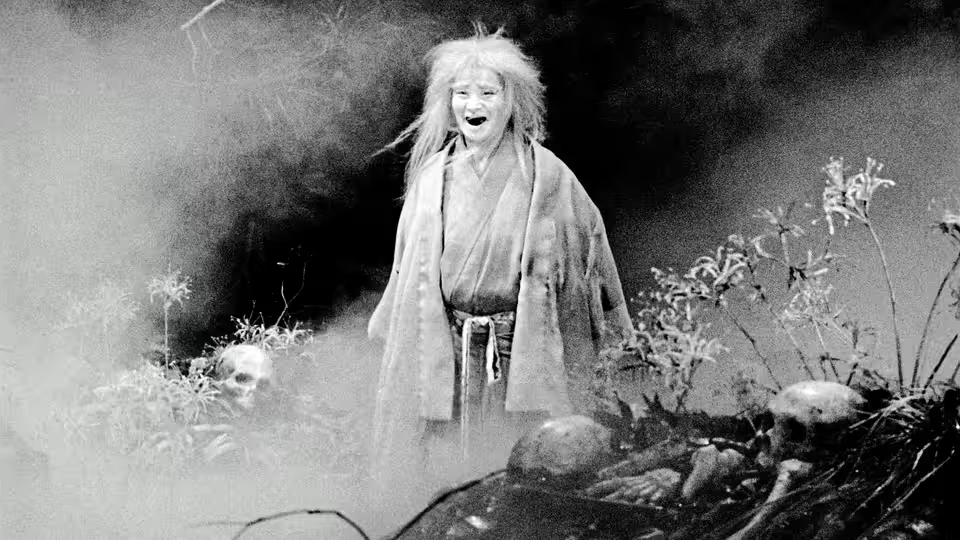
A pale forest spirit stands among plants and rocks, mouth open
Film review

Throne of Blood

1957 · Directed by Akira Kurosawa · 1h 48m · Eirin G

In a sentenceA castle full of people who could do with less ambition and more sleep

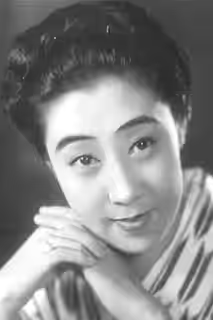
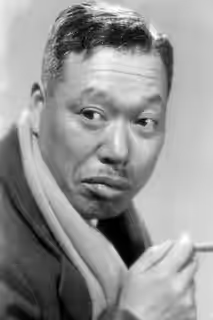
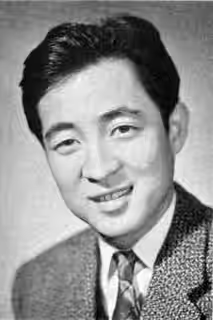
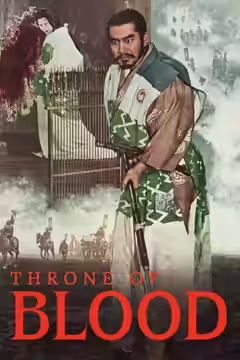
In feudal Japan, Taketoki Washizu (Toshirō Mifune) pursues power within the samurai order. Lady Asaji Washizu (Isuzu Yamada), his wife, becomes closely involved in his ambitions, while Yoshiaki Miki (Minoru Chiaki) belongs to the same military world. Cobweb Castle is the centre of authority in a landscape shrouded in mist. Washizu must reckon with competing loyalties and the pressure of his marriage as the prospect of advancement draws him on. Akira Kurosawa’s adaptation of Macbeth places its struggle for power among warriors whose rank governs their lives.

Fi1m review

Akira Kurosawa’s samurai Macbeth is frightening, forcefully acted and worth the occasional struggle to follow its politics. Toshirō Mifune and Isuzu Yamada make the pursuit of power feel exhausting before it can feel desirable.

Throne of Blood is a frightening and persuasive adaptation of Macbeth, with a stiffness in its storytelling that we would not pretend away. Akira Kurosawa moves the play into feudal Japan and makes the samurai setting feel essential to its account of ambition. Rank matters in every encounter, and the prospect of possessing more of it seems to make nobody comfortable. We recommend it warmly, with a reservation about how readily the atmosphere can overwhelm the telling of the story.

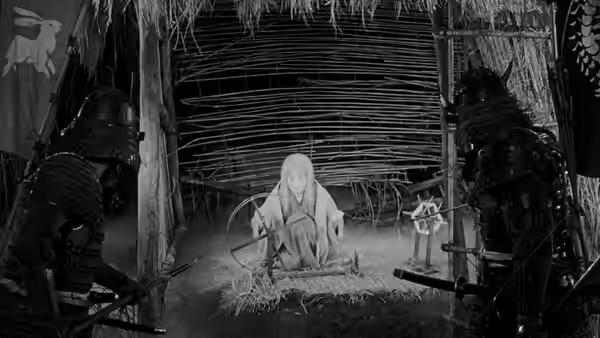
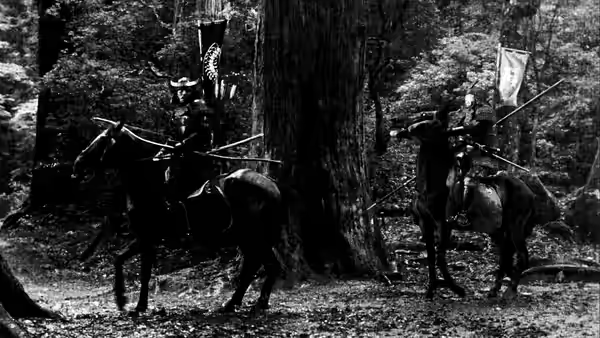
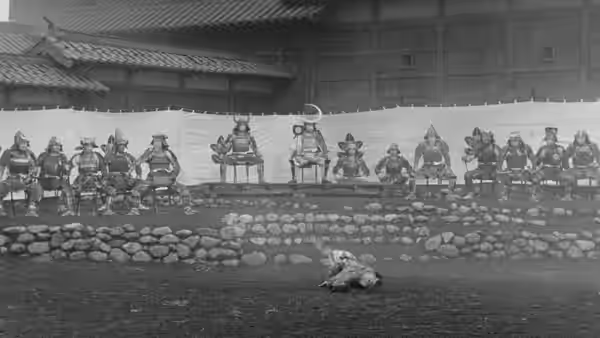
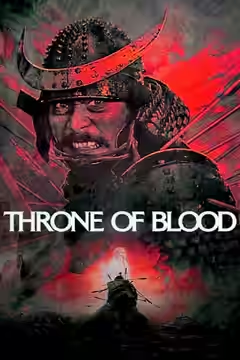
Asakazu Nakai’s cinematography makes the mist feel oppressive. It takes away our bearings, and the director’s camera movement gives little reassurance that a clearer view will make this place safer. We felt uneasy watching it, because the fog leaves us unable to judge the space around the characters. The unease continues inside Yoshirō Muraki’s sets, whose severity makes the castle seem a poor place to recover from anything encountered outside.

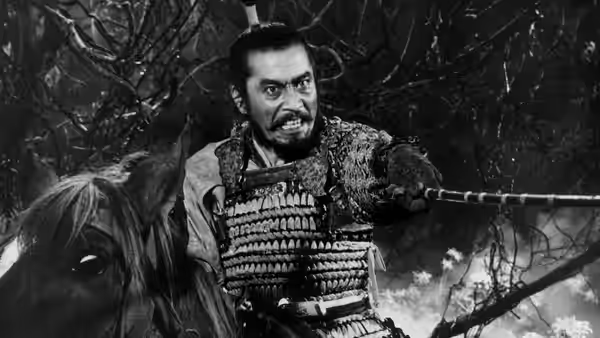
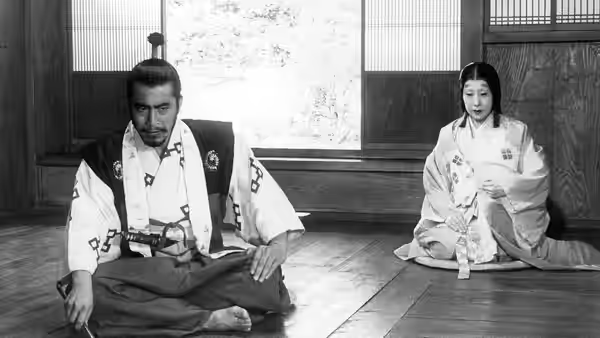
Toshirō Mifune gives Taketoki Washizu an agitation that keeps the formal staging from becoming merely impressive. There is something tiring about watching him, deliberately so: authority appears to require an effort he can never stop making. We keep looking for a moment when he might be comfortable with himself. The performance is large enough to risk exhausting our sympathy, but that excess suits a man who cannot leave his own ambitions alone.

Isuzu Yamada makes Lady Asaji Washizu harder to read, and the contrast is crucial. Her composure gives the marital scenes a pressure that another equally expansive performance would dissipate. Watch how much weight she gives to remaining calm while he cannot: it makes his agitation seem increasingly futile. The relationship supplies much of the film’s tension, and she deserves as much attention as the more visibly troubled man beside her.

Akira Kurosawa also edits, and his patience occasionally becomes a liability. He allows the atmosphere to gather until we begin anticipating trouble in images that need no overt threat. Some stretches feel held beyond their useful length, particularly when the political story needs greater clarity. Masaru Satō’s music helps sustain the unease, though sound and image cannot always supply a dramatic connection that the writing has left unclear.

As screen Shakespeare, the film has the confidence to give its setting a substantial part in the drama. There is no need to judge every character against a remembered counterpart in Macbeth, or to approach the samurai setting as a puzzle to be decoded. The fear remains clear even when the politics become difficult to follow. The castle, the mist and the strain visible in the performances give us enough to watch without mentally consulting the play.

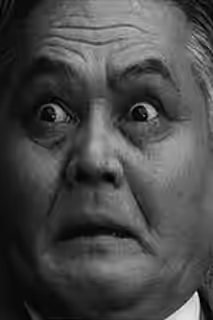
At 108 minutes, it does not demand a long evening, though its deliberate pace deserves a quiet one. We would choose it when we wanted to be unsettled and had no wish to be hurried. Familiarity with Macbeth is no reason to treat it as homework. Give those faces your full attention.

Critical consensus AI synthesised

83
Positive
8
Mixed
0
Negative
0

All eight reviews are positive, with most critics praising Kurosawa’s adaptation of Macbeth for its atmosphere and its translation of Shakespeare into a Japanese setting. The praise centres on the visual storytelling: camera movement, eerie sets and charged imagery make the struggle for power tense and unsettling. Several reviews regard the film as an unusually successful screen adaptation, finding that the move to feudal Japan gives the tragedy force rather than merely a different backdrop.

The differences are chiefly in the strength of the enthusiasm, with scores ranging from 70 to 100. Radio Times acknowledges weaknesses in the dramatic structure but finds the atmosphere powerful enough to outweigh them. Eye for Film offers a more qualified response, finding the film initially odd and sometimes difficult to follow, while still praising its visual imagery and eventual force; there is no outright dissent in this selection.

Radio Times
★★★★★ · David Parkinson
100

Parkinson acknowledges weaknesses in the dramatic structure but finds the film’s atmosphere powerful. He particularly praises Kurosawa’s camera movement and the eerie sets.

Read the full review →
Empire
1 January 2000 · David Parkinson
90*

Parkinson presents the film as a serious contender for the finest Shakespeare adaptation on screen. He praises its atmospheric visuals and striking set-pieces, especially the invasion of Cobweb Castle by birds.

Read the full review →
The Guardian
· Peter Bradshaw
90*

Bradshaw regards Kurosawa’s take on Macbeth as a stunning interpretation of Shakespeare and a study of history, power and sexual politics. He particularly praises the film’s lasting force as a samurai adaptation of the play.

Read the full review →
The New Yorker
12 July 2009 · Anthony Lane
85*

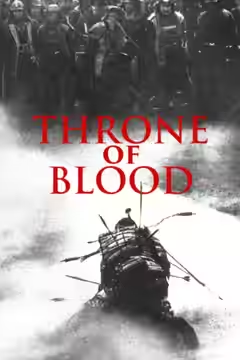
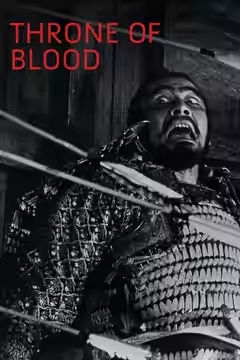
Lane finds the film tense and charged, with an unforgettable release once it breaks free of the mist. He especially praises Kurosawa’s arrow-pierced final image of Washizu, which makes the tragedy feel dreamlike and absurd.

Read the full review →
Slant Magazine
7 January 2014 · ★★★★ · Chuck Bowen
80

Bowen praises the Criterion Blu-ray as a sterling presentation of a top-tier Kurosawa film. He singles out its improved image clarity, rich blacks and grain, and nuanced mono sound.

Read the full review →
Time Out
· RM
75*

The available description presents Kurosawa’s adaptation as one of the few successful screen versions of Shakespeare. It praises the film’s achievement in translating Shakespeare to the screen.

Read the full review →

Straight answers AI written, from our review

Is Throne of Blood worth watching?
Throne of Blood is well worth watching for its frightening atmosphere and forceful performances, and we score it 88 out of 100. We recommend it especially to viewers who enjoy deliberate, unsettling drama, with the caveat that its oppressive mist and formal staging sometimes make the political story harder to follow.
How long is Throne of Blood, and what is it rated?
Throne of Blood runs 1h 48m and is rated G by the Eirin in Japan. It is a drama and history film.
Where can I watch Throne of Blood in Japan?
Throne of Blood is not on any streaming or rental service in Japan at the moment. It is available in 4 other countries; change your country at the top of the page to see where. Availability is checked daily.
How violent or frightening is Throne of Blood, and is it suitable for children?
Throne of Blood has a UK 12 certificate, and its frightening atmosphere makes it better suited to older children and teenagers than younger children. We find the obscuring fog, severe castle interiors and strain between the central couple unsettling; the concern here is sustained unease, though we cannot offer a detailed assessment of violence.
How does Throne of Blood compare to The Tragedy of Macbeth?
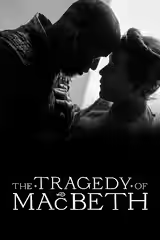
Throne of Blood offers the more persuasive central relationship, while The Tragedy of Macbeth is faster and more spare. We favour Kurosawa’s film for the pressure between Mifune and Yamada, despite its occasionally unclear politics; Coen’s adaptation suits those wanting a brisker telling, with frightening witches but a colder emotional centre.
What should I watch after Throne of Blood?
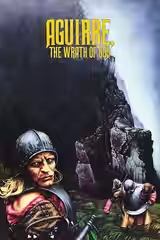
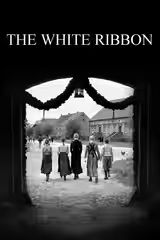
After Throne of Blood, try The Tragedy of Macbeth (2021, Fi1m 80): Another spare, enclosed Shakespeare adaptation, with ambition turning every room hostile. Then Aguirre, the Wrath of God (1972, Fi1m 91): A would-be ruler carries his ambition somewhere it has no business surviving; and The White Ribbon (2009, Fi1m 86): Rigid hierarchies and controlled performances make ordinary conversations feel quietly threatening.

Cast

Awards

Blue Ribbon Awards, 1957

Won
Blue Ribbon Awards

If you liked this, try…

  1. The Tragedy of Macbeth (2021, Fi1m 80)Another spare, enclosed Shakespeare adaptation, with ambition turning every room hostile.

  2. Onibaba (1964) · not on Fi1m yetReeds, sweat and suspicion make this another unnerving encounter with feudal Japan.

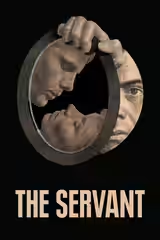
  3. The Servant (1963) · not on Fi1m yetA household becomes a contest for power, conducted through unnervingly polite exchanges.

  4. Aguirre, the Wrath of God (1972, Fi1m 91)A would-be ruler carries his ambition somewhere it has no business surviving.

  5. The White Ribbon (2009, Fi1m 86)Rigid hierarchies and controlled performances make ordinary conversations feel quietly threatening.