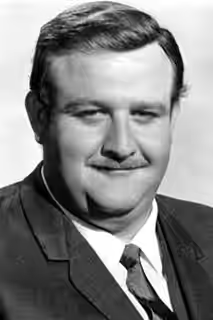
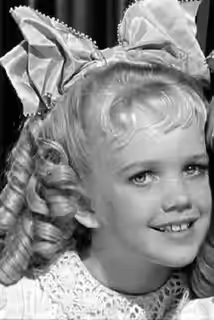
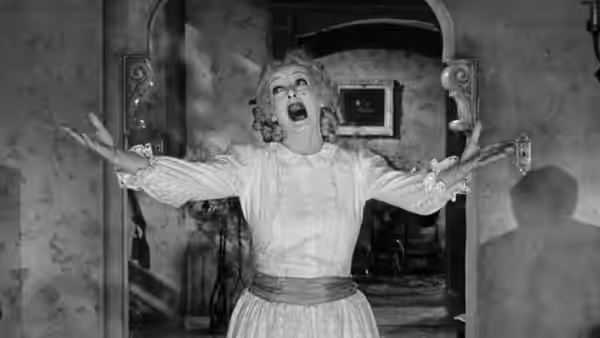
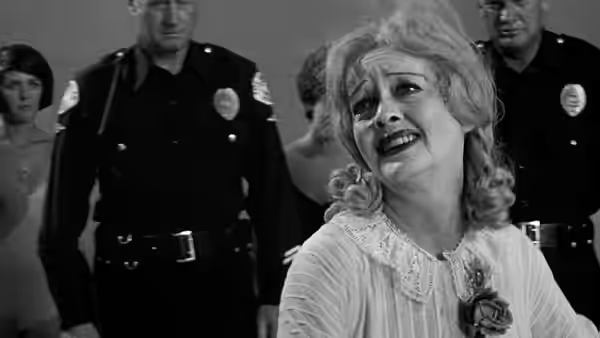
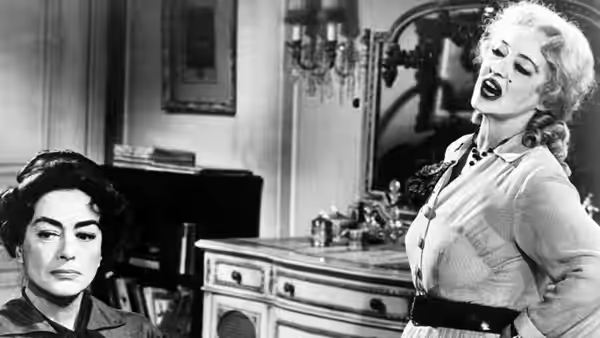
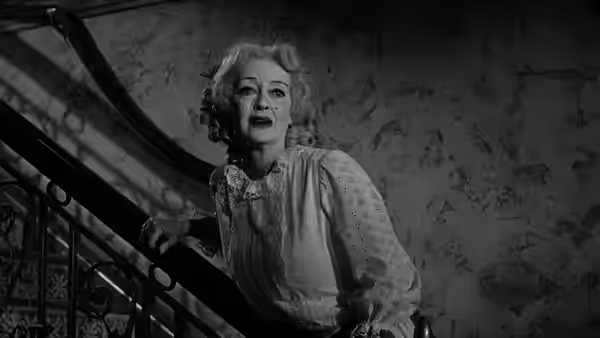
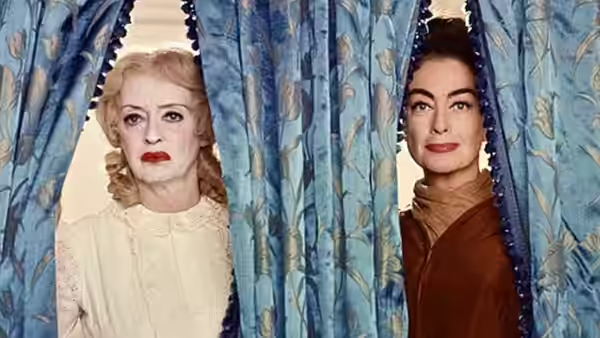
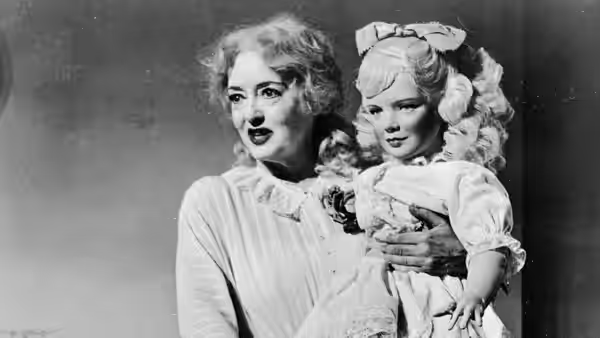
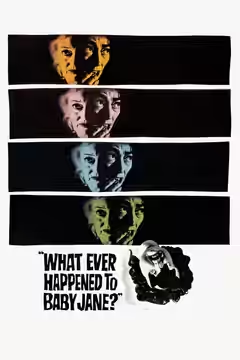
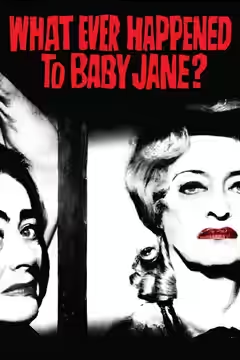
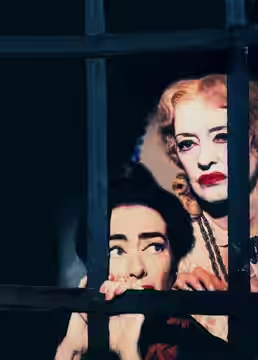
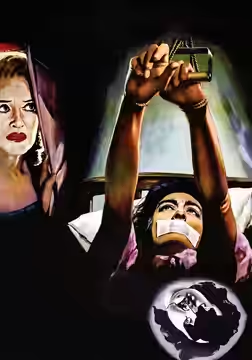
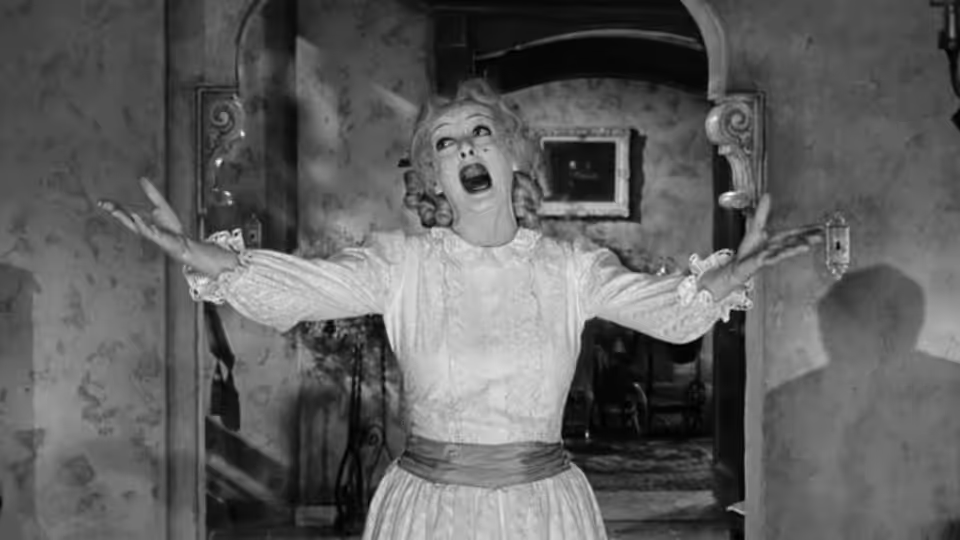
Baby Jane Hudson (Bette Davis) stands with arms outstretched in a parlor
Film review

What Ever Happened to Baby Jane?

1962 · Directed by Robert Aldrich · 2h 15m

In a sentenceNever let your sister bring you lunch on a covered tray

In 1917, Baby Jane Hudson is the child star of a vaudeville act, and her sister Blanche watches from the wings. By 1935 the fortunes have swapped: Blanche is a Hollywood leading lady, Jane a drunk, until a car crash outside their gates leaves Blanche unable to walk. Now the two live alone in a shuttered house in Los Angeles. Blanche (Joan Crawford), upstairs in a wheelchair, watches her old films on television and makes plans to sell the house. Jane (Bette Davis), downstairs in ringlets and white powder, carries up the trays, signs Blanche’s name on the cheques and places a newspaper advertisement for a pianist for her comeback. Edwin Flagg (Victor Buono) answers it. The housekeeper, Elvira Stitt (Maidie Norman), does not like what she sees.

Plays from YouTube when you press play; nothing loads from them until then.

Fi1m review

Robert Aldrich locks Bette Davis and Joan Crawford in a Hollywood mansion and lets them go at each other for 135 minutes. It is cruel, funny and frightening, and about twenty minutes too long. We recommend it, with the lights on.

Robert Aldrich’s film is about two sisters who were both famous once and now cannot leave each other alone. Baby Jane Hudson (Bette Davis) was a child star of the vaudeville stage. Blanche (Joan Crawford) grew up to be the film star Jane never became, until a car crash finished her career and put her in a wheelchair, and the two have been shut up together in a Hollywood house ever since. Lukas Heller’s screenplay, from Henry Farrell’s novel, treats this as a horror film, and it is one. It is also a comedy about show business and a study of two women who have each spent thirty years blaming the other. It is a fine film, and it is too long.

Davis plays Jane as a woman who stopped at about eleven. She wears the ringlets and frilled frocks of her old stage act, and a coat of white powder over which the lipstick and kohl have been applied by someone who cannot quite see. Her voice goes up into a baby’s whine when she wants something and down into a rasp when she does not get it. The scene most people remember is the one at the mirror: Jane, rehearsing her comeback, sings the song that made her famous as a child, gestures and all, and then catches sight of her own face. We laughed at the song. We were ashamed a moment later, when she screamed, because Davis had let us laugh on purpose and then showed us what we had been laughing at. There is no vanity in the performance at all.

Crawford has the harder job, because Blanche has to be sympathetic without being a saint, and she has to do most of it sitting down. She is patient with Jane, gracious to the housekeeper and shrewd about money, and Crawford lets you see what the patience costs her. Blanche watches her own old films on the bedroom television with an expression that is not quite pleasure. When Jane sets the covered tray on the bed, Crawford does the fear with her hands, gripping the blanket, and keeps her face still. Maidie Norman plays the housekeeper, Elvira Stitt, with plain good sense, and for a long stretch she is the only person in the house we would trust with a kettle.

Ernest Haller shoots the house in black and white with the blinds drawn, and the light is different on each floor. Blanche’s bedroom is lamplit and grey. Jane’s kitchen is lit hard from above, so every crack in the powder shows. The staircase between them is where the film really lives, and Michael Luciano cuts up and down it with a patience that makes each of Jane’s climbs feel longer than the last. Frank De Vol’s score takes the childhood song and slows it into something for a music box that has been left out in the rain. It is not subtle and it is not meant to be.

The film runs 135 minutes and does not need them all. Victor Buono’s Edwin Flagg, the large, damp pianist who answers Jane’s advertisement, is a good comic creation, all wounded dignity and one eye on the chequebook, but the scenes with his mother, Dehlia (Marjorie Bennett), in their rooms across town stop the film dead while we wait to get back to the house. The business with the trays is done one time more than it needs to be. And Aldrich, who directs the quiet scenes with real care, stages two of the violent ones so bluntly that the audience we sat with laughed at moments plainly meant to hurt. Some of that is the passage of sixty years. Some of it is the film.

It owes something to Sunset Boulevard, which also put a forgotten star in a big house with the curtains drawn, and it was followed by a decade of films about older actresses menacing each other in decaying mansions. Almost none of them understood what makes this one work. The dark stairs and the covered tray are the least frightening things in it. The frightening thing is that each sister has a case against the other, has had one since 1935, and the first act shows us just enough to know it. The film carries an 18 certificate, which surprised us until we thought about the tray.

Watch it with a sibling, and do not offer to make lunch.
Critical consensus AI synthesised

75
Positive
10
Mixed
1
Negative
1

Most critics are firmly in favour. Ten of the twelve reviews are positive, and the praise gathers almost entirely around Bette Davis and Joan Crawford, whose performances are described as fearless, grotesque and chilling, with Davis in particular credited for going furthest. Several critics also admire the film’s mix of psychodrama and black comedy, and its merciless view of a Hollywood that discards its stars once they age. A few note Aldrich’s direction and the vivid black-and-white cinematography as sharply constructed.

The reservations are few but pointed. Variety finds the opening inept and slow before the pace picks up, and Empire admits the mood makes for uncomfortable viewing. The one outright dissent comes from The New York Times, whose review on release treats the film as grisly horror rather than drama and objects to its excess. The spread is otherwise narrow, with the newer reviews warmer than the older ones.

Radio Times
★★★★★ · Alan Jones
100

The review praises the film as an innovative, much-imitated chiller. It singles out Bette Davis and Joan Crawford’s hair-raising chemistry and performances as unmatched.

Read the full review →
The AV Club
6 June 2008 · Nathan Rabin
90*

Rabin considers the film a straight-up classic, praising its blend of warped psychodrama and pitch-black comedy. He especially singles out Bette Davis’s fearless, monstrous performance and the film’s gleefully lurid show-business satire.

Read the full review →
Slant Magazine
6 November 2012 · ★★★★ · Budd Wilkins
80

Wilkins praises the film as a demented, sharply constructed masterwork, while finding the Blu-ray presentation impressive. He singles out the sisters’ chilling shared psychopathy and the film’s vivid black-and-white cinematography.

Read the full review →
Total Film
4 December 2012 · ★★★★ · Jane Crowther
80

Crowther finds the film a masterclass in grotesque, antagonistic performance and a still-relevant comment on celebrity. She especially praises the deliciously ugly performances by Bette Davis and Joan Crawford.

Read the full review →
Empire
1 January 2014 · Kim Newman
75*

Newman regards the film as a creepy, darkly comic classic, though its mood makes for an uncomfortable watch. He singles out Davis and Crawford’s committed performances, especially Davis’s disturbing mirror scene.

Read the full review →
The Guardian
16 December 2012 · Philip French
75*

French presents the film as a frightening, darkly comic classic and a merciless satire of Hollywood. He singles out the sisters’ twisted show-business history and the film’s debt to Sunset Boulevard.

Read the full review →

Straight answers AI written, from our review

Is What Ever Happened to Baby Jane? worth watching?
What Ever Happened to Baby Jane? is worth watching for anyone with the stomach for two hours of Bette Davis and Joan Crawford tormenting each other in a shuttered house, and we scored it 82. It is cruel, funny and frightening, and about twenty minutes too long, with the scenes away from the house the ones to sit through.
How long is What Ever Happened to Baby Jane?, and what is it rated?
What Ever Happened to Baby Jane? runs 2h 15m. It is a horror and thriller film.
Where can I watch What Ever Happened to Baby Jane? in Ukraine?
What Ever Happened to Baby Jane? is not on any streaming or rental service in Ukraine at the moment. It is available in 16 other countries; change your country at the top of the page to see where. Availability is checked daily.
How violent or frightening is What Ever Happened to Baby Jane?, and is it suitable for children?
What Ever Happened to Baby Jane? carries a UK 18 certificate and is not for children. It is a horror film built on menace rather than gore, with drawn blinds, covered lunch trays and a few blunt scenes of violence, and the frightening part is watching one sister's slow campaign against the other. Sensitive teenagers may find it more upsetting than it looks.
How does What Ever Happened to Baby Jane? compare to Sunset Boulevard?
What Ever Happened to Baby Jane? and Sunset Boulevard both shut a forgotten star in a mansion with the curtains drawn, but Billy Wilder's film came first and has more pity for its subject. Aldrich's is the crueller and more frightening of the two, and the longer. We recommend Sunset Boulevard without hesitation; Baby Jane we recommend with the lights on.
Is What Ever Happened to Baby Jane? based on a true story or a book?
What Ever Happened to Baby Jane? is based on a novel by Henry Farrell, adapted for the screen by Lukas Heller, and is not a true story. You do not need to have read the book: the film gives you everything you need about the two sisters and their thirty years of blame in its first act.
What should I watch after What Ever Happened to Baby Jane??
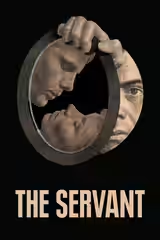
After What Ever Happened to Baby Jane?, try Sunset Boulevard (1950, Fi1m 91): The forgotten star in the shuttered mansion, done first and with more pity. Then The Servant (1963, Fi1m 89): Two people in one London house, and the power slowly changing hands; and Grey Gardens (1975, Fi1m 86): A real mother and daughter in a real decaying house; stranger than fiction.

Cast

Awards

Academy Awards, 1963

Nominated
Best Actress
Nominated
Best Cinematography, Black-and-White
Nominated
Best Sound
Nominated
Best Supporting Actor
Won
Best Costume Design, Black-and-White

If you liked this, try…

  1. Sunset Boulevard (1950, Fi1m 91)The forgotten star in the shuttered mansion, done first and with more pity.

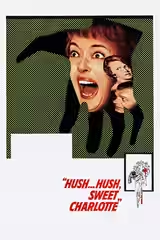
  2. Hush...Hush, Sweet Charlotte (1964) · not on Fi1m yetAldrich and Davis again, in the Deep South, with the gothic turned up.

  3. The Servant (1963, Fi1m 89)Two people in one London house, and the power slowly changing hands.

  4. Grey Gardens (1975, Fi1m 86)A real mother and daughter in a real decaying house; stranger than fiction.

  5. Misery (1990, Fi1m 83)A bed, a captor, a devoted fan; Kathy Bates carries the tray this time.