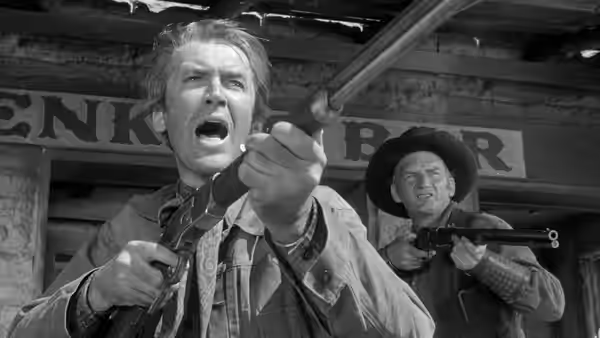
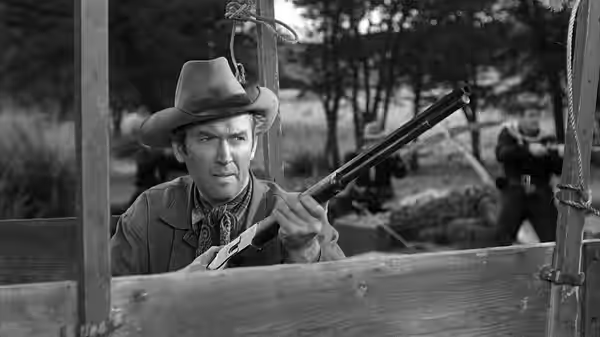
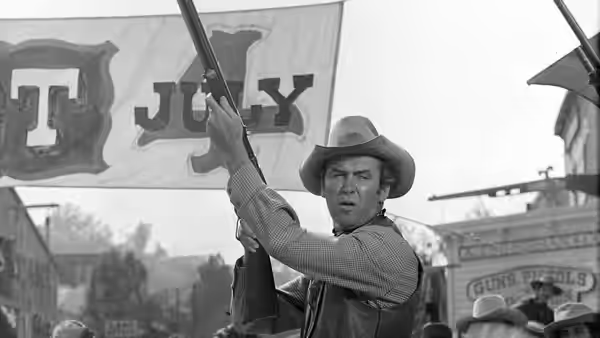
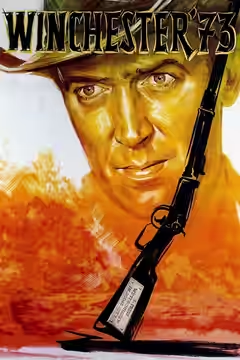
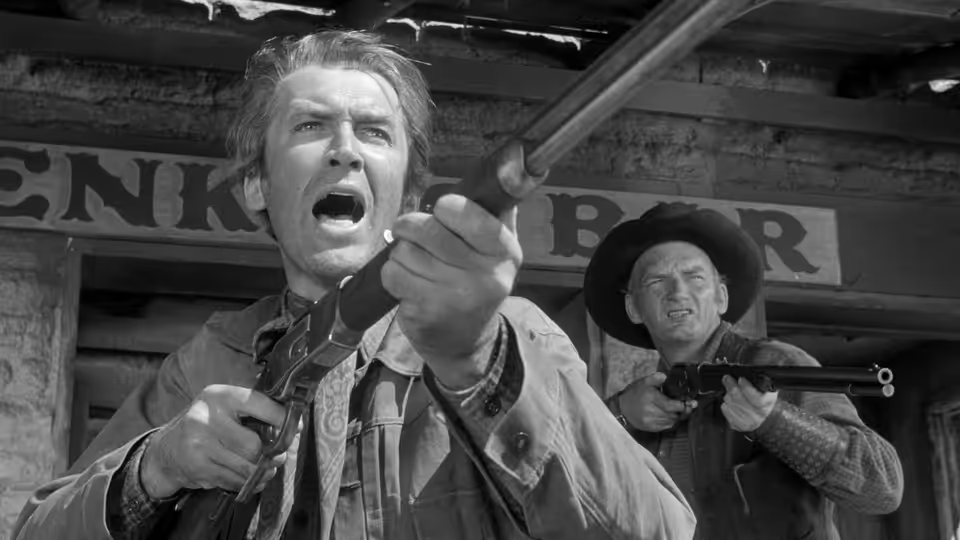
A man shouts while gripping a rifle as another aims from the storefront behind him
Film review

Winchester '73

1950 · Directed by Anthony Mann · 1h 32m

In a sentenceJames Stewart looks like the last person we would ask to settle an argument

Lin McAdam (James Stewart) pursues revenge across the frontier, accompanied by his loyal friend High Spade (Millard Mitchell). A Winchester rifle draws their pursuit into the lives of Dutch Henry Brown (Stephen McNally) and Lola Manners (Shelley Winters), with other people pulled into the violence surrounding the weapon. Lin wants to settle a personal grievance, but his anger does not account for every quarrel the gun attracts. The rifle passes between people with their own interests, widening a private pursuit into a series of confrontations across the West.

Fi1m review

Anthony Mann’s western is lean, forceful and sour about what men do for a gun. James Stewart gives it an unsettling anger, though the rifle’s travels sometimes make the supporting characters seem too conveniently arranged.

Winchester ‘73 is a tough, involving western, with one reservation: the rifle sometimes receives more attention than the people. Anthony Mann uses its destructive journey to take a revenge story beyond the concerns of a single man. We are invited to notice what possession of a gun encourages, and how readily people confuse being armed with being entitled to get their way. At 92 minutes, it makes that point without leaving much time for anyone to feel reassured.

James Stewart plays Lin McAdam with a concentration that makes revenge seem to have narrowed the man’s entire life. We found him unsettling. The sustained brooding does it: his anger prevents us from settling into the comfortable business of choosing a hero and waiting for him to prevail. There is little relief in the performance, and that severity gives the pursuit a weight that a more openly charming lead might have talked away.

Millard Mitchell matters because High Spade’s loyalty gives us some relief from all that concentration. He brings warmth to a film that could otherwise become a long demonstration of male grievance, and the friendship makes Lin McAdam’s severity easier to measure. It also leaves us wishing that more of the surrounding characters were as persuasive. The cast is strong, but the rifle’s itinerary can make a person seem important chiefly because the weapon has reached them.

William H. Daniels’s black-and-white photography gives the frontier a hardness that suits these people. The gun has enough weight on screen to justify the attention everyone pays it. Edward Curtiss’s editing keeps the travelling-gun structure legible, an important service when the story repeatedly moves away from its leading man. The pace is brisk without making the anger seem merely an excuse to reach the next confrontation.

Robert L. Richards and Borden Chase get considerable mileage from familiar western figures, but their screenplay is less convincing when the rifle starts to dictate too much. We begin to anticipate another example of what men will do for it, and some supporting players seem to have been allotted a turn before the story hurries on. That is the film’s chief limitation. Its bleak view of frontier conduct is persuasive, though the sense that everyone must help prove the same point becomes wearing.

The music credits include Frank Skinner and Hans J. Salter, and the accompaniment contributes dependable excitement. It is less distinctive than the acting or photography. We never need much help recognising the threat while James Stewart is there, and the music cannot supply that unease when our attention drifts towards the mechanics of the plot. His performance remains the reason to care about the pursuit.

This is still a western that understands the pleasure of watching a capable man handle a gun. It gives us enough excitement to keep its darker view of the characters from becoming a lecture. Come for the gunplay, but do not expect James Stewart to leave us feeling that everything is in safe hands.

Critical consensus AI synthesised

75
Positive
5
Mixed
2
Negative
0

Most critics respond warmly to Winchester ‘73, with praise centring on James Stewart’s concentrated intensity and the film’s treatment of revenge and violence. The reviews find a darker, more troubled presence in Stewart, supported by a strong cast and inventive handling of familiar Western characters. Anthony Mann’s approach draws praise for giving the frontier a bleak moral character, while the black-and-white camerawork and the warmth of Stewart’s friendship with Mitchell’s character also earn notice.

The recorded scores suggest a modest spread rather than a sharp division, with five positive assessments, two mixed and none negative. The reservations are harder to establish: the supplied New York Times and Time Out entries contain no accessible verdict to explain their lower scores. Among the substantive reviews, the differences concern emphasis, from performance and genre craft to the rifle’s destructive journey.

Empire
1 January 2000 · William Thomas
85*

Thomas calls the film an archetypal Western and an all-time favourite. He praises its strong cast and the characteristic Mann-Stewart elements of brooding, revenge and violence.

Read the full review →
Radio Times
★★★★ · Tony Sloman
80

Sloman calls it a fine, mature, intelligent western that creates a new persona for James Stewart. He praises its brilliant black-and-white camerawork and the film’s moral focus.

Read the full review →
Slant Magazine
10 January 2025 · ★★★★ · Jake Cole
80

Cole calls the film a touchstone of the western genre and praises the new 4K transfer. He also highlights the film’s bleak critique of frontier morality, embodied in the rifle’s destructive journey.

Read the full review →
The New Yorker
80*

The critic praises the film as a compelling Western held together by Stewart’s intensity. They single out his performance and Mann and Chase’s inventive use of familiar Western characters.

Read the full review →
Variety
31 December 1949 · Variety Staff
75*

The review is favorable, praising Stewart’s lean, concentrated portrayal. It also singles out the warmth Mitchell brings to his role as Stewart’s loyal friend.

Read the full review →
The New York Times
8 June 1950
64*

The supplied page does not expose the critic’s verdict. It provides no praise or complaint to identify.

Read the full review →

Straight answers AI written, from our review

Is Winchester '73 worth watching?
Winchester '73 is well worth watching for western fans who want forceful gunplay and an unsettling revenge story; we score it 81 out of 100. James Stewart’s sustained anger gives the pursuit its weight, though the rifle’s travels sometimes leave supporting characters looking as if they exist chiefly to pass it along.
How long is Winchester '73, and what is it rated?
Winchester '73 runs 1h 32m. It is a western film.
Where can I watch Winchester '73 in Chile?
Winchester '73 is not on any streaming or rental service in Chile at the moment. It is available in 10 other countries; change your country at the top of the page to see where. Availability is checked daily.
How does Winchester '73 compare to The Sisters Brothers?
Winchester '73 is the leaner, more forceful western, while The Sisters Brothers offers more kindness and humour in its story of killers poorly equipped for ordinary happiness. We recommend the former for a taut revenge story, despite its conveniently arranged supporting characters; the latter suits those who prefer warmth and oddity and can forgive a middle stretch that dawdles.
What should I watch after Winchester '73?
After Winchester '73, try The Naked Spur (1953, Fi1m 84): Another pursuit in which anger makes the supposed hero difficult company. Then The Sisters Brothers (2018, Fi1m 78): Two hired killers discover how poorly violence prepares them for ordinary happiness.

Cast

If you liked this, try…

  1. The Naked Spur (1953, Fi1m 84)Another pursuit in which anger makes the supposed hero difficult company.

  2. The Gunfighter (1950) · not on Fi1m yetA gunman’s reputation proves harder to escape than any pursuer.

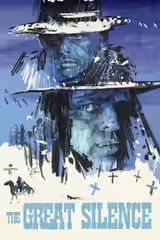
  3. The Great Silence (1968) · not on Fi1m yetFor a colder western that gives frontier brutality no comfortable excuses.

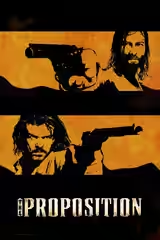
  4. The Proposition (2005) · not on Fi1m yetFamily loyalty and revenge make a grim business of the Australian frontier.

  5. The Sisters Brothers (2018, Fi1m 78)Two hired killers discover how poorly violence prepares them for ordinary happiness.

Winchester ‘73 (1950) review: A tough western with a troubling hero (Chile) | Fi1m