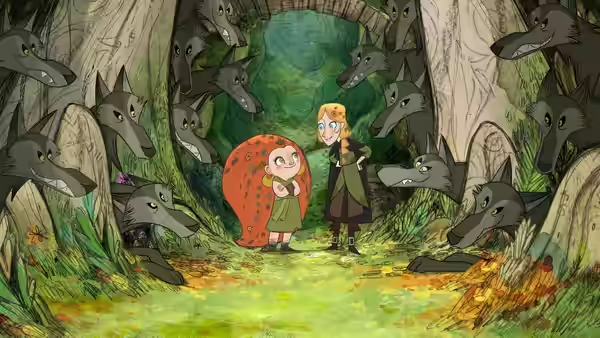
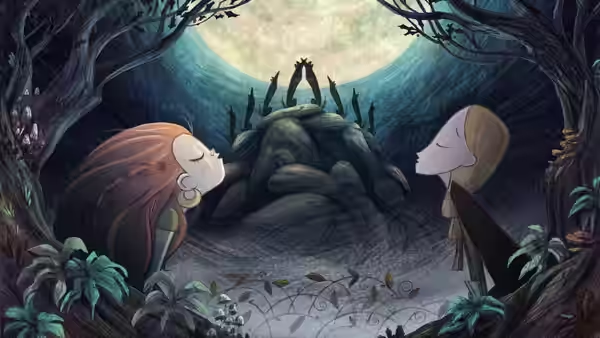
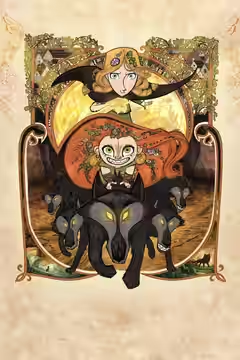
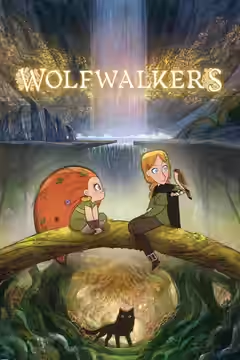
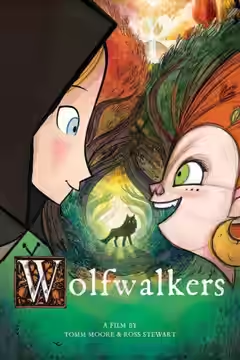
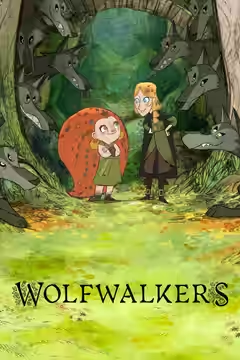
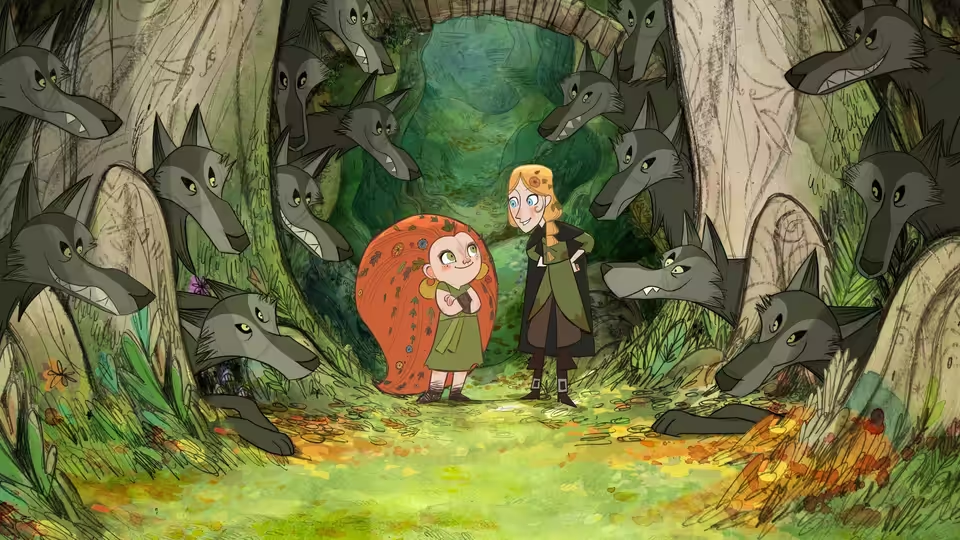
Mebh and Robyn stand among a watching pack of wolves in the forest
Film review

Wolfwalkers

2020 · Directed by Tomm Moore, Ross Stewart · 1h 42m · MTRCB G

In a sentenceA town drawn with a ruler, a forest drawn with a pencil that will not sit still, and two girls running between them

Kilkenny, 1650. The English have taken the town, the Lord Protector (Simon McBurney) has ordered the forest outside its walls cut down, and Bill Goodfellowe (Sean Bean), a hunter from England, has been brought over to kill the wolves in it. His daughter Robyn (Honor Kneafsey) wants to hunt beside him. He wants her indoors, scrubbing pots under the housekeeper Bridget (Nora Twomey). Robyn sneaks past the gate into the wood and meets Mebh Óg MacTíre (Eva Whittaker), a barefoot, red-haired girl who lives with the pack and is a wolfwalker: a girl awake, a wolf asleep. Mebh’s mother, Moll (Maria Doyle Kennedy), has gone missing. Before the two girls part, Mebh bites Robyn on the arm.

Plays from YouTube when you press play; nothing loads from them until then.

Fi1m review

Tomm Moore and Ross Stewart draw the town in hard lines and the wood in loose pencil, and it is the best-looking hand-drawn film we have seen in years. The villain is a stick figure and the story a familiar shape. We recommend it anyway.

Kilkenny, 1650. The English hold the town, the Lord Protector has ordered the forest cleared, and Bill Goodfellowe, a hunter brought over from England, has been given the job of killing every wolf in it. His daughter Robyn wants to go with him. He wants her in the scullery. Tomm Moore and Ross Stewart, working from a script by Will Collins, take that kitchen quarrel and grow it into a fable about who is allowed to be wild. It is the third film Cartoon Saloon has drawn from Irish folklore, after The Secret of Kells and Song of the Sea, and it is the best made of the three. We recommend it warmly, with the caveat that its villain is a stick figure and its story a shape you will know before the halfway mark.

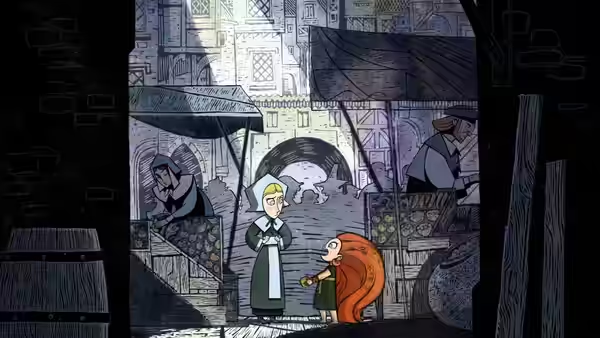
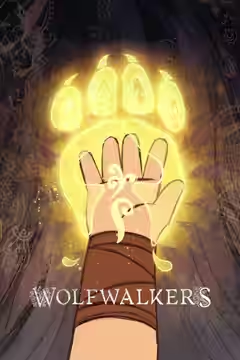
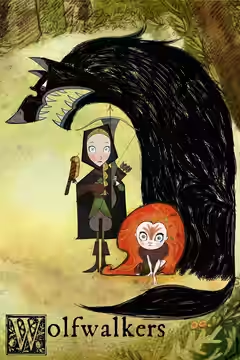
The first thing to say is how it looks, because the look is the argument. Moore, Stewart and Maria Pareja design the town as a woodcut: straight lines, right angles, grey stone, brown timber, every shot boxed in by walls, the townsfolk flat as figures on a playing card. The forest is drawn the other way round, in loose pencil with the construction lines left showing, curves everywhere, watercolour bleeding past the edges. Mebh’s hair is a red scribble that never quite stays on her head. When Robyn climbs over the wall the film loosens with her, and nobody has to say a word about freedom.

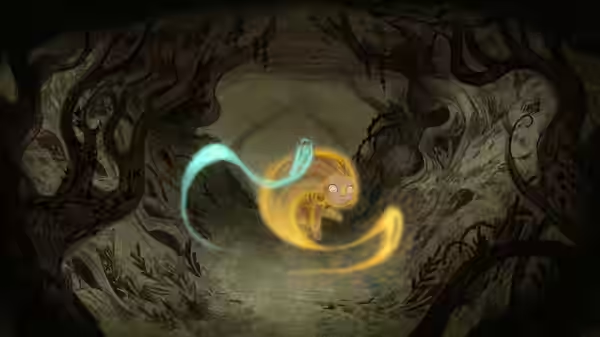
Then there is the running. When a wolf moves through the wood the picture goes to black and the world is redrawn in scent: glowing threads of colour trailing off rabbits and woodsmoke and frightened men, charcoal and light, the ground rushing past at nose height. We sat up. We have watched a great many animated forests and had never seen one drawn from the inside of a dog. Editors Richie Cody, Darren T. Holmes and Darragh Byrne split the screen into three and four panels when the girls run together, so you get the leap and the landing and the laugh at once, and for a minute or two it feels like being eight and out of breath. Bruno Coulais writes for whistle, drum and low voices, and has the sense to go quiet and let you hear paws on leaves.

The voices are well chosen. Honor Kneafsey plays Robyn as a careful, proper child who wants badly to be useful, and Eva Whittaker’s Mebh is all appetite and elbows; the film is funniest when she is eating. Sean Bean gives Bill a tired, low voice, a man doing a cruel job because he is frightened for his daughter and cannot say so. There is a scene between the two of them in the kitchen, Bill at his work and Robyn arguing, in which Bean says almost nothing and we were more moved than the scene had any right to make us. It was the pauses that did it. Tommy Tiernan and Jon Kenny fill the streets with grumbling; Maria Doyle Kennedy has less to do than she deserves, for a reason the story sets up early.

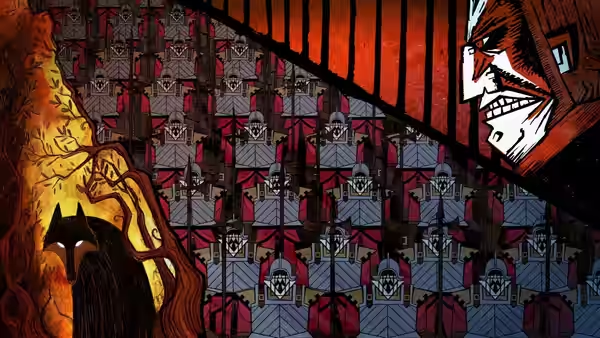
The weaknesses are mostly in the town. Simon McBurney’s Lord Protector is a murmur about the Lord’s will and a set jaw, and that is all Collins gives him. The politics are drawn with a thick marker: English straight lines bad, Irish curves good. That is a fair account of 1650, but a fable with a better villain would be a better fable, and this one could have used a man who believed he was right rather than a man who simply glowers. The story follows the path Song of the Sea wore in: a child with a secret that turns her into an animal, a parent who will not listen, a wild mother lost. The last movement has a siege and a stampede and ends with rather less blood than it has been promising, which is the right decision for a PG and a slightly soft one for a film about wolves.

We did not mind as much as we expected to. We were watching the lines. Set against its ancestors, it sits a long way below Princess Mononoke, which it clearly admires and which trusted its audience with a harder argument, and comfortably above most of what has been drawn by hand since. At 102 minutes it wastes little.

Watch it with a child if you have one to hand. If you do not, watch it anyway, and notice how long it takes before you stop seeing the pencil and start seeing the wood.

Critical consensus AI synthesised

87
Positive
20
Mixed
1
Negative
0

The reviews are close to unanimous: this is a Cartoon Saloon film that critics admire, and most admire it a great deal. The praise clusters on the hand-drawn animation, and on the way the film draws its two worlds differently, the oppressive town set against a vivid, living forest. Several critics single out the wolf’s-eye sequences and Mebh’s design, and the friendship between the two girls is often named as the thing that holds the story together. A number also credit the film with thematic weight, on nature, colonialism and belonging.

The spread is narrow and the reservations are small. Sight and Sound finds it hugely successful but not much of an advance on Moore’s earlier work, with thin adult characters and too little use of Robyn’s lupine vision. Slant thinks the ecological and religious ideas stay vague. HeyUGuys notes that a bloodless climax takes some edge off the peril. Nobody dislikes it.

Time Out
15 October 2020 · ★★★★★ · Phil de Semlyen
100

The review presents the film as a magical, clearly praised return from Cartoon Saloon. It singles out the film’s mythical magic as its appeal.

Read the full review →
Empire
26 October 2020 · John Nugent
95*

Nugent gives the film an enthusiastic verdict, calling it a treat and praising its extraordinary craft. He singles out the lush hand-drawn animation and visual storytelling as especially magical.

Read the full review →
Vulture
11 December 2020 · Bilge Ebiri
95*

Ebiri is deeply enthusiastic, calling the film glorious and profound. He especially praises how its hand-drawn textures and shifting visual styles express feelings beyond the dialogue.

Read the full review →
IndieWire
14 September 2020 · A- · David Ehrlich
90

Ehrlich calls it the year’s best animated film so far and Cartoon Saloon’s most poignant feature. He especially praises its richly detailed, expressive animation and how its visuals deepen the story’s themes of nature and colonialism.

Read the full review →
Los Angeles Times
13 November 2020 · Kevin Crust
90*

Crust finds “Wolfwalkers” enchanting, stirring entertainment with sophisticated themes and a modern perspective. He particularly praises the fluid, colorful animation and the contrast between the wolves’ vibrant forest and the oppressive town.

Read the full review →
Screen Daily
13 September 2020 · festival review · Allan Hunter
90*

The critic suggests the film is destined to become an instant classic. The standfirst singles out its role as the conclusion to Cartoon Saloon’s Irish folklore trilogy.

Read the full review →

Straight answers AI written, from our review

Is Wolfwalkers worth watching?
Wolfwalkers is worth watching for anyone who cares how a hand-drawn film looks, and we scored it 84. The town is drawn in hard woodcut lines and the forest in loose pencil, and the wolf-scent sequences are unlike anything we have seen in an animated wood. The villain is thin and the story a familiar shape, but we recommend it warmly, with or without a child beside you.
How long is Wolfwalkers, and what is it rated?
Wolfwalkers runs 1h 42m and is rated G by the MTRCB in the Philippines. It is an animation and family film.
Where can I watch Wolfwalkers in the Philippines?
Wolfwalkers is streaming on Apple TV in the Philippines. Availability is checked daily; the links above go straight to each service.
How does Wolfwalkers compare to Song of the Sea?
Wolfwalkers is the better-made film of the two, though Song of the Sea has the more openly aching story. Both come from Cartoon Saloon and both turn on a child who becomes an animal and a parent who will not listen, but the later film moves faster and wastes less. Choose Song of the Sea for grief and a selkie; choose Wolfwalkers for the drawing, and for the running.
What should I watch after Wolfwalkers?
After Wolfwalkers, try Song of the Sea (2014, Fi1m 82): The same studio, a selkie instead of a wolf, and the same watercolour ache. Then Princess Mononoke (1997, Fi1m 88): Miyazaki’s wolves and forest gods, drawn for grown-ups who were once frightened children; and Watership Down (1978, Fi1m 81): English fields, English cruelty, and animals who know exactly what men are for.

Cast

Awards

BAFTA Film Awards, 2022

Won
BAFTA's Children & Young People Award - Feature Film

European Film Academy Young Audience Award, 2021

Nominated
European Film Academy Young Audience Award

European Film Award for Best Animated Feature Film, 2021

Nominated
European Film Award for Best Animated Feature Film

Academy Awards, 2020

Nominated
Best Animated Feature

Critics' Choice Awards, 2020

Nominated
Best Animated Feature

If you liked this, try…

  1. Song of the Sea (2014, Fi1m 82)The same studio, a selkie instead of a wolf, and the same watercolour ache.

  2. Princess Mononoke (1997, Fi1m 88)Miyazaki’s wolves and forest gods, drawn for grown-ups who were once frightened children.

  3. Kirikou and the Sorceress (1998) · not on Fi1m yetMichel Ocelot’s flat, bright West African fable, as plainly told as a bedtime story.

  4. Watership Down (1978, Fi1m 81)English fields, English cruelty, and animals who know exactly what men are for.

  5. Ernest & Célestine (2012, Fi1m 84)A bear, a mouse, and a town of rules that deserve breaking, in soft pencil.