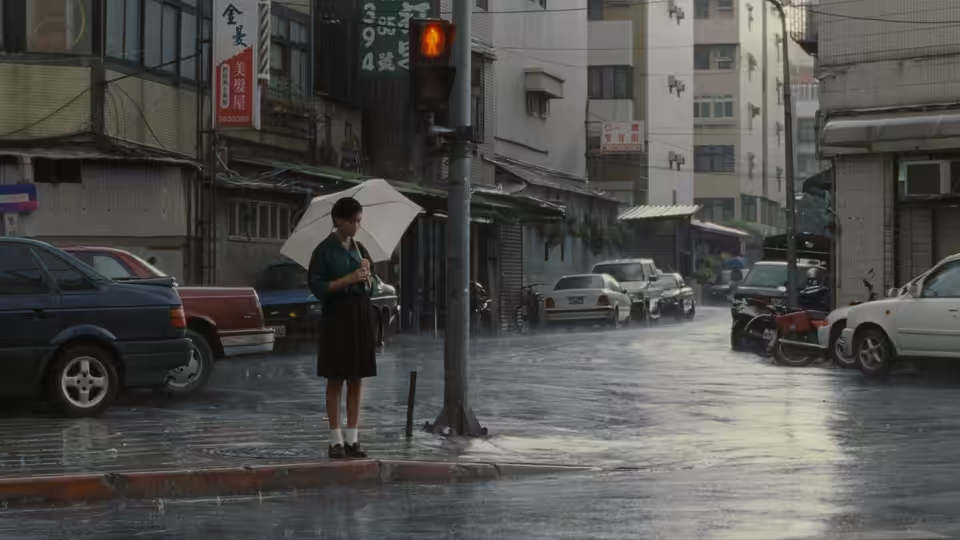
Ting-Ting stands beneath an umbrella at a rain-soaked city intersection
Film review

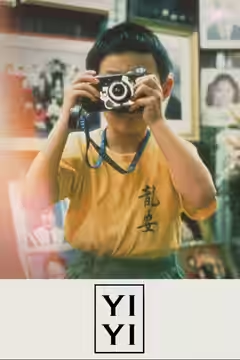
Yi Yi

2000 · Directed by Edward Yang · 2h 54m

In a sentenceNearly three hours with someone else’s family, and we still weren’t looking for an excuse to leave

NJ (Wu Nien-jen), Min-Min (Elaine Jin Yan-Ling), Ting-Ting (Kelly Lee) and Yang-Yang (Jonathan Chang) are at the centre of a family whose ordinary routines are being disrupted. Their private concerns sit alongside the lives of Mr. Ota (Issey Ogata), A-Di (Chen Hsi-sheng) and Sherry Chang-Breitner (Ko Su-yun). As circumstances change, each person confronts how little they understand about the others. The story moves between adults and younger characters, following the worries they carry separately and the ways they help one another see beyond their own experience.

Plays from YouTube when you press play; nothing loads from them until then.

Fi1m review

Edward Yang’s family drama earns its 174 minutes through patient performances and an unusual interest in everyone on screen. A few stretches feel overextended, but we recommend it even to viewers who normally avoid films this long.

We would recommend Yi Yi to someone who normally regards a 174-minute family drama as a threat to the evening. Edward Yang gives each person enough attention for us to become interested in worries that might sound unremarkable when recounted afterwards. The writing allows decency to be awkward, incomplete and sometimes insufficient; being fond of someone does not make it easy to understand them. That could become a rather improving experience, but the performances keep bringing us back to particular people.

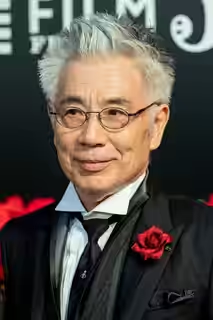
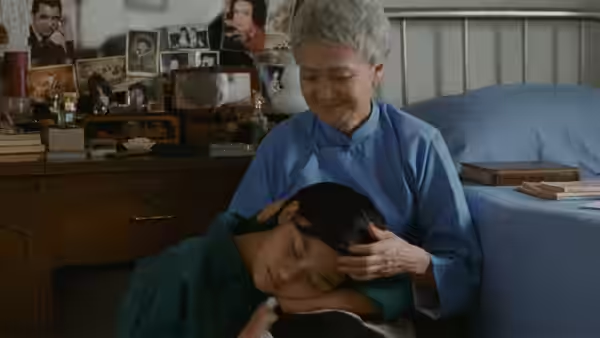
Wu Nien-jen is especially good as NJ, with a reserve that never feels like an actor withholding information for effect. We were moved by his hesitations: he makes the effort of deciding what to say feel as important as the words. Elaine Jin Yan-Ling gives Min-Min a comparable weight without making the two performances feel interchangeable. Both leave enough unspoken for us to watch their faces rather than wait for the next line.

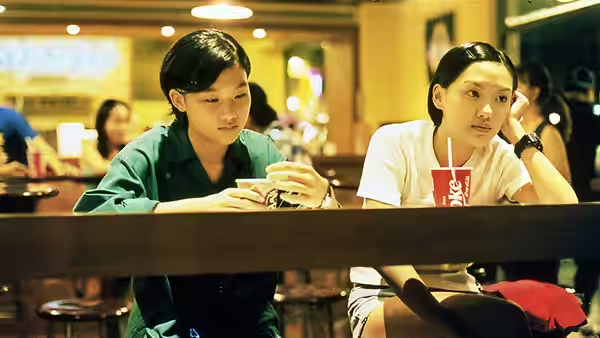
Kelly Lee as Ting-Ting and Jonathan Chang as Yang-Yang are just as necessary to the film’s success. Edward Yang takes their concerns seriously, and neither performance seems arranged simply to make the adults look foolish or wise. Jonathan Chang, in particular, has a directness that gives the film welcome lightness without asking for indulgence. Younger characters can become convenient illustrations of what their elders have forgotten; here we keep wanting to hear from them.

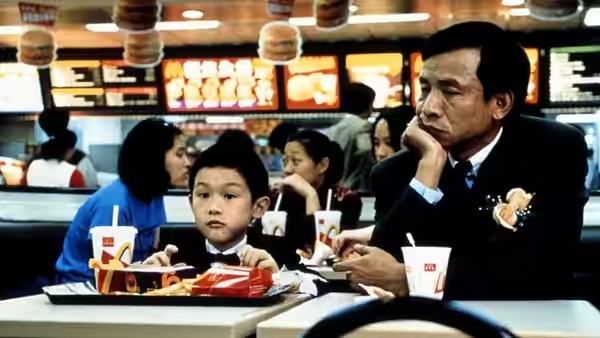
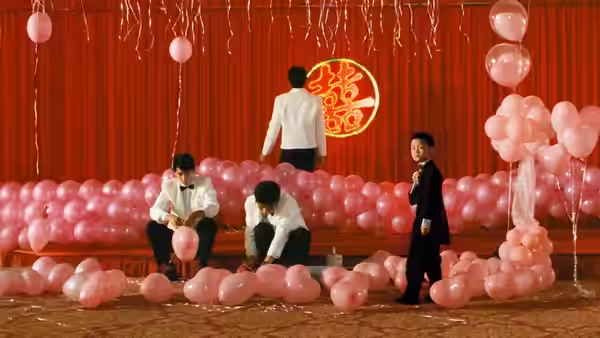
Yang Wei-han’s cinematography encourages us to look beyond the person who happens to be speaking. The clear backgrounds matter because our attention can settle elsewhere in the frame without losing its way. Kaili Peng’s production design supports that freedom: the surroundings remain interesting without competing with the actors for notice. The effect is quiet but useful, giving the people on screen room to seem absorbed in their own concerns.

Chen Po-Wen’s editing has the difficult job of making that freedom work across a whole family, and mostly succeeds. The shifts between characters let one person’s troubles remain in our minds while we spend time with another. Kaili Peng’s music is measured too, leaving the performances to establish how much a moment matters. These choices help the film sustain its length without requiring everyone to be equally interesting at every moment.

The generosity does have a cost. There are stretches when we would rather stay with a character than follow the next strand, and the return takes longer than we want. Edward Yang’s patience occasionally feels overextended, especially when an exchange has already told us enough to understand the hurt beneath it. At 174 minutes, the film asks for sustained concentration, and we cannot pretend that every passage earns an equal share.

Family dramas often hurry towards the scene in which everyone says what has been wrong all along. The pleasure here comes from watching people who remain difficult to sum up, even after we have spent so long with them. We become fond of them without feeling that the film has quietly removed their less agreeable qualities. Give it an evening when nobody needs to get up early.

Critical consensus AI synthesised

85
Positive
7
Mixed
2
Negative
0

Most critics respond warmly to Yi Yi, with praise clustering around Yang’s compassion and his attention to the family’s private emotional lives. The reviews repeatedly find tenderness, insight and a sense of connection between lonely people in its account of ordinary lives disrupted. Several emphasise the characters’ decency and individuality; Eye for Film also singles out the young actors’ performances. The prevailing view is of a carefully constructed family story whose quiet observations carry considerable feeling.

The recorded responses range from mixed to strongly positive, with seven positive reviews and none negative. The reservations are harder to establish: the two mixed entries lack accessible critical text, so no specific objection can fairly be assigned to them. Slant Magazine’s caveat concerns the modest improvements in a restored presentation rather than a weakness in the film, whose quiet profundity it praises. There is little documented disagreement about the filmmaking itself.

IndieWire
22 May 2020 · David Ehrlich
95*

Ehrlich presents the film as an enduring masterpiece that restores our ability to see the fullness of life. He especially praises Yang’s compassionate vision of how people help one another understand what they cannot see for themselves.

Read the full review →
Los Angeles Times
20 March 2011 · Dennis Lim
95*

Lim calls the film a remarkably delicate, assured work that has held up exceptionally well. He singles out its tenderness and empathy, especially in the way it connects its lonely characters to a wider human world.

Read the full review →
The AV Club
14 May 2000 · Scott Tobias
95*

Tobias calls the film an intimate masterpiece and a pointillist classic. He particularly praises Yang’s delicate, insightful portrayal of the family’s private emotional lives.

Read the full review →
The Guardian
8 April 2001 · Philip French
90*

French calls the film Yang’s best and most accessible, and says it deserves a wide audience. He particularly praises its deep humanism and the decency of its characters.

Read the full review →
Time Out
15 March 2012
90*

The visible description presents Yang’s film as a masterpiece. It singles out the family’s revelations as circumstances disrupt their ordinary lives.

Read the full review →
Slant Magazine
11 January 2026 · ★★★★ · Ed Gonzalez
80

The review praises the Criterion release’s transfer as a fitting complement to the film’s quiet profundity. It singles out the added sharpness in deep-focus backgrounds and stronger reds and greens, while noting that the improvements over the 2011 release are modest.

Read the full review →

Straight answers AI written, from our review

Is Yi Yi worth watching?
Yi Yi is worth watching for its patient performances and close attention to family life, and we score it 92 out of 100. A few stretches feel overextended, but we recommend it even to viewers who normally avoid long dramas: its 174 minutes give adults and children room to become people we care about.
How long is Yi Yi, and what is it rated?
Yi Yi runs 2h 54m. It is a drama film.
Where can I watch Yi Yi in Australia?
Yi Yi is not on any streaming or rental service in Australia at the moment. It is available in 8 other countries; change your country at the top of the page to see where. Availability is checked daily.
How does Yi Yi compare to Tokyo Story?
Yi Yi takes a patient interest in each family member’s separate worries, while Tokyo Story makes ordinary neglect painfully affecting without turning anyone into a villain. We recommend both, favouring Yi Yi for its attention to adults and younger characters alike, and Tokyo Story for its handling of neglect. Both ask for patience; Yi Yi occasionally lets an exchange run too long.
What should I watch after Yi Yi?
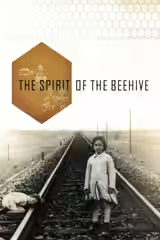
After Yi Yi, try Tokyo Story (1953, Fi1m 92): Another family whose smallest courtesies reveal how far apart they have drifted. Then A Separation (2011, Fi1m 93): For another patient account of decent people making decisions that hurt each other; and The Spirit of the Beehive (1973, Fi1m 87): A child’s curiosity receives the same serious attention as the adults’ hidden troubles.

Cast

Awards

European Film Award for Best Non-European Film, 2000

Nominated
European Film Award for Best Non-European Film

If you liked this, try…

  1. Tokyo Story (1953, Fi1m 92)Another family whose smallest courtesies reveal how far apart they have drifted.

  2. Still Walking (2008) · not on Fi1m yetFamily grievances surface through meals, routine and the things nobody quite says aloud.

  3. A Separation (2011, Fi1m 93)For another patient account of decent people making decisions that hurt each other.

  4. The Spirit of the Beehive (1973, Fi1m 87)A child’s curiosity receives the same serious attention as the adults’ hidden troubles.

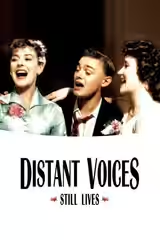
  5. Distant Voices, Still Lives (1988, Fi1m 90)Family memories accumulate through songs, rooms and gestures, with tenderness and pain intact.