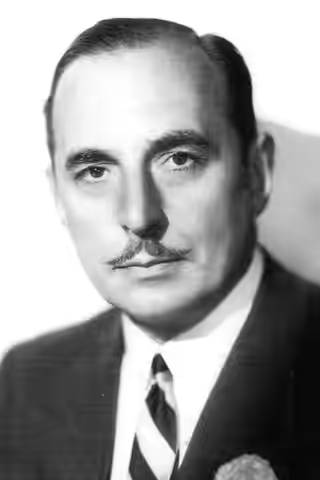
Douglass Dumbrille spent his career playing the well-dressed man you should not trust: crooked lawyers, politicians and sheriffs, with a fine voice and arrogant profile. In The Lives of a Bengal Lancer the manners make the cruelty tidier; that is the one to see.
Fi1m perspective
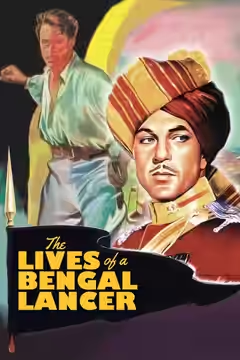
In The Lives of a Bengal Lancer (1935), Mohammed Khan tells his prisoners he has ways of making men talk, and Douglass Dumbrille says it without raising his voice. Khan has an English education and perfect manners, and the film uses both to make his cruelty tidier. Dumbrille understood that. The threat is not in the words; it is in how comfortable he is saying them.
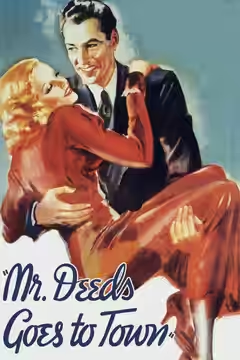
That was the job for most of his career. He had been a bank clerk before the stage, then stock companies and Broadway in 1924, and when he settled in Hollywood in the early 1930s the studios looked at the profile and the voice and cast him as the man in the good suit who was up to something: politicians, businessmen, lawyers, sheriffs, nearly all of them crooked. He made more than 200 films that way. For Frank Capra he was John Cedar, the corrupt lawyer in Mr. Deeds Goes to Town (1936); for the Marx Brothers he was Morgan in A Day at the Races (1937), the pompous man whose dignity is there to be knocked over. Later came Lepidus in Julius Caesar (1953) and Jannes, the priest and magician, in Cecil B. DeMille's The Ten Commandments (1956), one of three films he made with DeMille, and television work that ran into 1966.
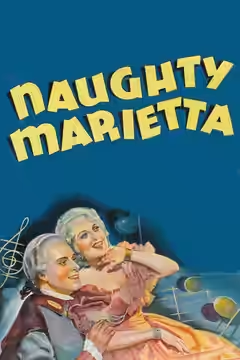
What he brought to these parts was a coldness that did not need underlining. In Naughty Marietta (1935), a creaky costume romance, he plays Marietta's uncle, the Prince de Namours de la Bonfain, and makes him properly cold while Frank Morgan flutters and Elsa Lanchester is a terror at dinner; between them the character players supply the wit the leads cannot. It is a small part and he does not inflate it. The limitation is that the studios seldom asked for more than the profile and the diction, and he seldom insisted. In comedy that becomes a virtue. A villain who is also faintly ridiculous, menace and pomposity in one man, is exactly what a Marx Brothers picture needs to push against.
Khan is the performance to see, and it is also the one that troubled us. We were more bothered by Bengal Lancer than we expected to be, and not by the brown make-up, which he shares with every tribesman in the film. It is that Dumbrille gives Khan wit and schooling and the script cannot imagine him wanting anything except the rifles. He plays a man; the film only needed an obstacle. That is the film's fault, not his, but it clings to the performance all the same.
Start with Bengal Lancer, for Cooper and Tone, and watch what Dumbrille does in the scenes he is allowed. Then try A Day at the Races, where the same manner is pointed at the Marx Brothers and comes back as pomposity. He was hired for thirty years to be distrusted on sight, and he made it look like good manners.
Biography
Douglass Rupert Dumbrille (1889–1974) was a Canadian actor. Born in Hamilton, Ontario, he worked as a bank clerk before entering the theatre. He appeared in a 1913 film and made his Broadway debut in 1924, supplementing his income with various sales jobs while working intermittently in stock companies and on tour.
During the Great Depression he moved to Hollywood, where he specialised in supporting character roles. He appeared in more than 200 films, including The Lives of a Bengal Lancer (1935) as Mohammed Khan and Naughty Marietta (1935) as the uncle of the title character. He later made numerous television appearances in the 1950s and 1960s.