Nicolas Roeg makes memory interrupt the present, often before we understand what we have seen. We rate him highly: in Don't Look Now, the fractured storytelling makes a grieving marriage painfully immediate.
Fi1m perspective
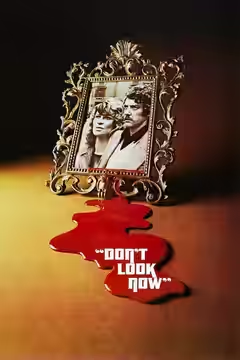
In Don't Look Now (1973), a fragment catches the eye before its place in the story becomes clear. Roeg and editor Graeme Clifford keep a remembered image close to what is happening now, denying us the comfort of leaving it in the past. We were shaken by the opening drowning because the cutting makes a family tragedy horribly difficult to take in. The shifts in time ask us to pay attention, but the parents' grief is never hard to recognise.
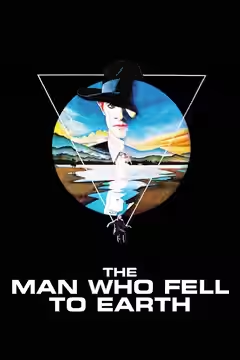
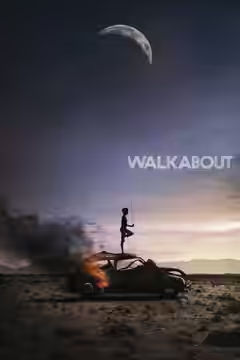
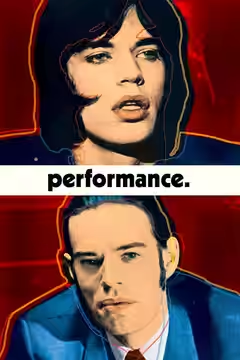
He came to directing after working as a cinematographer on films including Fahrenheit 451 (1966) and Petulia (1968). Performance (1970), co-directed with Donald Cammell, began his exploration of identity and fractured storytelling; Walkabout (1971), his first solo feature, took his interest in people out of place into the Australian outback. With David Bowie in The Man Who Fell to Earth (1976), the outsider became a science-fiction figure, and the leaps through time continued. Bad Timing (1980) applied non-linear storytelling to a destructive relationship, though its difficulty also became a point of criticism.
In Don't Look Now, Donald Sutherland and Julie Christie make John and Laura Baxter's marriage convincing enough that we want time with them, not just answers about what is happening. They are in Venice after their young daughter's death, and the possibility of contact with her disturbs an already grieving couple. Roeg allows their sorrow time without hurrying it into the next supernatural incident. Clifford's cutting suggests how little control they have over which images enter their thoughts. The fear hurts because these are people whose loss would matter even without a mystery attached.
His later films, including Eureka (1983) and Insignificance (1985), drew more mixed responses, and we would not defend every complication as necessary. Even Don't Look Now occasionally labours its warnings, drawing attention to signs when we are already alert to them. At those moments, Roeg risks distracting us from the performances that make the danger matter. Yet this is the film we would recommend first, with enough quiet to follow its sudden shifts. Leave time to talk afterwards.
Biography
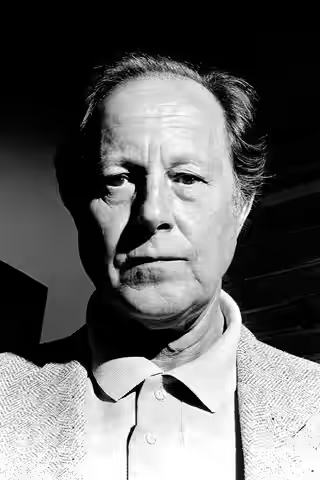
Nicolas Roeg was an English film director and cinematographer. Born in London on 15 August 1928, he died on 23 November 2018.
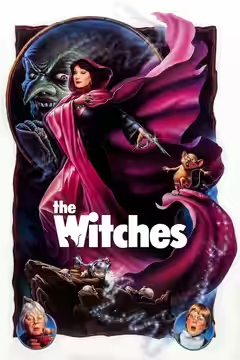
He entered the film industry in 1947 as an editing apprentice and later worked as a cinematographer on films including Fahrenheit 451 (1966) and Far from the Madding Crowd (1967). His directorial debut was the co-directed Performance (1970). Roeg directed Walkabout (1971), Don't Look Now (1973), The Man Who Fell to Earth (1976), Bad Timing (1980) and The Witches (1990), among others. He frequently used fragmented editing and non-linear narratives.