Series review

Amadeus

2025 · Directed by Julian Farino, Alice Seabright · Series

In a sentencePaul Bettany makes Mozart’s talent seem a terrible thing to inflict on a colleague

Drama

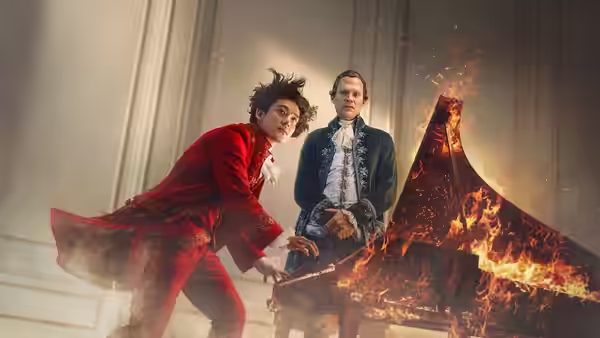
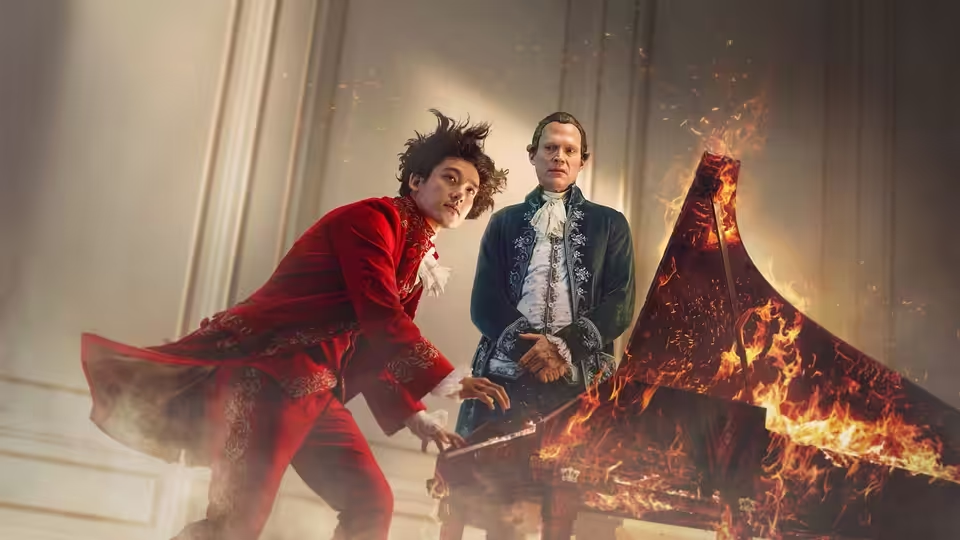
Wolfgang Amadeus Mozart (Will Sharpe) and Antonio Salieri (Paul Bettany) are composers caught in a rivalry that reaches into their beliefs and personal relationships. Salieri recognises Mozart’s musical gift and struggles with what it means for his own ambitions and faith. Mozart faces pressures of his own, while Constanze Weber (Gabrielle Creevy) has to reckon with the personal costs of life alongside him. Across five episodes, admiration turns to resentment as the two men contend with talent, status and each other. Jonathan Aris plays Leopold Mozart, and Rory Kinnear appears as Emperor Joseph.

Plays from YouTube when you press play; nothing loads from them until then.

Fi1m review

Amadeus is worth watching for Paul Bettany and Gabrielle Creevy, who make artistic jealousy and its consequences hurt. Five episodes give them room, but also leave the central rivalry repeating itself when the music should take over.

Amadeus finds its strongest subject in Salieri: a composer who can hear precisely how far another man’s abilities exceed his own. That is a cruel predicament, and this five-part series is worth watching for Paul Bettany’s handling of it, with Gabrielle Creevy making Constanze worth following in her own right. Directors Alice Seabright and Julian Farino allow the performers plenty of space. Across five episodes, however, the exchanges between the composers begin to repeat themselves.

Bettany makes Salieri’s admiration as important as his resentment. His distress is convincing because he understands what he is hearing; the music gives him another reason to question the value of his own work and his belief in God. We found his torment unexpectedly upsetting, particularly the shame that accompanies his recognition of Mozart’s gift. Bettany keeps that shame present in the tense exchanges with Mozart, so there is something painful happening even when the men are simply discussing their work.

Will Sharpe’s Mozart is an effective partner for this, though the series is less persuasive about what makes him exceptional. Sharpe gives him emotional complications and an abrasive presence that prevent the part becoming merely a display of charm. The confrontations have energy, and neither actor seems to be waiting politely for his next speech. Yet when the programme asks us to believe in Mozart’s genius, it too often relies on the strength of Salieri’s reaction.

Creevy benefits most from the longer telling. Constanze has enough of a life here for the consequences of the men’s behaviour to matter beyond their quarrel, and Creevy makes that additional attention feel necessary. Her performance gives the series someone worth following even when the rivalry has begun to wear thin. The expanded attention to Constanze brings personal suffering into a story that can otherwise become absorbed in professional complaints.

Morgan Kennedy’s production design gives the series a richness that suits its theatrical manner, though the lavish surroundings sometimes distract from the conflict. Seabright and Farino are more successful when the performances command attention without competing with that display. The music is a greater frustration: Bryce Dessner’s contribution belongs to a programme that gives too little time to listening. Mozart’s work needs room to affect us before another conversation tells us how much it matters.

The comparison with the 1984 film is unavoidable, and five episodes give this version more time than it always knows how to use. Once Salieri’s jealousy is established, further exchanges can confirm what the actors have already made clear. Constanze’s fuller story is the strongest reason for taking the longer route, and the performances keep it worth following. For anyone drawn to dramas about artistic ambition, this is a good, uneven addition. If the music is your chief reason for watching, expect to spend a fair amount of time waiting for the conversation to stop.

Critical consensus AI synthesised

66
Positive
4
Mixed
1
Negative
1

Most critics find Amadeus a worthwhile reworking of the familiar rivalry, though the spread runs from enthusiastic praise to outright dismissal. Praise centres on the performances, particularly Paul Bettany’s tormented Salieri, and on the extra space given to relationships, personal tragedy and Gabrielle Creevy’s Constanze. Supporters find substance in its treatment of jealousy, faith and the burden of genius, rather than simply another retelling.

Reservations concern whether the longer format earns its length and whether theatrical spectacle comes at the expense of depth. Variety admires Bettany and the production design but finds that five episodes dilute the tension, with too little use of the music. The Guardian is the sharpest dissenter, finding the scenes lifeless and Will Sharpe’s Mozart thin; Digital Spy, by contrast, praises his emotional complexity. The central divide is over whether expansion deepens the story or makes its rivalry less compelling.

Vulture
11 May 2026
85*

The critic calls the miniseries captivating and anachronistic, praising how it reconfigures the rivalry to explore deeper themes of genius as an existential burden, inferiority, and power dynamics. It singles out Bettany’s incredible, tormented Salieri as shaping the series’ rumination on ambition and faith.

Read the full review →
Radio Times
15 December 2025 · James Hibbs
80*

The series succeeds as a companion piece to the classic film by expanding on characters and adding depth to relationships and personal tragedies, particularly Constanze's story. It features strong performances from the leads and offers a gritty, complex take that justifies its existence despite the formidable legacy of the source material.

Read the full review →
The AV Club
6 May 2026 · B · Caroline Siede
77

The critic finds Barton’s adaptation frequently compelling and occasionally riveting, though never quite essential viewing. It singles out the strong performances, especially Gabrielle Creevy’s Constanze, and the grounded, earthier take on the rivalry with added historical realism and stakes.

Read the full review →
The Guardian
21 December 2025
20*

The series is a pale, petty version of the 1984 film, with flat, airless and banal scenes that reduce the original's themes of envy and genius to lesser forms. The performances, especially Will Sharpe's thin take on Mozart, fail to match the source material's wit and depth.

Read the full review →
The Hollywood Reporter
7 May 2026 · Angie Han

The adaptation understands the maddening failure to capture true genius and delivers a thrilling exploration of jealousy and rivalry through strong performances, especially Bettany's Salieri. It makes the familiar story feel complete in its own right while highlighting the limits of sublime art in everyday life.

Read the full review →
The Times
21 December 2025 · ★★★★☆ · Carol Midgley

The reimagining is vivacious and vicious, chronicling Salieri’s jealousy with superbly charismatic performances from Will Sharpe and Paul Bettany that make it a Christmas treat.

Read the full review →

Cast

Stills

If you liked this, try…

Topsy-Turvy poster

Topsy-Turvy

1999 · For the rehearsal-room labour and petty grievances behind an evening of music.

The Disciple poster

The Disciple

2020 · Another musician measures himself against greatness, and finds devotion insufficient.

Tous les matins du monde poster

Tous les matins du monde

1991 · For music, grief and the strain of learning from a difficult master.

The Duellists poster

The Duellists

1977 · For a rivalry that outlives every sensible reason to keep it going.

Shine poster

Shine

1996 · For a pianist whose gifts do little to protect him from pressure.