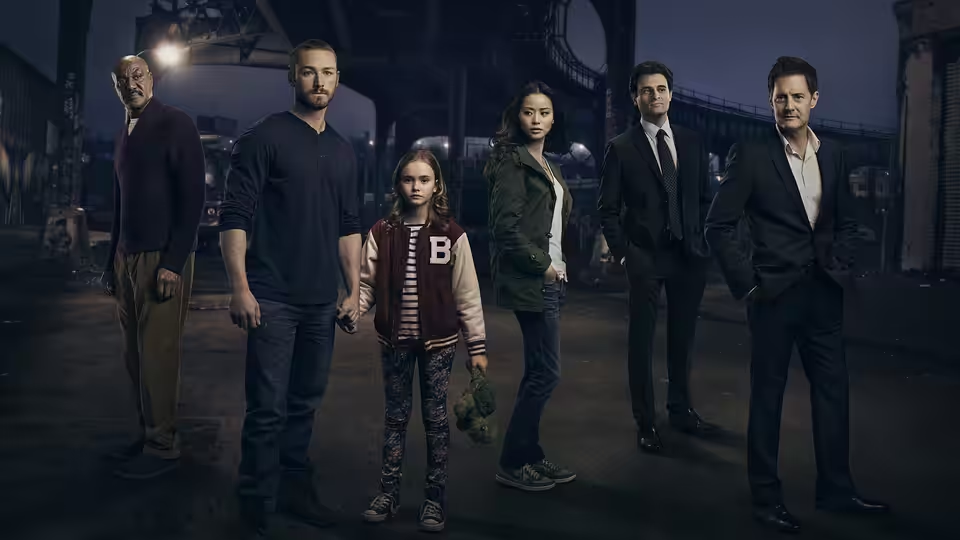
Alfonso Cuarón directs a pilot that opens like a film and settles within the hour into a chase anybody could run. Sequoyah and Lindo are worth watching; the thirteen episodes around them are not, and a series about wonder should not be this easy to predict.
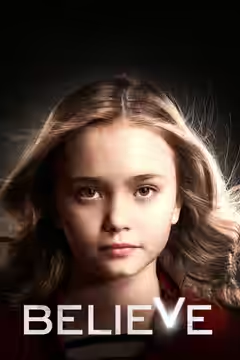
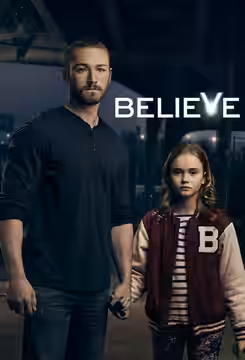
Believe was created by Mark Friedman and Alfonso Cuarón, and Cuarón directs the first episode. Its opening minutes are the best argument the whole 13-episode run ever makes for itself. A car leaves a road at night, and the camera stays with it as it rolls, then stays with the girl as she climbs out of the wreck, then stays with the men who come for her, all in one long take that has been planned down to the water on the windscreen. It is a piece of staging that would be impressive in a cinema. On television, in a series that first aired on 10 March 2014, it is a promise the rest of the show cannot keep.
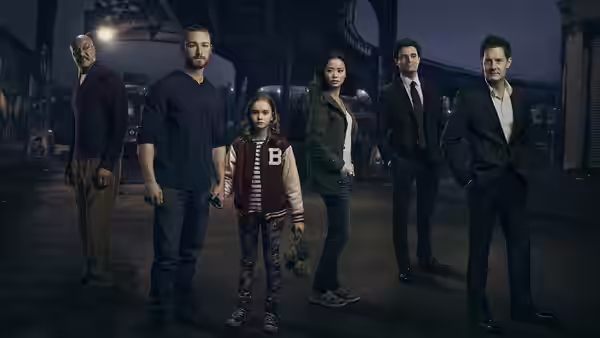
The premise is a decent one and the show knows it. Bo (Johnny Sequoyah) can do things nobody can explain, and rather than build a weapon the writing builds a moral: she is drawn each week to a stranger in trouble and made to do them some good. Kindness as a superpower is a rare idea for a chase drama, and Sequoyah plays it without a trace of the knowing, adult-shaped child that usually gets cast in these parts. She is watchful, stubborn and occasionally very funny, and when the writing gives her something to look at rather than something to say, she carries the frame.
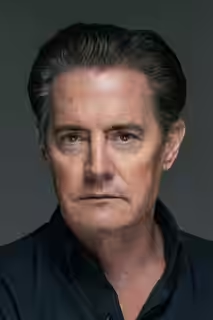
Delroy Lindo and Kyle MacLachlan are the other reasons to stay. Lindo plays Milton Winter as a man who has done things he regrets and has decided to spend what is left of him on this one girl, and he does it with almost no raised voices. MacLachlan gives Roman Skouras a soft, reasonable manner that is far more unsettling than the standard villainy the part could have been. Steven Price scores it with low strings and long held notes, and he has the sense to go quiet whenever Bo does something impossible, which is the right instinct.
For those first ten minutes we sat up. For most of the twelve episodes that followed we did not, and somewhere around the fourth episode we were bored, and then annoyed at being bored, because a series about a child who can make grown men weep with a look ought to be able to hold our attention past the adverts. The reason is the shape of each week: Bo senses a stranger, the stranger is helped, Skouras’s people arrive a scene too late, Tate and Bo argue in a borrowed car, and Channing (Jamie Chung) tells them where to go next. The pattern is set by the second episode and never once broken.
The centre does not hold either. Jake McLaughlin plays Tate as a scowl with a jacket, a hard man softened one notch per episode, and the show needs us to enjoy watching him and Bo fail to get on. We did not. The lines they are given are the lines any such pair would be given, and McLaughlin delivers them as if he had been told to save something for later. Kerry Condon’s Dr. Zoe Boyle is asked to look troubled at monitors, which she does well and to no purpose. Eleven other directors take episodes after Cuarón, and ten writers are credited, and the result looks and sounds like a show made by a rota.
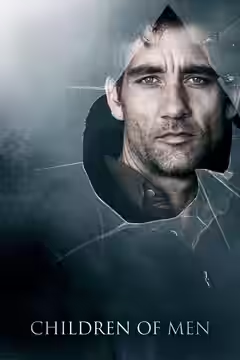
Cuarón’s own Children of Men, from 2006, was also about a hard man handed a vulnerable stranger he did not ask to protect, and it found the whole of the man’s life in the way he carried her. Believe has the same idea, at 43 minutes a week, and finds only the carrying. Against the run of supernatural-chase television it sits in the middle: better cast than most, more decent in its intentions than nearly all, and no more surprising than any.
Watch the pilot, which is a real piece of work and stands on its own. Whether you go on from there depends on how much you want to see Sequoyah and Lindo in a series that never gives them a second week as good as the first.