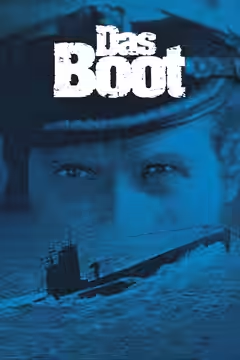
Wolfgang Petersen’s six-hour television cut of his submarine story is the one to watch. The boredom is long and the terror is longer, and Jürgen Prochnow’s captain holds it together with a look. Only the episode breaks work against it.
There is a 1981 feature film called Das Boot, directed by Wolfgang Petersen. This is the other version, six episodes of 52 minutes made for television by the same director, and it is better. The film is a very good two and a half hours about a U-boat. The series is six hours in which you live on the thing, and the difference is not one of degree. By the fourth episode we could have told you where every man slept.
The story, from a screenplay by Petersen, Lothar-Günther Buchheim and Dean Riesner, is deliberately thin. A boat leaves port. It looks for convoys. Mostly it does not find them. When it does, the hunt is short and the aftermath is long. Petersen is not interested in the war as strategy and barely interested in it as politics; the one true believer aboard, Hubertus Bengsch’s First Watch Officer, is treated by everyone else as a man with an embarrassing hobby. What Petersen cares about is forty-odd men in a space the size of a railway carriage, and what happens to their faces over three months.
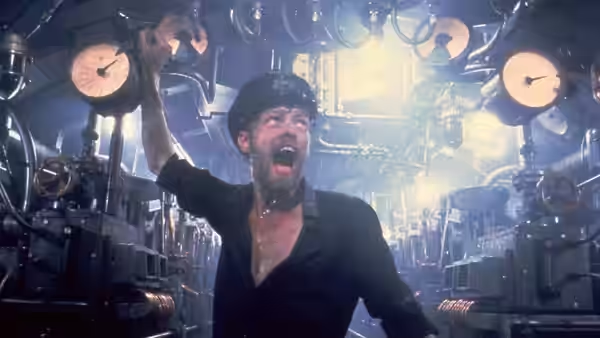
Jost Vacano’s camera is the reason it works. He shoots the boat from inside, at the height of a man’s shoulders, and when the alarm sounds he runs with the crew the length of the hull, through hatch after hatch, with the lens ducking at each one. We have never seen a confined space photographed so that you feel the confinement in your knees. The light is whatever the boat gives him: bare bulbs in the day, red emergency lamps when they dive, and in the control room during an attack the faces are lit from below by the instruments and nothing else. Hannes Nikel’s editing follows the same rule. In the depth-charge sequences he does not cut faster to make us frightened. He holds on men waiting, and cuts to the next man waiting, and lets the sound do the rest.
The sound is what got us. Not the explosions, which are loud and over quickly, but the hull afterwards, groaning as the pressure finds it, and the rivets that go off like gunshots, and the ping of the destroyer’s sonar coming back every few seconds while nobody is allowed to speak. We were frightened in a way that had nothing to do with suspense. We knew these men could not simply get out, and after an hour of it neither could we.
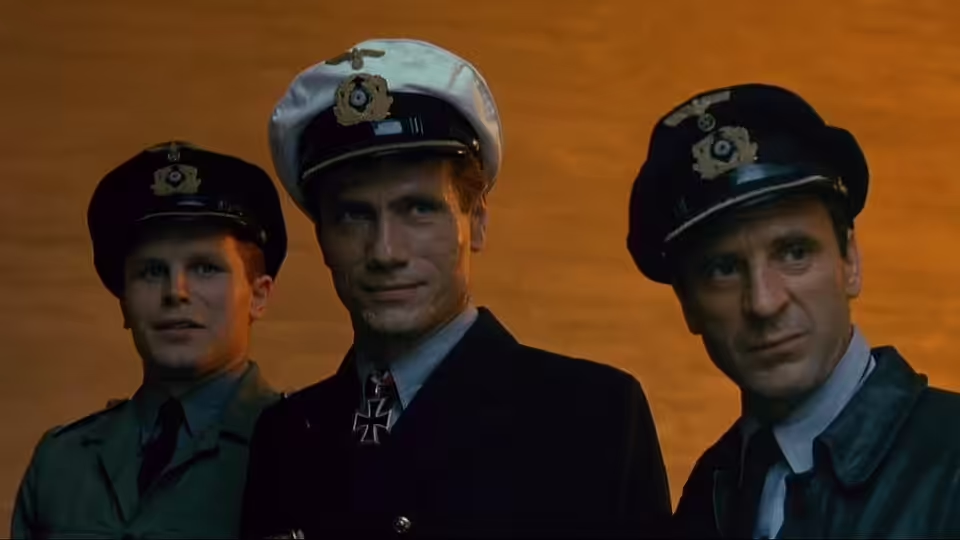
Jürgen Prochnow plays the captain as a man who has already seen how this ends and has decided to be competent anyway. He has a beard and a white cap and he is very still, and the two or three times the stillness breaks are the loudest moments in the series. Klaus Wennemann’s Chief Engineer is the performance we kept watching, a thin, decent man slowly coming apart at the seams who has to be the one who keeps the boat alive. Erwin Leder’s Johann, the chief machinist, gets the scene everybody remembers from the film and here it has more room to hurt. Herbert Grönemeyer’s Werner is the problem, or rather the device. He is our way in, and the series treats him as a camera with a notebook; he observes a great deal and is given very little of his own.
The length is both the argument and the cost. The slow stretches, men reading, mending, listening to gramophone records, a birthday celebrated with a cake nobody wants, are what make the attacks matter, and we felt the boredom properly and then felt it turn into dread. But the material was shot as one film and the episode breaks fall where the hour ends rather than where the story does. Twice an instalment stops with the boat in the middle of something, and the recap at the top of the next one undoes the air you were holding. Watch two at a time and the joins stop showing.
The second half goes somewhere we will not describe, except to say that it is the point at which the men stop fearing the enemy and start fearing the sea, and that Petersen trusts silence here more than most directors ever do.
It was first shown in Britain on 24 February 1985. It is grimy in a way that gets into your clothes. Clear an evening, or two, and do not plan on sleeping easily.