A seven-hour hijack told in real time, and for its first half as tense as the setup promises. Idris Elba holds the cabin together by sheer calm; the writers hold the ground together with much less, and the last two episodes strain credit.
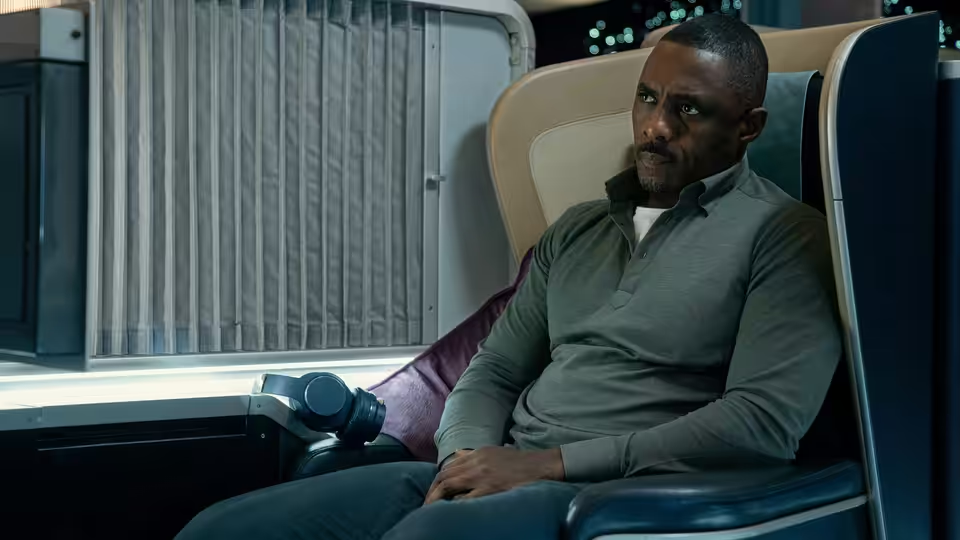
Hijack has one idea and it is a good one. A flight from Dubai to London takes about seven hours; the series runs seven episodes, each covering one hour of it, so the clock on screen and the clock on your wall move at the same speed. George Kay and Jim Field Smith, who created it, put Idris Elba in business class as Sam Nelson, a man who negotiates company buyouts for a living and decides, when the guns come out, that a cabin full of frightened people is a deal like any other. For about three and a half hours this works. Then the ground takes over, and the ground is where the series goes to be ordinary.
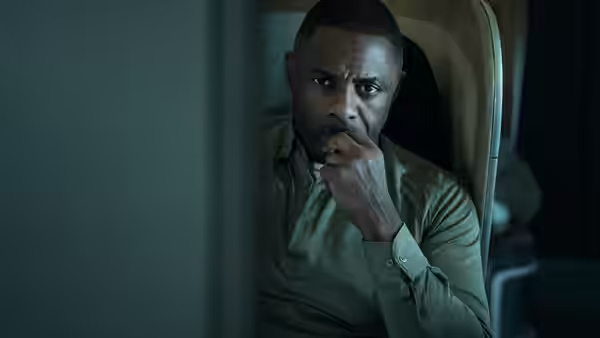
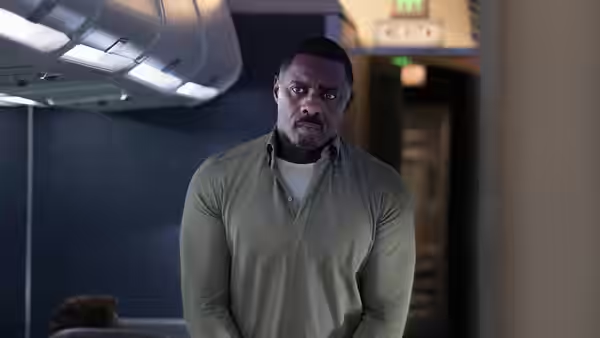
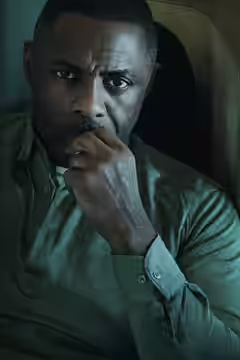
Elba is the reason to watch and the reason the first half holds. He plays Sam as a man who has never raised his voice in a meeting and is not going to start now, talking to Neil Maskell’s Stuart Atterton in the low, reasonable tone of someone offering a slightly better price. Maskell gives Atterton a tired, working man’s menace, a hijacker who looks as though he would rather be at home, and their exchanges in the galley are the best written stretches of the series. Nobody shouts, and Elba can do a great deal with a glance down an aisle.
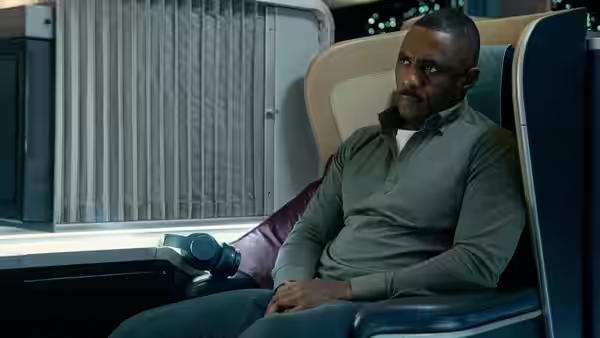
Andrew Purcell’s cabin is a long narrow space of pale seats and the flat, even light of cruising altitude, and Ed Moore shoots it mostly from seated height, so we see what a passenger would see: the back of a head, a hand on an armrest, the curtain between cabins moving. Anne Nikitin’s score keeps to a low pulse under the plane scenes and stays out of the dialogue. The editors, Natasha Wilkinson, Robert Frost and David Webb, cut between air and ground with a metronome’s regularity, and in the early episodes the rhythm is tight.
The ground is the trouble. Eve Myles’s Alice Sinclair, the controller who first suspects something is wrong, is the one person down there whose scenes have any urgency, and Myles plays her with a pleasing stubbornness. Archie Panjabi’s Zahra Gahfoor is handed a plot of phone calls and corridors. Max Beesley’s Daniel O’Farrell is a policeman who happens to be living with Sam’s estranged wife Marsha (Christine Adams), a coincidence the series has to keep pointing at. Neil Stuke’s Home Secretary and Hattie Morahan’s Louise sit in a government room and say what government rooms say. Thirteen writers are credited across seven episodes, and the ground scenes have the feel of work handed round.
For the first two episodes we were properly tense, counting hijackers and exits along with Sam. There is one outbreak of violence in the middle stretch that we found hard to watch, sudden and nastier than anything either side of it, and it is the one moment the series admits what a hijack is. By the fifth hour we had started checking the time, which in a drama built on a clock is the wrong kind of attention. The last two episodes ask us to accept a great deal about what airports, pilots and ministers would do, and we found we were not willing to give it.
24 made a virtue of real time by never letting anyone sit still. Hijack has the opposite problem: its people are belted in, and the writers have to invent reasons for them to stand up. Some are clever, a trip to the lavatory, a sick passenger, a phone that should be off. Some are not, and the hijackers, Atterton aside, are dim in the way thriller henchmen are dim, so Sam’s wins cost him less than they should. Elba spent years in Luther being the most composed man in any crisis, and Sam Nelson is that man with the violence taken out.
Watch the first four episodes; they are tight, well played and worth your evening. It carries a 15 certificate. A second season of eight episodes followed on 14 January 2026, which suggests plenty of people stayed to the end. We understand why. We also understand the ones who got off at hour five.