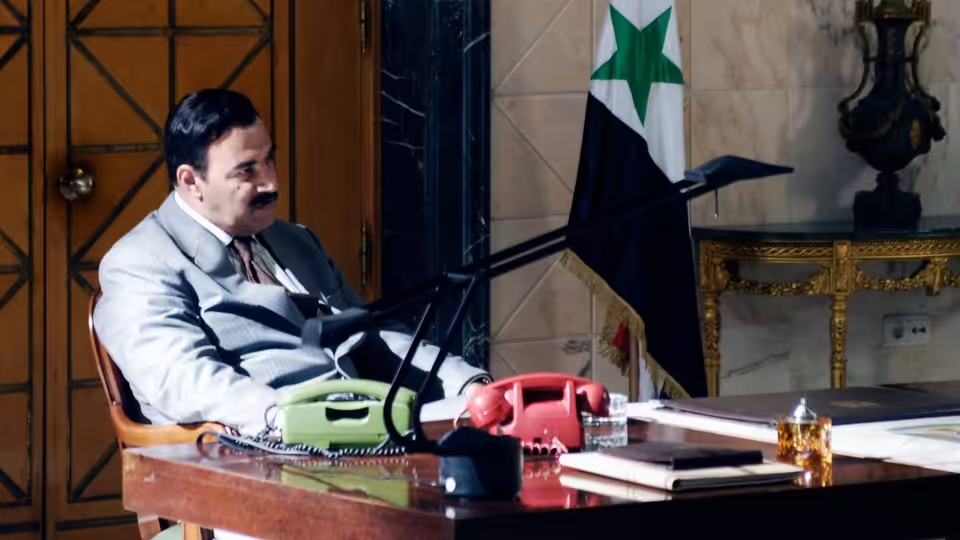
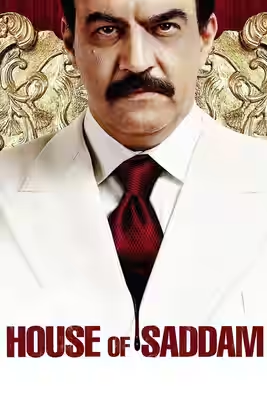
Yigal Naor’s Saddam is a frightening, courteous, oddly domestic creation and the first hour around him is a proper gangster drama. Then four hours try to cover twenty-four years, and the series ends up a chronicle of a family rather than an account of a country.
House of Saddam is a four-part series, an hour an episode, created by Alex Holmes, written by Holmes and Stephen Butchard, and directed by Holmes and Jim O’Hanlon. It starts in 1979 with Saddam Hussein taking power and it runs to the end, and the idea underneath it is a sound one: tell the story as a family saga, a dynasty of fathers, sons, wives and sons-in-law, and let the state be the business they happen to be in. The gangster-film shape is not hidden. It is the point.
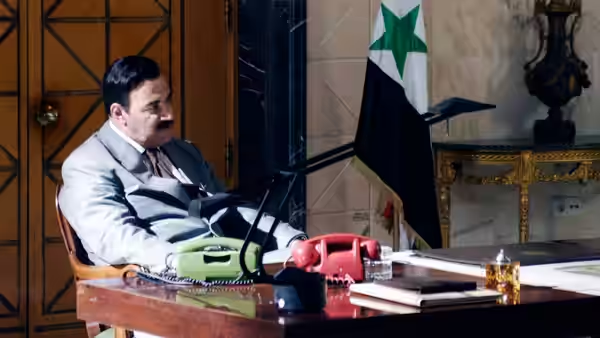
For its first hour that shape works. Yigal Naor plays Saddam as a big, soft-spoken, well-mannered man who touches people’s faces when he speaks to them and never raises his voice, and the series understands that this is where the fear lives. The party meeting in the opening episode, in which names are read from a sheet of paper and the named men are led out while the rest applaud, is as frightening a scene as we have watched in a television drama for some time, and what frightened us was the applause. Nobody is forced to clap. Naor simply waits, pleasantly, until they do. We felt the hall go cold and we felt how much we wanted to clap too.
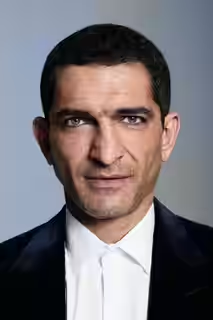
The household is cast with care. Shohreh Aghdashloo plays Sajida as a woman who has decided not to notice things, and the effort of not noticing is on her face in every scene. Makram Khoury’s Tariq Aziz is the courtier who knows the exact weight of each silence. Philip Arditti gives Uday a spoiled, nervy violence that the series is sensible enough not to explain, and Mounir Margoum’s Qusay is the quiet one, which in this house is a job in itself. Amr Waked, as the son-in-law Hussein Kamel, has the hardest part, a man who rises fast and knows what rising fast means here, and he plays the knowledge rather than the ambition.
Florian Hoffmeister shoots the palaces in hard, flat sunlight, all marble floors and brass fittings and nothing soft to sit on, so that even the family dinners look like meetings. Samuel Sim’s score is low strings and drums, used sparingly, and it is at its best when it is absent, which is often. Philip Kloss and Crispin Green cut the first two episodes tightly, with the camera leaving a scene a beat before the consequence arrives.
The trouble is the arithmetic. Four hours have to carry the war with Iran, the war over Kuwait, the sanctions years, the invasion and what followed, and the series does it by caption. A year goes by, then five, and we are handed the result of a decision we never saw taken. The third episode is the weakest for exactly this reason: it is a list of things that happened, in order, with the family growing older in the gaps. The series is also, as most of the reviews have pointed out, quiet about what Saddam’s government did to the Kurds, which is a large thing to leave out of a portrait of the man. A drama can choose its frame. This one chose the dinner table and then found there were things the dinner table could not see.
The last hour recovers some of the first hour’s nerve, and we will not describe it except to say that it strips the palaces away and leaves Naor alone with the part, and that he is more than good enough to carry it. By then we had been bored for a while and were slightly annoyed with the series for having had the actor all along and spent so much of the middle looking elsewhere.
Most critics have landed close to where we have, interested and not satisfied, and we think that is fair. It is worth an evening if the first episode’s hall scene makes you want to know how such a man behaves at breakfast. It is less worth a second evening, and the middle two hours are the ones you may find yourself talking through.