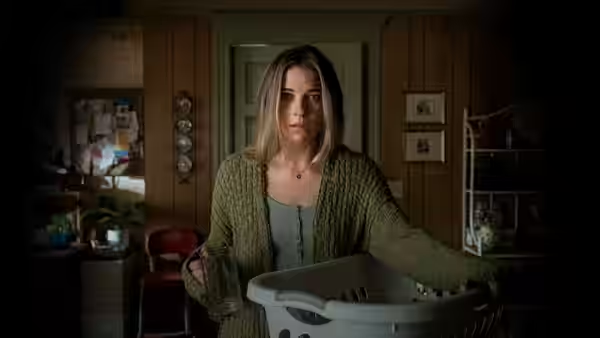
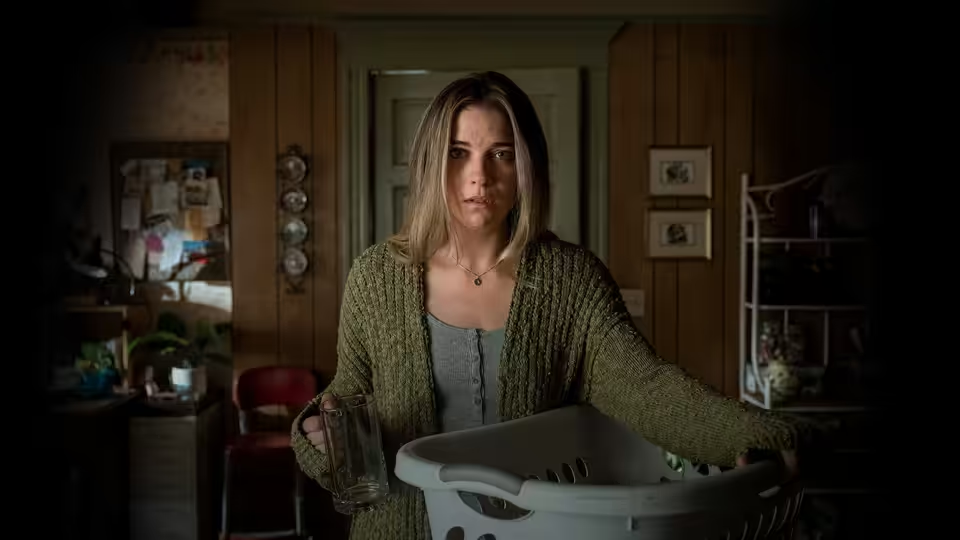
Allison McRoberts (Annie Murphy) stands holding a laundry basket in a wood-paneled home
Series review

Kevin Can F**K Himself

2021 · Created by Valerie Armstrong · Series · 44m

In a sentenceThe laughter follows Kevin out of the door and his wife stays behind in the dark, doing the sums

Allison McRoberts (Annie Murphy) is married to Kevin (Eric Petersen), a man who treats their living room as a stage and her as the straight man. While he is there the house is bright, an audience laughs and nothing matters. When she steps into the kitchen the laughter stops, the colour goes and she is a woman with a bleeding hand and no savings, because Kevin has spent the money she put aside for a house. Her neighbour Patty (Mary Hollis Inboden), sister of Kevin’s sidekick Neil (Alex Bonifer), has watched it all for years and is not inclined to help. Allison decides the only way out is for Kevin to die, and she starts, badly, to work out how.

Plays from YouTube when you press play; nothing loads from them until then.

Fi1m review

Valerie Armstrong’s series has one sharp idea, a sitcom wife who steps out of the sitcom, and two performers good enough to carry it. Over sixteen episodes the idea thins, the crime plot wobbles and Kevin stays on the sofa too long.

Valerie Armstrong’s series opens as a sitcom about a big, loud husband and the wife who rolls her eyes at him, the kind of marriage American television spent twenty years asking us to find adorable. Kevin McRoberts throws himself a party and the audience laughs at everything he says. Then Allison walks out of the living room and the series goes with her. The light drops, the laughter stops, the camera comes off its stand and follows her into a kitchen with stains on the counter, and she is a woman thinking about killing her husband. It is a sharp idea, and the first time it happened we sat up. Over two runs of eight episodes it is also an idea the series has to keep paying for.

The two halves are properly built. Shannon Madden and Adrian Correia light the sitcom flat and bright from three fixed positions, the sofa dead centre and the front door ready for whoever is about to burst through it; the drama scenes are handheld, close and the colour of a winter afternoon, browns and greys and car-park orange. Tony Fanning and James Bolenbaugh dress the living room so it reads as a set, then let that same space look tatty and small when Allison is alone in it. Carol Cutshall puts her in florals and cardigans that are cheerful under studio lights and look like somebody else’s clothes in daylight. The editors, Ivan Victor, Dan Schalk, Maura Corey and Kenneth LaMere, make the switch a hard cut, usually on a door, and never soften it.

Annie Murphy, who spent six series being Alexis Rose in Schitt’s Creek, gives something close to two performances at once. Sitcom Allison is bright and brittle, every line pitched for the back row; drama Allison has the smile wiped off and a voice half an octave lower, and Murphy moves between them in the width of a doorframe. She is at her best in silence, in a car or a diner booth, letting the plan form on her face. The series depends on her and she holds it.

Mary Hollis Inboden’s Patty is the reason to stay. She is the neighbour and the sidekick’s sister, a woman who has watched Kevin for years with the patience of someone who stopped expecting better from anyone, and once the series starts letting her out of the sitcom too it finds its real subject: two women who do not much like each other working out how to be on the same side. Eric Petersen plays Kevin with total commitment to a part the series holds in contempt, which is a harder job than it looks, and Alex Bonifer gives Neil a stupidity with something frightened under it. Raymond Lee, as Sam, the man Allison might have married, is quietly decent and slightly dull, which is about right.

The trouble is the living room. The sitcom scenes are bad on purpose, and a bad joke made on purpose is still a bad joke, and there are a great many of them. By the fifth episode we found ourselves dreading the cut back to the sofa, and we are not convinced the series meant us to dread it quite that much; the point had been made by the end of the first hour. The murder plot is the weaker thread as well. Allison is not good at crime, which is fair, but the series cannot decide whether her bungling is comedy or tragedy, and the arrival of Candice Coke’s Detective Tammy Ridgeway and Robin Lord Taylor’s Nick pulls it toward a crime show it never fully commits to.

The second run is better. It stops pretending the plot is the engine and lets Allison and Patty carry it, and the final episodes give Petersen something to play beyond the braying, which we will not describe. We laughed in the first run and felt grubby about it, which is what the series wanted; by the end of the second we had stopped laughing at Kevin altogether, and that felt earned rather than imposed.

Watch it in stretches of two or three episodes, for Murphy and Inboden, and accept the living room as the price of the kitchen. It runs to sixteen episodes of around 44 minutes and carries a 15 certificate.

Critical consensus AI synthesised

73
Positive
8
Mixed
3
Negative
0

Most critics like it, and nobody actively dislikes it. The praise clusters on two things: the conceit itself, a bright sitcom that keeps cutting away to the muted reality of its put-upon wife, and Annie Murphy, who is found convincing in both. Mary Hollis Inboden’s Patty is singled out almost as often, and the friendship between the two women is called the show’s strongest thread. Reviews of the second and final season are warmer still, calling it a satisfying finish that ends with its story told.

The reservations are about the join. Three reviews, none hostile, find that the sitcom half and the crime half never quite become one show, and that the plot loses pace once the trick is established. The Hollywood Reporter thinks too much time goes on the deliberately bad sitcom scenes; The Guardian says the two narratives fail to come together at all, though both are warm about Murphy. The spread is moderate rather than wide.

Vulture
14 June 2021 · Jen Chaney
90*

Chaney finds the series entertaining, wry, and thought-provoking in its critique of sitcom conventions and misogyny. She especially praises Annie Murphy’s range and the show’s assured interplay between sitcom and dramatic styles.

Read the full review →
IndieWire
22 August 2022 · B+ · Kristen Lopez
83

Lopez calls the second season a fine farewell, though some storylines lack resolution. She praises the chemistry between Annie Murphy and Mary Hollis Inboden, and singles out Eric Petersen’s finale performance.

Read the full review →
The AV Club
21 June 2021 · B+ · Saloni Gajjar
83

The premiere earns a qualified positive verdict for its inventive sitcom-to-drama shift, though the review finds the crime angle less compelling without Allison recognizing her own worth. Annie Murphy’s performance and Mary Hollis Inboden’s emerging role as Patty stand out for praise.

Read the full review →
The i Paper
26 August 2021 · Emily Baker
80*

The critic finds the series compulsive and engaging, praising its inventive shifts between sitcom and dark drama. They also single out Annie Murphy’s chameleonic performance and the writing’s dexterity.

Read the full review →
Variety
7 June 2021 · Caroline Framke
75*

Framke finds the series’ tricky mix of sitcom and drama compelling, though its success remains uncertain midway through the season. She especially praises Mary Hollis Inboden’s sharp performance as Patty, whose cynicism gives the show emotional bite.

Read the full review →
The Hollywood Reporter
15 June 2021 · Daniel Fienberg
50*

Fienberg finds the series’ premise compelling but says its execution is uneven and its satire unclear. He praises Annie Murphy’s sympathetic, nuanced performance as Allison, while criticizing how much time the show spends on its deliberately bad sitcom scenes.

Read the full review →

Straight answers AI written, from our review

Is Kevin Can F**K Himself worth watching?
Kevin Can FK Himself is worth watching for anyone who can put up with a deliberately bad sitcom to get at the good drama beneath it, and we scored it 70. Annie Murphy and Mary Hollis Inboden carry it, and the second run of eight episodes is the stronger. Watch in stretches of two or three episodes rather than in one go.
How long is Kevin Can F**K Himself, and what is it rated?
Kevin Can FK Himself has episodes of about 44m. It is a comedy and drama series.
Where can I watch Kevin Can F**K Himself in India?
Kevin Can FK Himself is not on any streaming or rental service in India at the moment. It is available in 30 other countries; change your country at the top of the page to see where. Availability is checked daily.
How violent or frightening is Kevin Can F**K Himself, and is it suitable for children?
Kevin Can FK Himself carries a 15 certificate and is not for children. It is a comedy-drama about a wife planning to kill her husband, with a bleeding hand in the first episode, a murder plot that runs across sixteen episodes and adult language throughout. Teenagers of fifteen and over should be fine; there is little in it to frighten anyone.
How does Kevin Can F**K Himself compare to Fleabag?
Kevin Can FK Himself and Fleabag both let a woman step outside the comedy she is trapped in, but Fleabag is the better series by some distance. Waller-Bridge's half-hours are tighter and built to last; Armstrong's forty-four minute episodes carry a crime plot that wobbles and sitcom scenes that outstay their point. Watch Fleabag first, then this for Murphy and Inboden.
What should I watch after Kevin Can F**K Himself?
After Kevin Can FK Himself, try Fleabag (2016, Fi1m 90): A woman talks past the comedy to us, and the drama is in what she withholds. Then Breaking Bad (2008, Fi1m 91): An ordinary person decides on a crime and discovers they are not good at it, yet.

Cast

If you liked this, try…

  1. WandaVision (2021) · not reviewed yetThe same year, the same trick: sitcom conventions as a cage, played for grief.

  2. Pleasantville (1998) · not reviewed yetBlack-and-white suburbia starts bleeding colour the moment anyone wants something real.

  3. The Stepford Wives (1975) · not reviewed yetThe husbands’ idea of a perfect wife, taken to its logical and horrible end.

  4. Fleabag (2016, Fi1m 90)A woman talks past the comedy to us, and the drama is in what she withholds.

  5. Breaking Bad (2008, Fi1m 91)An ordinary person decides on a crime and discovers they are not good at it, yet.

Free account

Know what to watch tonight

Two lists that know where things are streaming, collections you can share, your own score beside ours, and Discover that remembers what you have seen.

  • Want to see, sorted by what is streaming now
  • Seen, with your score out of ten
  • No adverts, ever