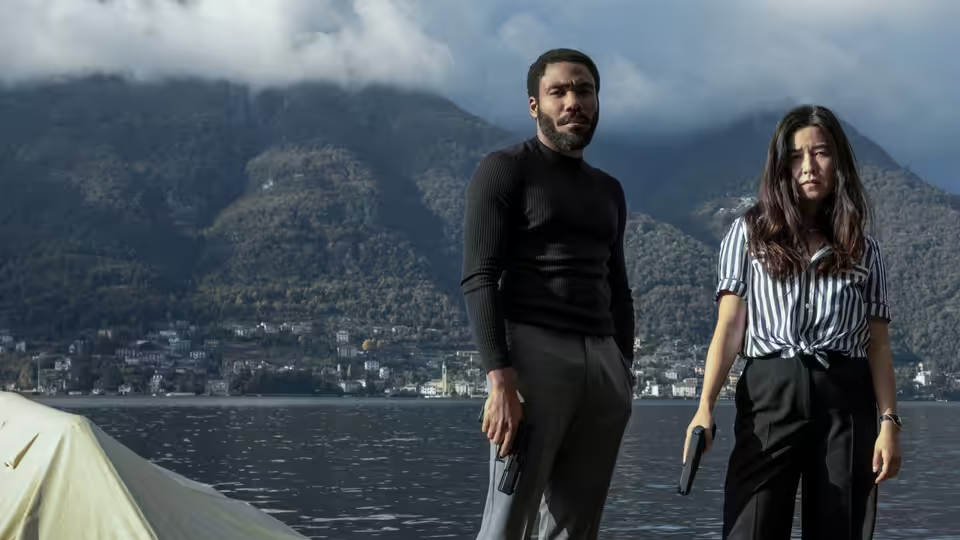
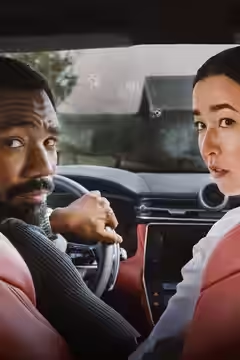
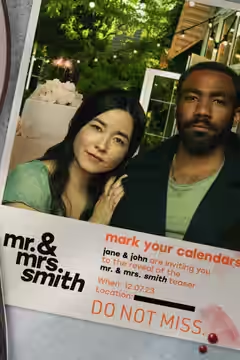
Donald Glover and Maya Erskine make a convincing couple out of two people who have been told to be one, and the house around them is beautifully built. The missions are errands. Stay for the marriage; the spying is set dressing.
Donald Glover and Francesca Sloane have taken the title of Doug Liman’s 2005 film and left most of the rest behind. In this version John Smith (Glover) and Jane Smith (Maya Erskine) are not married spies who have been hiding their work from each other. They are strangers hired by an agency nobody ever sees, given a house and a marriage, and sent out on jobs. Eight episodes, certificate 15. It is good company, and we would rather spend an evening with these two than with most couples on television. The spying is the least interesting thing they do.
Erskine is the find. She plays Jane as blunt, watchful and privately frightened, a woman who treats the marriage as the one test she cannot afford to fail. Glover is softer than we have seen him, the one who wants to be liked, who talks when he should be listening. Their rapport is in the small stuff: who takes the sofa, who does the talking, whether a lie told on a job counts at home. The series is wise enough to let those arguments run longer than the gunfights.
Hiro Murai directs the opening and sets the look, which the other directors, Glover, Christian Sprenger, Karena Evans and Amy Seimetz, hold to. The frames are wide and still. The house is photographed as a handsome cage. Gerald Sullivan’s production design gives the Smiths a home no two people their age could have paid for, all dark wood and tasteful lamps, so that the lie of their lives is visible in every room. Madeline Weeks dresses them like a couple from a magazine spread, and the clothes stop looking like armour only when the two of them are alone. David Fleming’s music keeps a low, uneasy pulse under the domestic scenes, which is where the real tension sits.
We laughed at their first job, which goes wrong in exactly the way a first day at work goes wrong. What we did not expect was to be moved, and we were, by a scene in a kitchen with the lights off, two people on opposite sides of a counter, neither saying the thing. The editors, Kyle Reiter, Greg O’Bryant, Isaac Hagy and Kate Brokaw, let it run past the point where a comedy would have cut to safety. That patience is the best thing about the series.
The missions are the worst. Each episode brings a job and a guest star, and the guests are often livelier than the plot they have been handed; they arrive, are interesting for forty minutes, and leave. The action is cleanly staged and almost never frightening, because the series does not quite believe the Smiths can be hurt. One chase through an Italian village has real weight. The rest is competent people in nice coats pointing guns at other competent people.
The structure costs something too. The episodes jump forward in time, and the falling in love happens in the gaps. We are told the Smiths are a couple now and must take it on trust, and for a series built on this marriage that is a strange thing to skip. There is a coolness about the whole enterprise, as though it were slightly embarrassed to be a romance and would rather be a mood piece. Most critics have been warmer than we are, and we understand why; the leads are that good. But we kept wanting the show to commit to its own premise.
Set beside Atlanta, Glover and Murai’s earlier series, this is tidier and far less strange. Set beside the 2005 film, it has less flirtation and more marriage, which is the right trade for eight hours. Watch it two episodes at a time, with someone you have argued with about the washing-up.