Series review

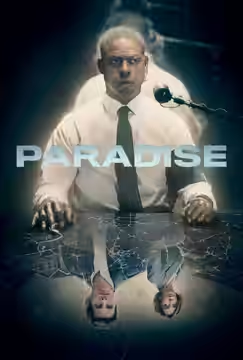
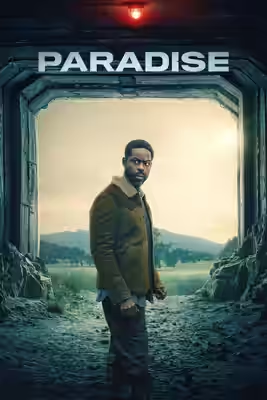
Paradise

2025 · Directed by John Requa, Glenn Ficarra, Hanelle M. Culpepper, Liza Johnson, Gandja Monteiro, Ken Olin · Series · 15

In a sentenceWe meant to go to bed, but this cast has made another implausible secret seem worth staying up for

CrimeDrama

A murder mystery draws Xavier Collins (Sterling K. Brown) into a drama involving President Cal Bradford (James Marsden) and Samantha ‘Sinatra’ Redmond (Julianne Nicholson). Flashbacks bring the characters’ histories into the story as political intrigue and personal troubles complicate the search for answers. Sarah Shahi plays Dr. Gabriela Torabi, alongside Nicole Brydon Bloom as Jane Driscoll and Krys Marshall as Nicole Robinson. As the mystery changes direction, Paradise expands beyond the investigation to follow the people caught up in it and the relationships that shape their decisions.

Plays from YouTube when you press play; nothing loads from them until then.

Fi1m review

Sterling K. Brown makes Paradise worth following through some improbable turns. The mystery keeps us engaged, and the feelings usually land, though the second season asks for more patience with loose plotting and flashbacks.

Paradise is an entertaining thriller whose cast makes its wilder plotting worth tolerating. With Dan Fogelman among its writers, it gives personal pain considerable space beside the business of solving a murder, and that choice pays off more often than the elaborate surprises. There is pleasure in following a mystery that takes such obvious delight in changing direction. We recommend it to thriller regulars, provided a convincing performance can occasionally persuade them to overlook an unconvincing explanation.

Sterling K. Brown does most of that persuading as Xavier Collins. His restraint gives the character a life beyond whatever information the plot needs him to uncover next, and keeps the emotional scenes from becoming requests for sympathy. We were moved by the effort he makes Xavier put into containing his distress. That control gives the programme room to become extravagant elsewhere without making every scene feel as though it is pleading for our attention.

James Marsden, as President Cal Bradford, provides a welcome change of rhythm; he is engaging company even when the surrounding drama grows solemn. Julianne Nicholson’s Samantha ‘Sinatra’ Redmond has the force to hold our attention without competing with Brown for it. The three performances make the larger shifts in the story easier to accept. They give us reasons to care beyond wanting the next answer, which matters when the explanations start to look questionable.

The visual work is less distinctive. Cinematographer Yasu Tanida and production designer Kevin Bird give the drama a polished finish, although the surroundings seldom become as interesting as the people occupying them. A story with this much conceptual ambition would benefit from a more convincing sense of how its setting works. Too often, the performers have to supply the reassurance that the larger premise has not earned.

The editing team, including Howard Leder and Lai-San Ho, helps the first season move briskly through its reversals. Scenes have an immediate pull even when the explanation behind them invites awkward questions, and the urge to continue is fairly reliable. The music is less well judged: alongside Siddhartha Khosla’s score, songs arrive to spell out emotions that the actors have already made clear. Those choices are intrusive precisely because the performances need so little assistance.

The second season makes the weaknesses harder to overlook. Flashbacks interrupt more insistently, and the growing number of subplots makes it difficult for the series to keep its attention on the people who matter most. The writing still finds emotional force, but loose explanations accumulate, and patience becomes a bigger part of the viewing experience. The cast remains a reason to return, though we would rather the plotting gave them less repair work.

The political thriller usually asks us to inspect motives and explanations, which is an awkward invitation here. Paradise gets through on the strength of its people, and the first season gives them a more satisfying mystery to work within. The pleasure lies in watching Brown, Marsden and Nicholson make even a questionable turn feel worth pursuing. Those who need every explanation to add up should choose a stricter sort of thriller.


Critical consensus AI synthesised

70
Positive
7
Mixed
1
Negative
1

Most critics find Paradise an absorbing, twist-driven thriller whose performances keep its more improbable ideas credible. Praise centres on Sterling K. Brown, with James Marsden and Julianne Nicholson also singled out for giving the elaborate mystery emotional weight. The favourable reviews value its character-led momentum, wit and willingness to combine genres, finding enough feeling beneath the plotting to make the demands on patience and belief worthwhile.

The spread is wide, with disagreement chiefly over whether that emotional pull compensates for thin ideas and implausible developments. Some find the silliness enjoyable; The Telegraph sees superficial characters and storytelling despite the strong acting. Reactions to the second series retain that divide: The Hollywood Reporter finds its emotion undermined by plot holes, flashbacks and lost momentum, while /Film is more forgiving of uneven subplots because of the ambition and performances. Even sympathetic reviews acknowledge that the mechanics do not always withstand scrutiny.

The Guardian
28 January 2025
85*

The critic calls it a precision-tooled thriller with wit and heart, praising the twisty concept and especially the performances of Sterling K Brown and James Marsden.

Read the full review →
The AV Club
24 January 2025 · B+ · Saloni Gajjar
83

The critic finds Paradise a rewarding, twisty thriller that blends genres effectively with strong performances, though it demands patience and suspension of disbelief. It praises the character-driven momentum, incisive scripts, terrific performances (especially Sterling K. Brown's), and the way it evolves into a multifaceted, thought-provoking drama.

Read the full review →
The Times
28 January 2025
80*

The critic describes an addictive thriller with well-wrought twists and back-story emotion, highlighting Marsden's performance and an exciting episode seven.

Read the full review →
The i Paper
28 January 2025 · Rachael Sigee
75*

The series is an ambitious, conceptual thriller that combines murder-mystery elements with big emotions and high stakes, unafraid to take big swings that mostly pay off. It singles out the strong performances of the three leads—particularly Sterling K. Brown, Julianne Nicholson, and James Marsden—for grounding the story amid its twists and conceptual ambition.

Read the full review →
Vulture
29 January 2025 · Kathryn VanArendonk
70*

The critic finds the series a fun, broad, and snappy-paced thriller that stands out among other apocalypse-bunker shows despite its frequent silliness and reliance on on-the-nose needle drops. The twist-driven premise and momentum make it entertaining even if it lacks depth or high-gloss production values.

Read the full review →
Evening Standard
29 January 2025 · Vicky Jessop
60*

The review calls it one of the most bonkers shows of the year, an enjoyable but flimsy binge-watch that falls short of glossy prestige TV ambitions despite the cast's efforts.

Read the full review →

Cast

Stills

If you liked this, try…

State of Play poster

State of Play

2003 · Political intrigue with characters worth following even when the investigation grows tangled.

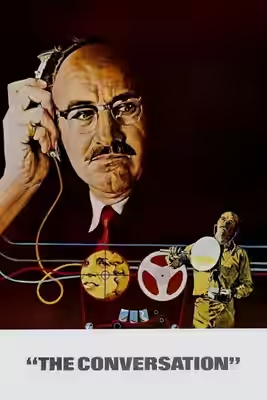
The Conversation poster

The Conversation

1974 · For the unease of watching a careful professional lose confidence in his work.

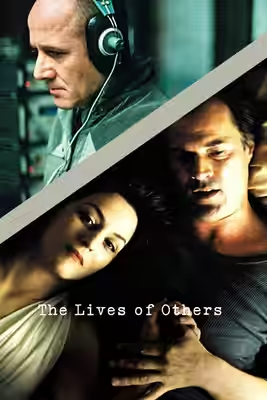
The Lives of Others poster

The Lives of Others

2006 · A controlled surveillance drama where private feeling complicates the exercise of state power.

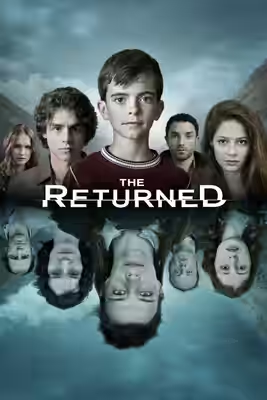
The Returned poster

The Returned

2012 · A mystery that makes room for grief without hurrying everyone towards an explanation.

The Leftovers poster

The Leftovers

2014 · For troubled people whose emotional lives matter more than solving the central mystery.