Two of these four modern Shakespeares are good television and the Macbeth is better than that. The Shrew is fun and the Dream a long evening. Start with the restaurant and forgive the series its weakest quarter.
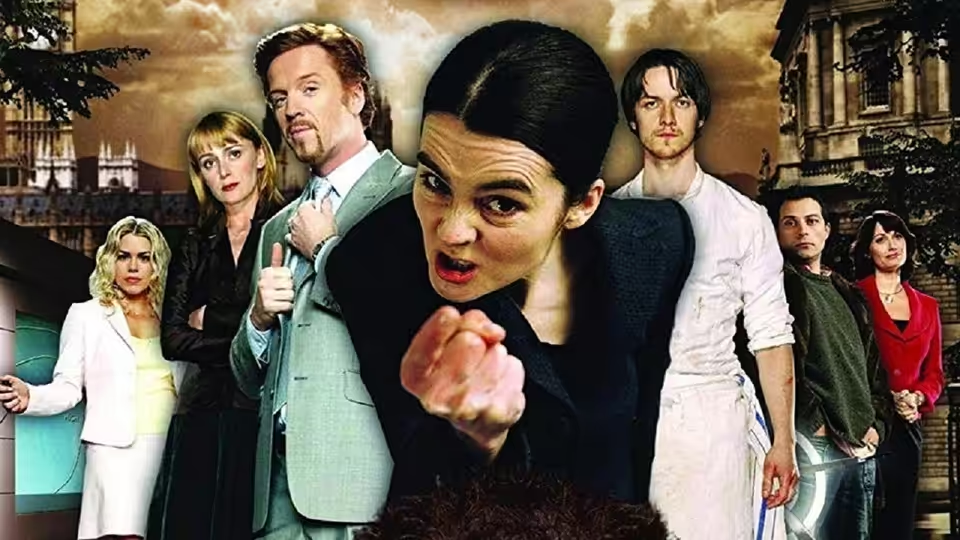
Peter Bowker’s series, first shown on 7 November 2005, takes four Shakespeare plays, strips out the verse, keeps the plots and the names, and hands each to a different writer for a 90-minute film. David Nicholls has Much Ado About Nothing, Peter Moffat has Macbeth, Sally Wainwright has The Taming of the Shrew and Bowker keeps A Midsummer Night’s Dream for himself. It is the kind of idea that usually produces an hour of smugness about how relevant the Bard still is. Here it mostly does not, and the reason is that the writers were allowed to treat the plays as plots rather than monuments. Two of the four are good, one is a pleasure with a problem, and one we would skip.
Nicholls puts Much Ado in a regional television newsroom, which is the right size for it. Sarah Parish plays Beatrice as a woman who has been the cleverest person in the building for ten years and has stopped expecting anyone to notice. The script gives her and Benedick real work to do between the insults, autocues, running orders, a weather map, and Brian Percival directs the studio scenes so that the on-air smiles and the off-air faces are in the same shot. Olivia Colman’s Ursula is one of the small parts that make the thing feel like a workplace rather than a cast list. Tom Ellis has the thankless job of Claude, the decent young man who believes the wrong thing, and does not make him a fool.
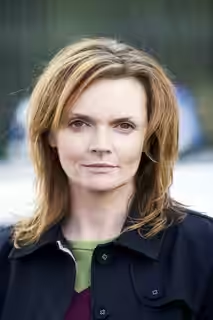
The Macbeth is the one to see. Moffat sets it in a restaurant kitchen, with Joe Macbeth at the pass and Keeley Hawes’s Ella running the dining room, both of them doing the work while the man whose name is over the door collects the praise. Mark Brozel shoots the kitchen as a place of steel, steam and shouting, and keeps the camera low and close. We were tense before anyone had so much as thought about doing anything wrong, and what did it was Hawes: the way she stands at the door between the kitchen and the restaurant, smiling at the customers, watching her husband be patronised, and saying nothing at all. Richard Armitage, as the other man in the kitchen, plays decency without making it dull. What follows we will not describe, except to say that a kitchen turns out to be a fine place for it.
Wainwright’s Shrew makes Kate Minola a Conservative MP, and Shirley Henderson plays her as a woman who has decided that being disliked is quicker than being charming. Henderson is small and the voice is small and she fills every room anyway; we laughed, properly, at her first scene in the Commons, and kept laughing for an hour. Twiggy is dry and well cast as her mother and David Mitchell gets good value from a few lines. The problem is the one every modern Shrew has, which is the last ten minutes of the play, and Wainwright’s way round it is clever rather than convincing. We admired the footwork and did not believe a word.
The Dream is the weak one. Bowker moves it to a holiday park, which should be funny and mostly is not, and Ed Fraiman directs the lovers in the woods as if the woods were a problem to be got through. Sharon Small and Rupert Evans do what they can. The mechanicals’ play, which ought to be the easiest laugh in the canon, lands flat, and the 90 minutes feel like more.
Across the four, the production design is the series’ best decision: Jon Henson, Phil Roberson, Malcolm Thornton and Claire Kenny give each film its own world, a newsroom, a kitchen, a Westminster office, a caravan site, and none of them looks like the same Sunday-night drama with the furniture moved. The music is the opposite. Four composers, Charlie Mole, Tim Atack, Kevin Sargent and Hal Lindes, between them produce a lot of pleasant underscore that tells you how to feel a beat before the actors do.
The reviews so far have been cooler than we are, finding the whole thing uneven and only moderately watchable. Uneven is fair; we have said as much. But a series is not an average, and the Macbeth on its own would justify the evening. Watch that first, then the Much Ado, then the Shrew if you are enjoying Henderson, and leave the Dream for a night when you have nothing better and are feeling forgiving.