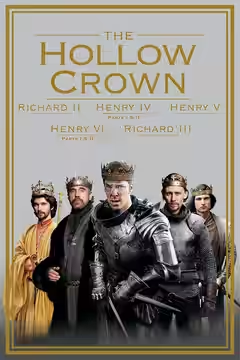
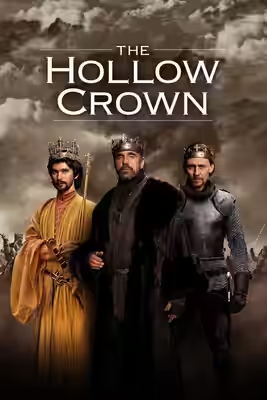
Ben Whishaw’s self-dramatising King Richard gives The Hollow Crown its strongest reason to watch. This is rewarding historical drama that asks for concentration, though the close-ups sometimes insist on feelings the performances already make clear.
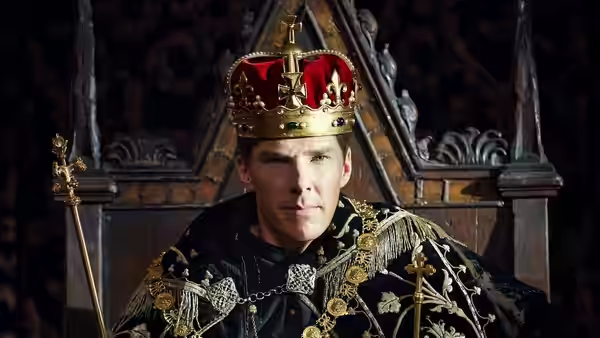
Our strongest reason for recommending The Hollow Crown is Ben Whishaw’s King Richard, a ruler whose self-importance is maddening and painfully recognisable. This is demanding, rewarding historical drama, though it can press too close to its actors when their voices already tell us enough. Its interest lies in how people behave once everyone is obliged to take them seriously. The language asks for concentration, and the production generally repays it by making temperament as important as rank.
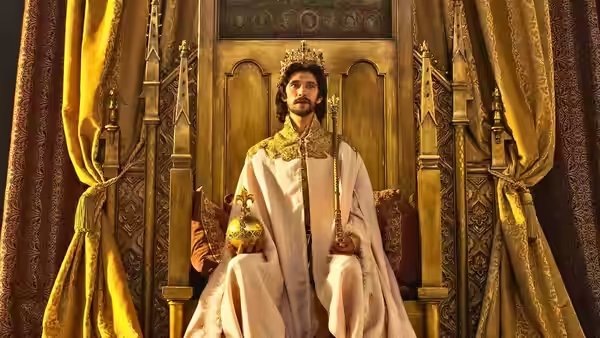
Whishaw makes Richard’s capriciousness feel personal, with the king apparently as absorbed by his own performance as anyone watching him. Self-dramatisation can become a tiresome acting trick, yet here it helps explain why the character is so difficult to dismiss. We were moved more than we expected by how human Whishaw makes this exasperating man. Richard’s need for attention remains visible even when it is least attractive, and the performance does not ask us to mistake that need for wisdom.
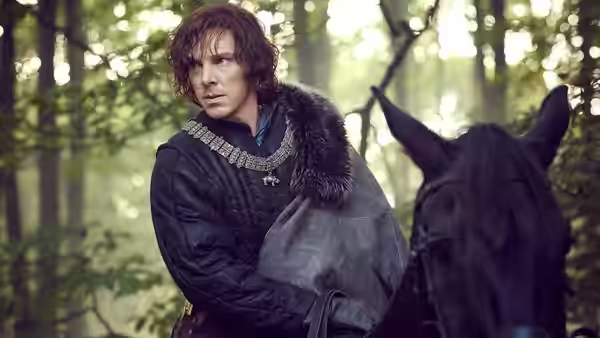
Rory Kinnear’s Bollingbroke is another reason the programme survives its weight of language. He makes the character understandable without making every thought obvious, and that restraint gives us something to watch as well as something to hear. The danger with material this dense is that actors begin delivering explanations rather than speaking to one another. Kinnear avoids that stiffness, and the clarity of his performance is worth more than any amount of additional emphasis.
Ben Smithard and Danny Cohen are credited with the cinematography, and the close-ups are useful but occasionally wearing. They let us study Whishaw’s self-absorption, though repeated scrutiny can make a performance feel over-explained. There are moments when a little more distance would let us decide where to look and whom to believe. Gareth C. Scales’s editing keeps the drama comprehensible, although clarity alone cannot make every stretch feel brisk. We can follow what is being said and still wish the production would move on.
John Stevenson’s production design and Nigel Egerton’s costume design make the ranks and titles convincing before the actors have much explaining to do. The clothes help us read status, a useful contribution when the language already requires close attention. Dan Jones’s music leaves less of an impression than the performances, and we would have welcomed a more distinctive contribution from it. These departments support the actors capably, but none supplies quite the same reason to keep watching.
Royal drama can become a procession of important people announcing important matters. Here, vanity and changeable judgement make the people intelligible before we have mastered every relationship. That is what makes the demands on our attention worthwhile, although it does not remove them. Anyone hoping the language will become incidental to the entertainment is likely to have a tiring evening.
Our recommendation comes with that practical reservation. This is a series to listen to closely, and its pleasures depend on how much patience we have for a difficult, sometimes exhausting personality such as Richard. The close-ups can be insistent and the pace can test patience, but the performances keep earning the concentration they require. Give it your attention, and leave the next episode for another evening if the speeches start passing you by.