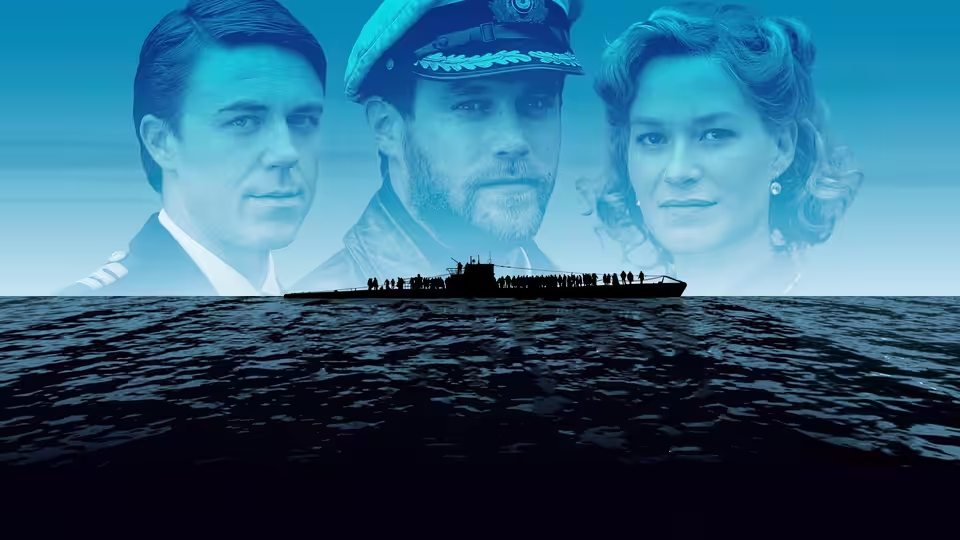
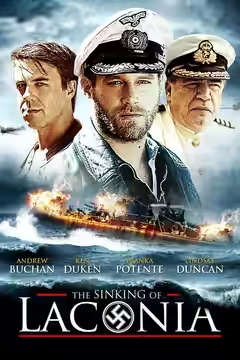
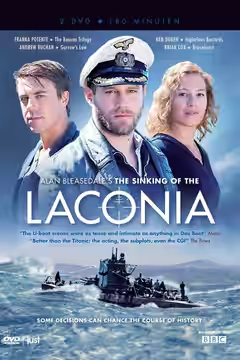
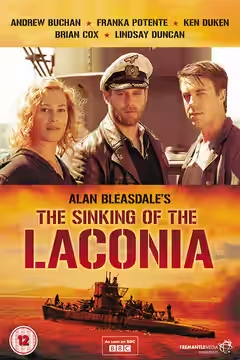
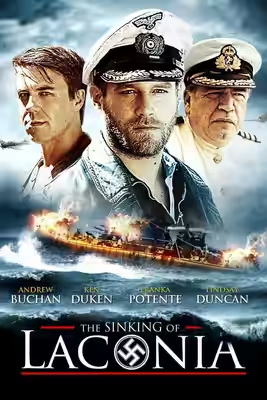
Alan Bleasdale’s two-part drama about the U-boat commander who torpedoed a liner and tried to save its survivors is sober, humane and well acted in both languages. It sags in the middle and some of the British are drawn broad, but it held us.
Alan Bleasdale, who wrote Boys from the Blackstuff, has taken on a true story that is nearly too good: in September 1942 a German U-boat torpedoed a British liner in the South Atlantic, and the man who fired, Werner Hartenstein, surfaced to find the sea full of Italian prisoners, his own side’s allies, along with the British who had been guarding them. He began pulling them out. The drama runs to two parts of 90 minutes, with Uwe Janson directing, and it is a sober, well acted piece of work that we would put in front of most people, though it takes its time and does not always use it well.
The first hour is the best. Tobias Haas cuts between the liner and the submarine without hurrying, so that we are in the Laconia’s dining saloon one minute, among people dressing for dinner and pretending there is no war, and the next in a steel tube where nobody has washed for a month. Knut Loewe’s production design makes the submarine out of pipes, sweat and condensation, and the liner out of brass and tired carpet, and the contrast carries most of the tension before a shot is fired. Monika Jacobs has dressed the Italians in rags and the British in laundered white, which is the point.
The sinking is done at night, mostly in close shots, with the Italians locked in the holds and Polish guards with rifles between them and the ladders. It is plainly a television budget, and Janson has turned that into a virtue: we are not shown the ship going down from a helicopter, we are shown faces in a flooding corridor. We were angry watching the holds, and we were meant to be. Bleasdale is quite clear about who was treated as cargo on a British ship.
Then Hartenstein surfaces, and Ken Duken plays the next ten minutes almost without moving his face. He hears voices in the water, listens, and understands that they are speaking Italian. The German scenes are in German with subtitles, and the choice pays off here, because we are hearing exactly what he hears. That moment moved us more than anything else in three hours, and it is built on nothing but a man standing on a conning tower in the dark. His crew, Jacob Matschenz’s Mannesmann, Stefan Rudolf’s Remmert, Matthias Koeberlin’s Rostau and Frederick Lau’s Fiedler, are played as what they were, which is young, and they look at their captain as though he has gone mad, which he may have.
On the British side, Franka Potente is the anchor. Her Hilda Smith is a German among the British, keeping quiet about it, and Potente gives her the watchfulness of a woman who has had to listen before speaking for years. Andrew Buchan’s Thomas Mortimer is decent and damp and does not get much more than that to play. Lindsay Duncan’s Elisabeth Fullwood is the broadest thing in the drama, a woman who treats the sinking as an affront to her standing, and Duncan is too good to be spent on a type; Jodi Balfour, as her daughter Sarah, has more to do and does it quietly. Nicholas Burns gives Benjamin Coutts, the officer who has to keep order in a lifeboat, a nice line in exhausted politeness. Adrian Johnston’s score is low strings and silence, and it stays out of the way when the actors are working.
The second part is where the time tells. Once the rescue is under way the story has to leave the water and go ashore to headquarters, where Thomas Kretschmann’s Karl Dönitz sits in a well lit room and weighs the lives of several hundred strangers against the safety of one boat. Kretschmann plays him calm rather than cruel, which is right, but every cut to the admiral loses the heat of the sea, and the middle hour is where we started counting the lifeboats. What follows, we will not describe. It is a matter of record, and the drama is faithful to it.
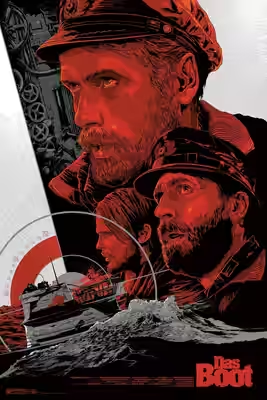
The submarine scenes owe an obvious debt to Das Boot, Wolfgang Petersen’s 1981 film, in their grammar of sweat and dripping pipes, and Bleasdale has added the thing Petersen could not: the view from the people the torpedo was aimed at. It is a drama about men deciding, at some cost to themselves, to behave like sailors rather than combatants, and it does not pretend the decision changed much.
Watch both parts in one evening if you can. The gap between them is where the story cools, and it deserves better than to be left overnight.