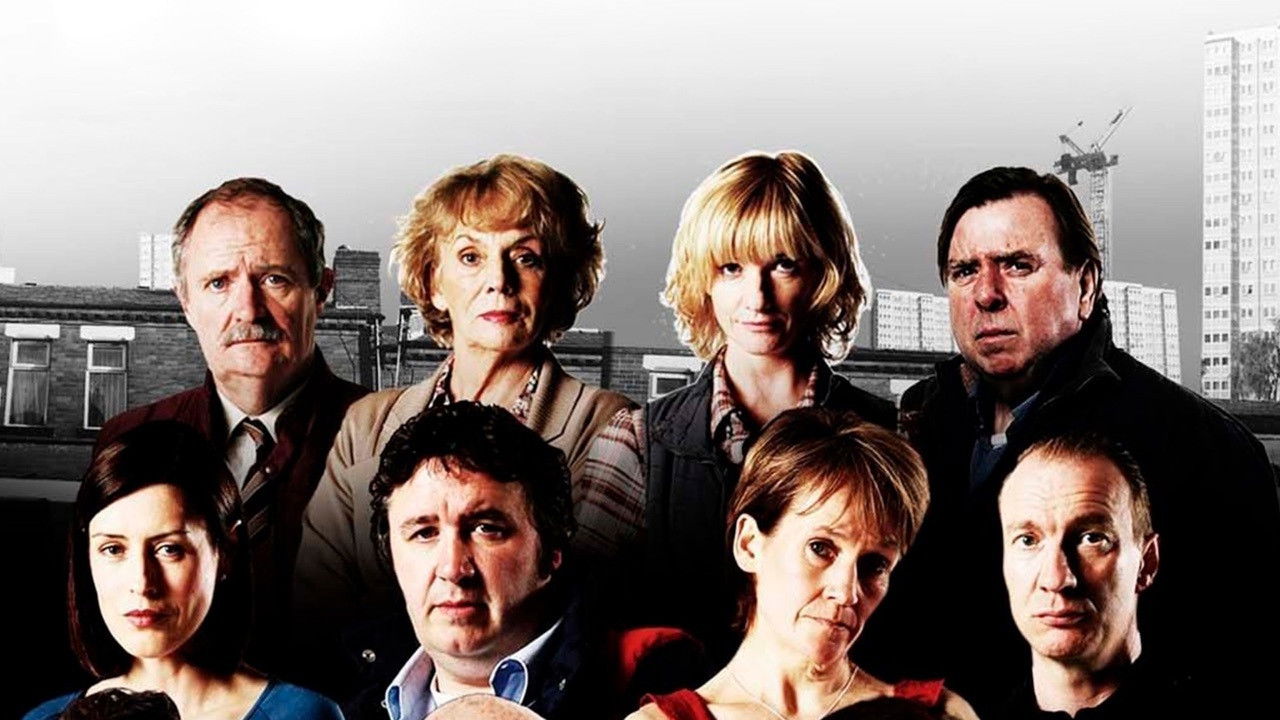
Jimmy McGovern’s anthology of one Manchester terrace is television built on kitchen tables and bad decisions, acted with rare honesty by a cast that reads like a roll call. It is often devastating. It would be better still if it let anyone laugh.
Jimmy McGovern’s idea fits on a postcard. Take one terrace in Manchester and, each week, walk through a different front door. The first run of six hours was shown from 13 April 2006, and two further runs of six followed. Behind every door is a household in ordinary trouble that turns, over sixty minutes, into the kind you cannot come back from. It is blunt, it is sometimes preachy, and it is often as honest as British television gets about what people say to each other in kitchens. We recommend it, an hour at a time.
The first hour belongs to Jane Horrocks. Angela Quinn is having an affair with a man over the road, and she is enjoying it, which McGovern is careful to show before he takes it away. Then her daughter is hit by a car outside the house and does not wake up. What follows is not a hospital drama; it is a woman sitting beside a bed, making tea for her husband and trying to keep her face straight. We were wrecked by the end of it, and it was not the drip and the monitors that did it but Horrocks, saying almost nothing, trying to be a good wife while carrying a secret that would end the marriage.
The cast list reads like a roll call. Timothy Spall and Ger Ryan are Eddie and Margie McEvoy; Lee Ingleby and Christine Bottomley are Sean and Yvonne O’Neill; Jim Broadbent is Stan McDermott; Neil Dudgeon, David Schofield and Jody Latham take other doors. Across the three runs Bob Hoskins, Anna Friel and Stephen Graham turn up too. None of them are asked to be charming. Spall does the thing only he does, the large face going slowly still while a decision is made behind it, and Broadbent plays Stan as a man who has stopped expecting to be consulted about anything. Nobody is acting for the back row.
Fabian Wagner and Ben Smithard shoot it in flat northern daylight, through doorways and over the backs of sofas, and they have not tidied anything up. The wallpaper is the wallpaper people actually chose. David Blair directs by staying on a face a beat after the line has landed, which is where most of the damage in this series happens. There is no gloss and there is no grime either; it looks like a street.
Now the caveats. McGovern has never trusted an audience to draw its own conclusion when a character could draw it for them, and in the first run there is a speech, delivered straight and at length, that tells us what the hour has already shown. We winced. The other trouble is bigger. For a terrace full of Mancunians this is an almost laughless place, and real people in real grief make jokes, bad ones, at the worst possible moment; it is one of the truest things about them, and the series will not allow it. Six hours of unrelieved bad news is a lot to ask, and the format, one household and out, means a thin hour has nowhere to hide.
McGovern’s people have always been cornered by one wrong turn, from Cracker (1993) on, and the anthology shape suits him better than it has any right to. He shares the writing with Daniel Brocklehurst, Marc Pye and Alice Nutter, and the seams barely show; the voice is his, direct and unforgiving, all the way down the street.
Take it one door at a time and take a night off between. Watched in a run it flattens into misery; watched as it was made, an hour and then a night’s sleep, each household gets the weight it deserves.