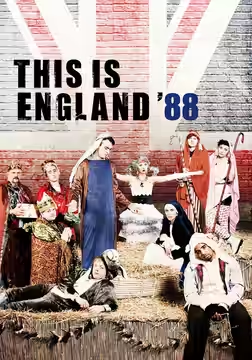
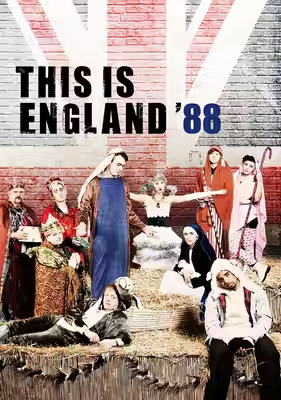
Lol (Vicky McClure) stands with her arms crossed against a peeling wall
Series review

This Is England '88

2011 · Created by Shane Meadows · Series · 50m · CNC 18

In a sentenceThree Christmases’ worth of misery packed into three episodes, and we would not have missed a minute

Christmas 1988, two years after the events of This Is England ‘86. Lol (Vicky McClure) is living in a cold council flat with a baby daughter, barely sleeping, and visited at night by her father Mick (Johnny Harris), who should not be there. Woody (Joe Gilgun), the man she left, has a job, a fiancée and a new life with his parents’ blessing, and still keeps finding reasons to drive past her door. Shaun (Thomas Turgoose) is at college studying performing arts, drifting away from Smell (Rosamund Hanson) towards a girl in his drama group. Milky (Andrew Shim) is closer to the flat than Woody would like. Combo (Stephen Graham) is in prison. The rest of the old gang, Gadget (Andrew Ellis), Kelly (Chanel Cresswell), Harvey (Michael Socha) and Trev (Danielle Watson), are planning a Christmas nobody is sure Lol will come to.

Plays from YouTube when you press play; nothing loads from them until then.

Fi1m review

Shane Meadows’s second television return to his skinheads is a Christmas story with almost no cheer in it. Vicky McClure, Joe Gilgun and Thomas Turgoose are as good as British television acting gets, and the three episodes are over before you are ready.

Shane Meadows’s This Is England (2006) followed a boy called Shaun through the summer of 1983 and the gang of skinheads who took him in. This Is England ‘86 (2010) moved the story to television and left its characters in a worse place than it found them. ’88 picks them up at Christmas two years on, across three episodes of around 50 minutes, written by Meadows with Jack Thorne, and it is less interested in the gang than in one woman and what two years of carrying a secret have done to her face.

Our verdict is plain. This is the best of the television instalments and one of the finest British dramas of its decade. It is short, it is bleak, and it earns almost all of its bleakness. It carries an 18 certificate and the certificate is not for show.

Vicky McClure’s Lol is the centre of it. She has a baby, a damp flat and a face that has stopped expecting anything. McClure does nearly all of it in silence; she lets the camera sit on her while she does not cry, and the not-crying is harder to watch than tears would be. Joe Gilgun’s Woody has a job, a fiancée and a side parting, and spends the series being funny in rooms where he is plainly terrified. Gilgun’s gift is that the jokes and the fear come out of the same mouth at the same time. Thomas Turgoose’s Shaun is at college now, learning to act, which Meadows plays as both a joke and a hope. Stephen Graham’s Combo has only a handful of scenes, from prison, and is quieter than we have ever seen him.

Danny Cohen shoots it in the grey of an English December: low sun, sodium streetlights, interiors lit by whatever lamp the character could afford. Lol’s flat is the darkest place on screen and he does nothing to brighten it. Jane Levick’s production design gives Woody’s parents a house full of velour and ornaments and gives Lol a cot, a kettle and nothing on the walls. Charlotte Walter has let the clothes go; the sharp cuts and braces of the first film have softened into cardigans, shell suits and one unfortunate office jacket on Woody. Alastair Reid lets the improvised scenes run past the point where a tidier editor would have cut, and the series is better for the slack.

We were wrung out by the end of the second episode, and it was Christmas dinner that did it. Woody sits at his parents’ table with the fiancée beside him, making everyone laugh, and the series keeps cutting back to the flat, where Lol is sitting with the baby and the television and nothing is happening. Meadows holds it. It is the most ordinary picture in the whole series and we found it the hardest to look at, because by then we understood exactly what she was not telling anyone, and that the laughter across town was the sound of a man not asking.

It is not faultless. Johnny Harris returns as Mick, Lol’s father, in scenes we will leave undescribed, and they are the one place Meadows reaches for a device the series does not need. McClure has already shown us everything those visits tell us. Shaun’s strand, the college and the girl in his drama group, is thinner than the rest, and Turgoose is sometimes left holding scenes that do not go anywhere. And the final episode makes its peace a little faster than the first two had led us to expect. We will not say how, only that we believed the misery more than the mercy.

Against Meadows’s own work it sits near the top. Dead Man’s Shoes (2004) was angrier and the first film funnier, but nothing he has made watches a single person as patiently as this watches Lol. Produced by Mark Herbert, it runs about two and a half hours in total and feels longer, in the way a long night does.

Watch it after ’86, not instead of it; the secret at its centre belongs to the earlier series and this one assumes you know it. Then watch all three episodes in one sitting, with the heating on, and do not plan anything cheerful for afterwards.


Critical consensus AI synthesised

1 of 6
Positive
1
Mixed
0
Negative
0
The Guardian
18 December 2011 · Euan Ferguson
90*

Ferguson regards the series as an outstanding, hauntingly watchable drama and eagerly anticipates its next story. He especially praises the performances of Thomas Turgoose, Joe Gilgun and Vicky McClure, singling out Gilgun’s balance of humor and fear.

Read the full review →

Straight answers AI written, from our review

Is This Is England '88 worth watching?
This Is England '88 is worth watching for anyone who can take three episodes of unrelenting bleakness, and we scored it 86. Vicky McClure and Joe Gilgun give as good a pair of performances as British television has managed, and the series is over in about two and a half hours. Watch it after This Is England '86, not instead of it, because the secret at its centre belongs to the earlier series.
How long is This Is England '88, and what is it rated?
This Is England '88 has episodes of about 50m and is rated 18 by the CNC in France. It is a drama series.
Where can I watch This Is England '88 in France?
This Is England '88 is not on any streaming or rental service in France at the moment. It is available in 2 other countries; change your country at the top of the page to see where. Availability is checked daily.
How violent or frightening is This Is England '88, and is it suitable for children?
This Is England '88 carries an 18 certificate and the certificate is not for show; it is not suitable for children and we would keep younger teenagers away too. There is little in the way of action, but the story turns on abuse and its aftermath, and the scenes involving Lol's father Mick are hard to sit through. The misery is sustained rather than sudden.
How does This Is England '88 compare to This Is England?
This Is England is the warmer and funnier of the two, following Shaun into the gang through a sunny 1983, while This Is England '88 is a Christmas story with almost no cheer in it. The film is the better place to start and the broader piece of work; the series is narrower and sadder, watching one woman with a patience Meadows has not matched elsewhere. We rate both highly and would see the film first.
What should I watch after This Is England '88?
After This Is England '88, try This Is England (2006, Fi1m 85): Where Shaun and the gang began; funnier, sunnier, and the ground this stands on. Then Nil by Mouth (1997, Fi1m 87): Gary Oldman’s south London family, shouted at close range; harder going, same honesty; and Ratcatcher (1999, Fi1m 88): Lynne Ramsay’s Glasgow childhood in a bin strike, shot with the same patience for faces.

Cast

If you liked this, try…

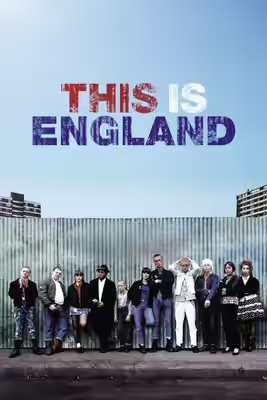
  1. This Is England (2006, Fi1m 85)Where Shaun and the gang began; funnier, sunnier, and the ground this stands on.

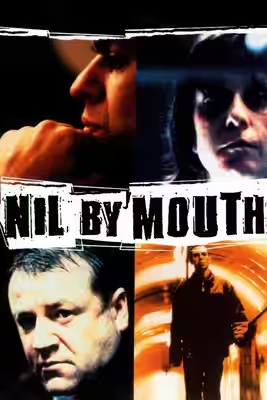
  2. Nil by Mouth (1997, Fi1m 87)Gary Oldman’s south London family, shouted at close range; harder going, same honesty.

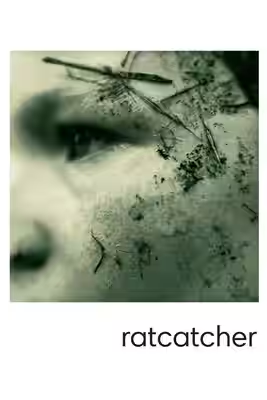
  3. Ratcatcher (1999, Fi1m 88)Lynne Ramsay’s Glasgow childhood in a bin strike, shot with the same patience for faces.

  4. The Snapper (1993, Fi1m 82)A Dublin family and an unexplained pregnancy, handled with warmth where Meadows uses cold.

  5. A Christmas Tale (2008) · not reviewed yetDesplechin’s French family Christmas, all old wounds and good wine, for the bourgeois version.

Free account

Know what to watch tonight

Two lists that know where things are streaming, collections you can share, your own score beside ours, and Discover that remembers what you have seen.

  • Want to see, sorted by what is streaming now
  • Seen, with your score out of ten
  • No adverts, ever