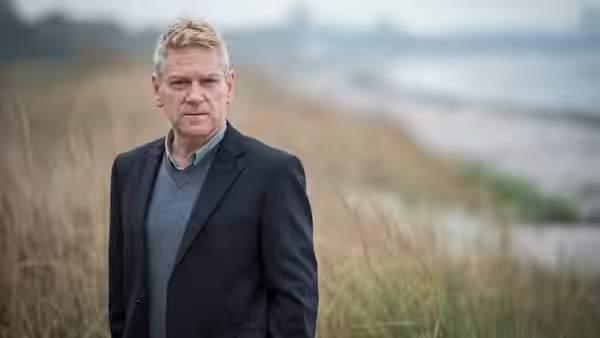
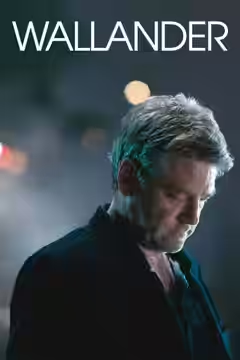
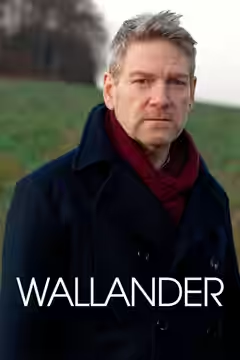
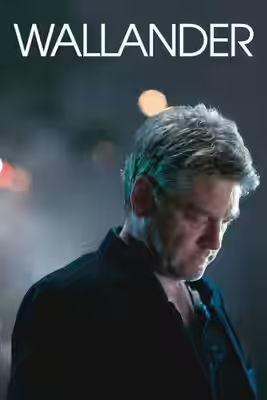
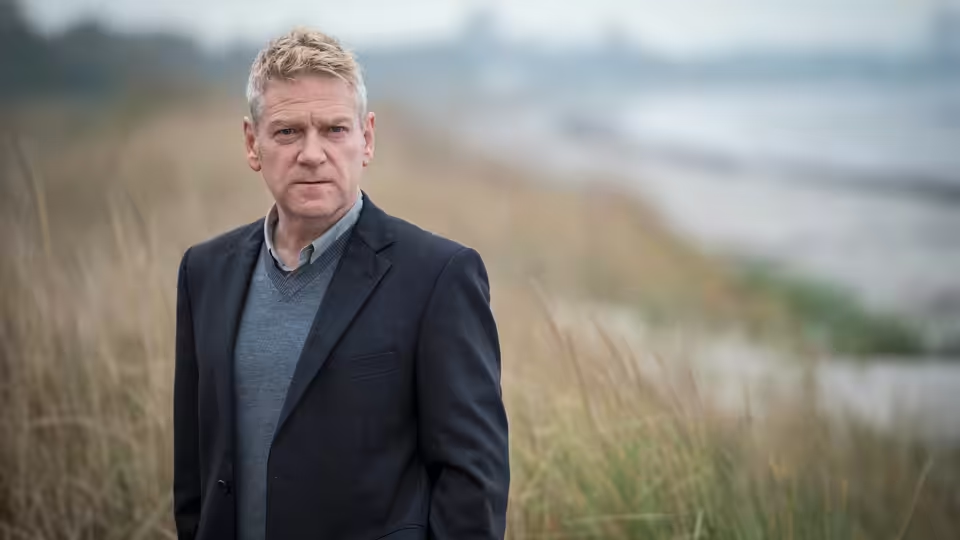
Kurt Wallander (Kenneth Branagh) stands among dune grass overlooking the coast
Series review

Wallander

2008 · Created by Henning Mankell · Series · 1h 29m

In a sentenceEvery field is yellow, every corpse is a sculpture and Branagh has not slept since 2008

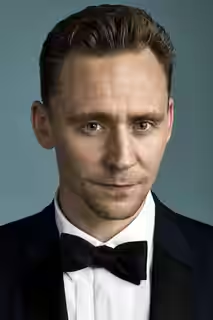
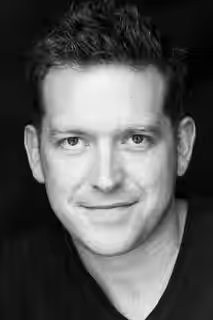
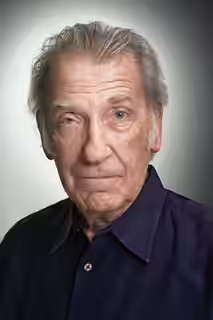
Kurt Wallander (Kenneth Branagh) is a detective inspector in Ystad, a small town on the southern coast of Sweden. His wife has gone, his daughter Linda (Jeany Spark) rings to check he is eating, and his father Povel (David Warner), a painter, is beginning to forget things. In the opening episode a teenage girl stands in a field of yellow rape and sets herself alight as Wallander walks towards her, and before he has slept a retired politician is found murdered on his own land. With Nyberg (Richard McCabe) on forensics, Anne-Britt Hoglund (Sarah Smart) and the young, impatient Magnus Martinsson (Tom Hiddleston) beside him, he starts looking for a link between the two, while his boss Lisa Holgersson (Sadie Shimmin) asks when he last took a day off.

Plays from YouTube when you press play; nothing loads from them until then.

Fi1m review

Kenneth Branagh plays Henning Mankell’s sleepless Swedish detective as a man held together by coffee and guilt, and the series is worth watching for him alone. The cases are grislier than they need to be and the Sweden on screen is a little too pretty to be true.

Kurt Wallander is a detective in Ystad, a small town on the southern coast of Sweden, and he is not well. He does not sleep. He eats standing up, when he eats. His wife has left, his daughter Linda rings to check he is alive, and his father is losing his memory in a farmhouse full of his own paintings. The BBC’s adaptation of Henning Mankell’s novels gives him an English voice and an English cast, keeps the Swedish names and the Swedish light, and runs each case to feature length: three episodes of 89 minutes per series, four series between 2008 and 2016. It is a good series carried by one performance, and the performance is worth your evening.

Kenneth Branagh plays him without a scrap of charm, which for Branagh is the brave choice. He is pale, unshaven, slightly stooped, and he looks at every corpse as though it were his fault. There is no wisecrack, no eccentricity, no trick of deduction. What there is instead is a man who cannot stop thinking and cannot bear what he thinks, and Branagh lets the fatigue show in his hands, which shake when he reaches for the phone, and in his pauses, which run a beat longer than anyone else’s. Most critics have said the series belongs to Branagh, and for once we agree with most critics.

The look is the other thing people remember. Southern Sweden is shot in flat, bright, overexposed daylight, the kind that gives you a headache, with the focus so shallow that Wallander’s face floats in front of a blur of yellow rapeseed or grey sea. The directors, Philip Martin, Niall MacCormick and Hettie Macdonald among them, keep the camera close and hand-held and the colours scrubbed almost to white. The first episode opens with a girl standing in a rape field who sets herself alight as Wallander walks towards her, and we were horrified, not by the flames but by the silence before them and by the way the camera stays on his face afterwards rather than on the fire. It is a strong opening, and it sets the pattern: the series reaches for the terrible image early and often.

Around Branagh, the casting is sound. David Warner plays Povel, the father, and plays his dementia as irritation rather than pathos; he is angry at his son for existing and angrier at himself for forgetting why, and the scenes between them are the best thing in the series after Branagh himself. Tom Hiddleston’s Magnus Martinsson is the young detective who thinks he is cleverer than his boss and is sometimes right. Richard McCabe’s Nyberg does forensics with the weary good humour of a man who has seen worse, and Sarah Smart, as Anne-Britt Hoglund, gets the thankless job of being sensible in a room full of men who are not. Jeany Spark, as Linda, is given too little, and the series seems to know it, because she keeps turning up to be worried and then leaving.

The cases are the weakness. Mankell’s plots run on grudges that go back decades and killers with elaborate rituals, and on screen the rituals arrive faster than the grudges, so every episode has at least one body arranged for effect before anyone has explained why. We flinched at the right moments and then, more than once, caught ourselves wondering whether the writers (Richard Cottan, Richard McBrien and Peter Harness share the credits) had the ending before they had the middle. The feature length lets the mood settle, which is good, and lets the plot wander, which is not. By the third series the misery has become a habit: Wallander is sad, something terrible happens, Wallander is sadder.

There is also the matter of the accents. Everyone speaks English, the signs are in Swedish and nobody ever mentions it. We got used to this within ten minutes and then, every so often, Tom Beard’s Svedberg would say something in received pronunciation and we would notice all over again. It is a convention, and a reasonable one, and it never quite goes away.

The last series takes part of the story to South Africa, which gives the directors new light to work with and gives the critics a sentimental speech to object to. We will not describe it, except to say they have a point.

Twelve episodes of 89 minutes is a long time to spend with a man who will not cheer up. Spend it anyway; just not all at once, and not before bed.
Critical consensus AI synthesised

78
Positive
4
Mixed
0
Negative
0
Radio Times
10 November 2017 · Ben Dowell
90*

Dowell praises the series as a strong drama elevated to brilliance by Kenneth Branagh. He singles out Branagh’s captivating central performance as the series’ defining strength.

Read the full review →
The AV Club
9 September 2012 · Dennis Perkins
75*

Perkins finds the third season reliably entertaining, with the finale especially satisfying. He singles out Kenneth Branagh’s empathetic, controlled performance as the series’ chief strength.

Read the full review →
Variety
6 May 2009 · Brian Lowry
75*

Lowry gives the series a positive verdict, finding enough freshness and conviction in a familiar crime-drama formula. He especially praises its vivid color palette and atmospheric Swedish settings.

Read the full review →
The Guardian
23 May 2016 · Sam Wollaston
70*

Wollaston finds Wallander still compelling, with the detective’s investigative instincts and the case’s unfolding intrigue working well. He especially praises the evocative South African locations, though he objects to the sentimental closing speech.

Read the full review →

Straight answers AI written, from our review

Is Wallander worth watching?
Wallander is worth watching for Kenneth Branagh's performance alone, and we scored it 76. He plays Henning Mankell's Swedish detective as a sleepless, charmless man who treats every corpse as his own fault, and the fatigue in his hands and pauses carries the series. The cases are grislier than they need to be and the plots wander, so take it an episode at a time.
How long is Wallander, and what is it rated?
Wallander has episodes of about 1h 29m. It is a drama and crime series.
Where can I watch Wallander in Slovenia?
Wallander is not on any streaming or rental service in Slovenia at the moment. It is available in 6 other countries; change your country at the top of the page to see where. Availability is checked daily.
How violent or frightening is Wallander, and is it suitable for children?
Wallander carries a UK 15 certificate and is not suitable for children. The first episode opens with a teenage girl setting herself alight in a field, and most cases include at least one body arranged for effect before anyone explains why; the horror is in the silence and the aftermath rather than in gore. Adults who are squeamish about ritual killings should expect to flinch.
How does Wallander compare to Prime Suspect?
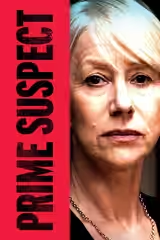
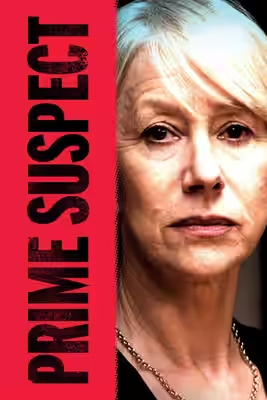
Wallander and Prime Suspect are both about detectives worn down by the job, but Prime Suspect is the better series. Helen Mirren's Jane Tennison is right, tired and resented for being both, and her first story is as good as British crime television has been. Wallander has the stronger look, with its bleached Swedish light and shallow focus, and the sadder lead, but its cases are weaker and its misery becomes a habit by the third series.

Cast

Awards

Satellite Award for Best Miniseries or Television Film, 2012

Nominated
Satellite Award for Best Miniseries or Television Film

BAFTA Television Awards, 2010

Won
Best Actor

BAFTA Television Awards, 2009

Won
Best Drama Series

Primetime Emmy Awards, 2009

Nominated
Outstanding Directing for a Limited Series, Movie, or Dramatic Special
Nominated
Outstanding Lead Actor in a Miniseries or a Movie

Satellite Award for Best Miniseries, 2009

Nominated
Satellite Award for Best Miniseries

If you liked this, try…

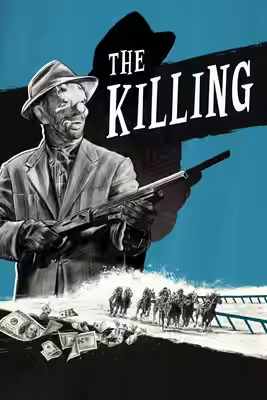
  1. The Killing (2007) · not reviewed yetDanish, twenty hours, one case, and a detective in a jumper who never goes home.

  2. Prime Suspect (1991, Fi1m 88)Helen Mirren’s Jane Tennison, the British original for a detective worn down by the job.

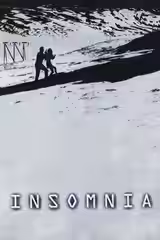
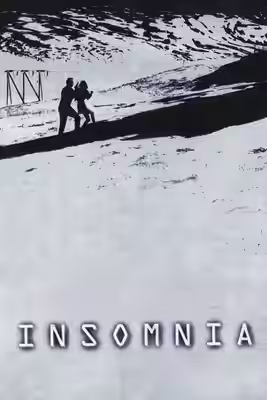
  3. Insomnia (1997) · not reviewed yetA Norwegian policeman in midnight sun who cannot sleep; Stellan Skarsgård at his most exhausted.

  4. Hinterland (2013) · not reviewed yetWelsh coast, grey light, a haunted inspector; the same mood with less sunshine.

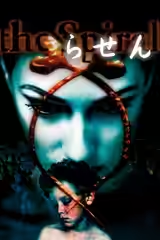
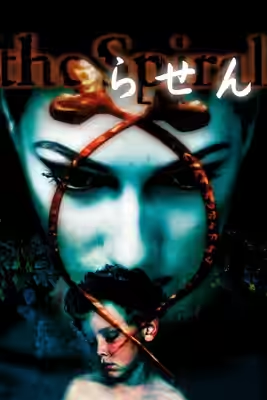
  5. Spiral (2005) · not reviewed yetFrench police procedure with real teeth, and a cast that ages across its eight series.

Free account

Know what to watch tonight

Two lists that know where things are streaming, collections you can share, your own score beside ours, and Discover that remembers what you have seen.

  • Want to see, sorted by what is streaming now
  • Seen, with your score out of ten
  • No adverts, ever