Toby Haynes uses the camera to keep large-scale television close to its characters. We rate his patient, character-led approach, though Andor also shows how slowly it can get started.
Fi1m perspective
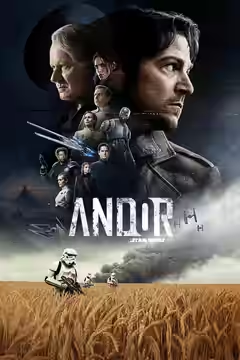
Toby Haynes switches between controlled shots and energetic handheld camerawork to put us alongside his characters. We value that flexibility: the camera need not keep announcing the director when there are people worth watching. In Andor (2022), he directed six episodes of the first series, helping establish its grounded, character-led approach. The thriller works because the ordinary lives under the Empire are worth caring about.
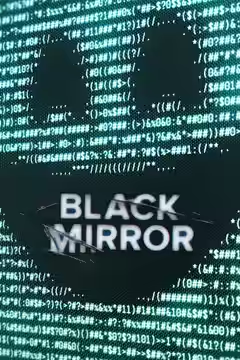
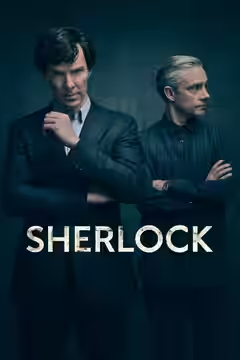
Doctor Who (2010–11) gave Haynes room for large-scale science fiction, followed by Sherlock's The Reichenbach Fall (2012). The more revealing change came with Jonathan Strange & Mr Norrell (2015): all seven episodes were his. That meant carrying a visual approach through a whole adaptation, rather than contributing to an established programme. Black Mirror's USS Callister (2017) brought another science-fiction assignment. By Andor, he was again working across a substantial part of a series.
Haynes works early with writers to build visual and narrative choices into scripts, and takes a clear plan to the set without insisting it remain unchanged. These are useful habits for a director moving between programmes whose identities are already established. His collaborators include writer and showrunner Tony Gilroy, so there is no reason to mistake Andor for a solo achievement. Still, the series makes a persuasive case for giving Haynes room to stay with characters rather than hurry them through the plot.
Andor also supplies the caveat: its opening takes too long to find its shape. A firmer opening would not have made its people any less convincing. We were gripped once its ordinary people and their surroundings had become familiar enough for us to worry about them. The performances repay that attention, which is why the slow start remains a reservation rather than a reason to stay away. Begin there, and give it a little more time than the opening quite earns.
Biography
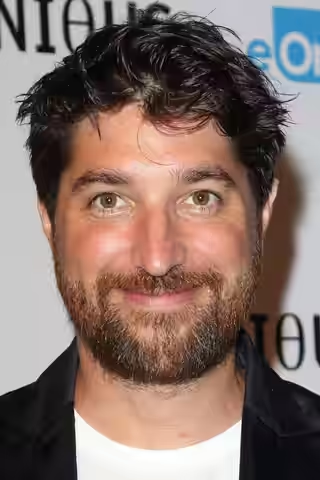
Toby Haynes is a British television director. Born in October 1977, he is a graduate of the National Film and Television School and an alumnus of Falmouth University.
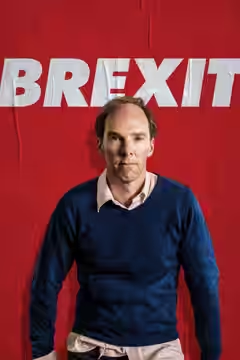
He has directed episodes of Doctor Who (2010–2011), Sherlock (2012), Black Mirror (2017–2025) and Andor (2022). He also directed the Channel 4/HBO television film Brexit: The Uncivil War (2019).
Haynes won the Hugo Award for Best Dramatic Presentation (Short Form) for the Doctor Who episodes "The Pandorica Opens" and "The Big Bang" (2010).