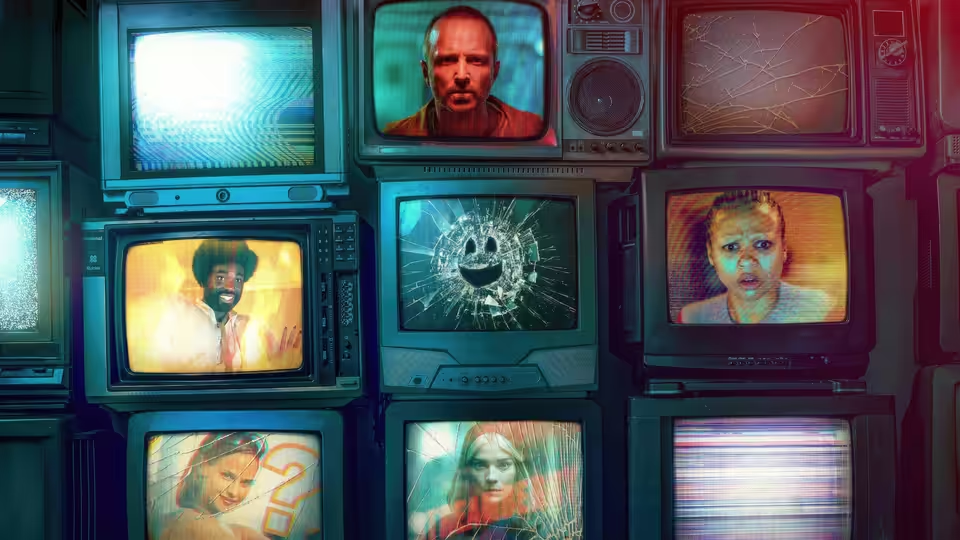
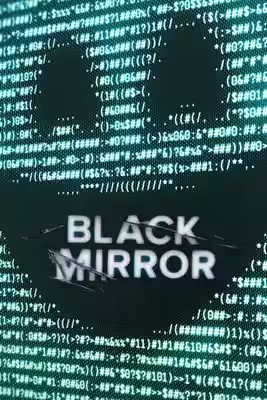
We recommend Black Mirror for its straight-faced absurdity and performances that make the distress matter. Its weakness is a tendency to keep tightening the screws after the point is already clear.
Black Mirror is a sharp, upsetting anthology that we recommend with one reservation: it can be too pleased with how much it makes its characters suffer. Charlie Brooker and his fellow writers examine familiar appetites for amusement and other people’s trouble through science fiction and satire. The opening story establishes the method through a political crisis played with an almost unreasonable degree of seriousness. The ridiculous premise gets its chance because the people inside it cannot afford to find it ridiculous.
Rory Kinnear’s Michael Callow is a prime minister facing an impossible dilemma, while public opinion and the media help make his situation worse. Kinnear gives the distress enough weight to prevent the episode becoming merely an extended offensive joke. We laughed at the solemn handling of the predicament, then felt uncomfortable about laughing, because he makes the man caught in it seem painfully credible. The surrounding media frenzy is recognisable enough to make the episode difficult to dismiss as mere provocation.
The cinematographers include Lol Crawley and Zac Nicholson, and the photography is most convincing in its attention to faces. Embarrassment and fear need to register for these stories to work, and the visual restraint helps them do so. The production design, with Joel Collins among its contributors, is similarly effective when the surroundings feel ordinary enough to accept without inspection. A recognisable setting gives us less excuse to dismiss the behaviour as something belonging to an impossible future.
The editing, with Tony Kearns among its contributors, is good at making an unpleasant prospect feel steadily harder to avoid. Waiting becomes part of the discomfort, and the stronger stretches let us sit with it rather than hurrying towards another surprise. Daniel Pemberton is among the composers, and the music supports the seriousness with which these stories treat their unlikely situations. The tension works, though the insistence can become tiring when a story has already made its danger quite clear.
The limitation is that the writing sometimes seems more interested in securing our horror than in letting people behave unexpectedly. Once the likely consequences are clear, another stretch of distress can feel repetitive, however skilfully it is staged. Brooker and his fellow writers do not always give the characters enough freedom to complicate the lesson. This is where the severity becomes wearing: we start noticing how firmly everything has been arranged to produce our next appalled reaction.
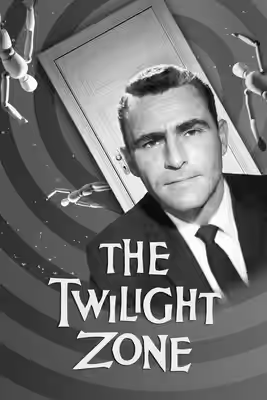
The Twilight Zone is the useful comparison, because the appeal lies in entering a separate disturbing story and discovering which ordinary weakness it has chosen to examine. Black Mirror earns that company through its ability to make an outrageous starting point feel plausible. Its less successful stretches are easier to anticipate than they should be, especially when suspicion has already become our default response. The satire is sharper when the behaviour surprises us instead of merely confirming that people can be cruel.
The acting and straight-faced humour are good enough to justify the occasional bout of over-insistence. We would take these stories one at a time, allowing the discomfort to settle before inviting more. Choose it for an evening when an argument afterwards would count as part of the entertainment.