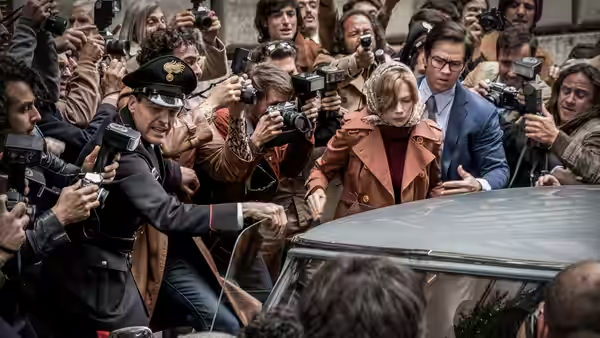
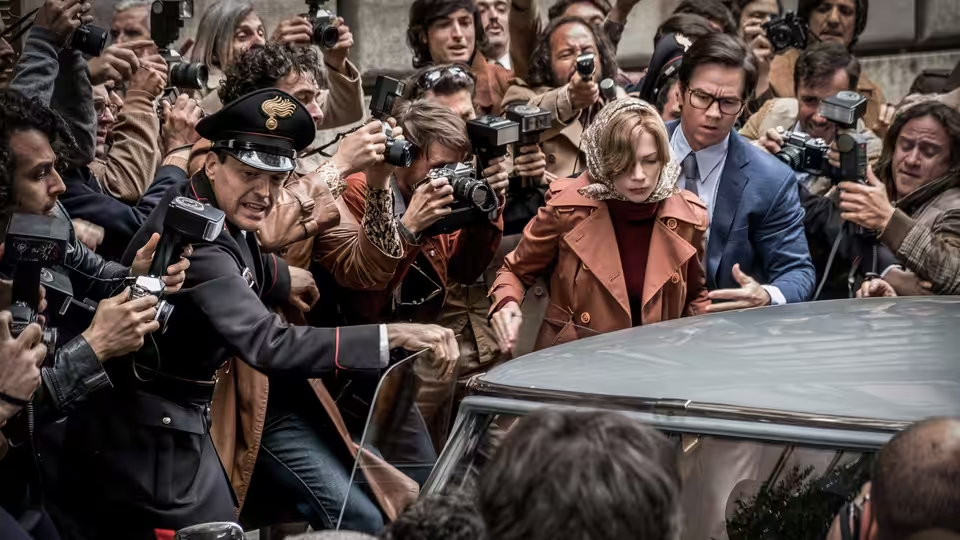
Gail Harris (Michelle Williams) and Fletcher Chase (Mark Wahlberg) push through photographers beside a car
Film review

All the Money in the World

2017 · Directed by Ridley Scott · 2h 12m · FSK 12

In a sentenceThe richest man in the world installs a payphone for his guests, and that is the whole film in one prop

Rome, 1973. John Paul Getty III (Charlie Plummer), sixteen and grandson of the richest man in the world, is pulled into a van off a night street by men who want 17 million dollars. His mother, Gail Harris (Michelle Williams), divorced from his father John Paul Getty II (Andrew Buchan) and with no Getty money of her own, goes to the old man. Jean Paul Getty (Christopher Plummer), at Sutton Place outside London among the paintings he does pay for, says no: a ransom paid is a price set on his other grandchildren. He sends his fixer, former CIA man Fletcher Chase (Mark Wahlberg), to Rome to settle it cheaply. The boy sits chained in a Calabrian farmhouse with Cinquanta (Romain Duris), the one kidnapper who talks to him.

Plays from YouTube when you press play; nothing loads from them until then.

Fi1m review

Ridley Scott’s Getty kidnapping thriller is handsomely made and has one great thing in it: Christopher Plummer, drafted in late and better than the film around him. The rest is well played, slack in the middle and unsure whose story it is.

Ridley Scott has made a film about a man who could afford anything and would not pay for his grandson. In 1973 the sixteen-year-old John Paul Getty III (Charlie Plummer) is taken off a Rome street by men who want 17 million dollars, and his grandfather, Jean Paul Getty (Christopher Plummer), announces that he will give them nothing. David Scarpa’s script follows three people who cannot agree on what the boy is worth. It is a good subject and a handsome, airless film with one performance we would send anyone to see.

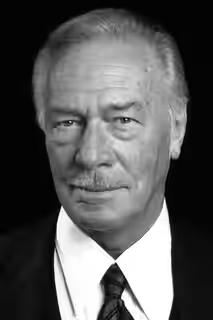
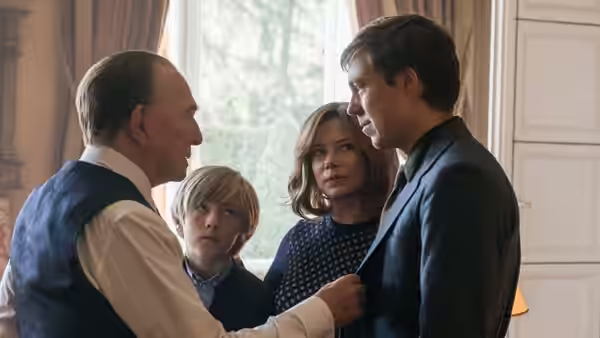
That performance was shot in a hurry after Scott recast the part weeks before release, and you would not know it. Christopher Plummer plays Getty as a man who has mistaken his money for a philosophy. He tells a journalist he trusts objects because they do not change, and he has a payphone installed at Sutton Place so his guests will not run up his bill. Plummer does not play him as a monster. He plays him as reasonable, with a twinkle, and that is far worse. When he explained why paying would put a price on his other grandchildren, we followed the logic for a second before we caught up with ourselves, and it chilled us. The film knows what it has and cuts back to him whenever the Italian scenes flag.

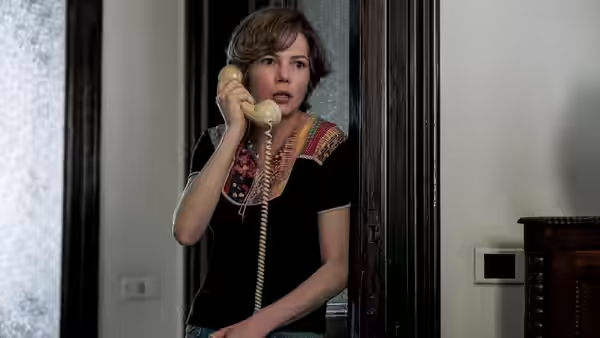
Michelle Williams gives Gail a clipped, old-money voice and a face that has decided not to crack in public. Her best scenes are with the press, who want a weeping mother and get a woman reading a statement, and with Getty, who treats her as a servant asking for a raise. The script keeps pulling her off the board. She spends long stretches on the telephone or waiting while the film goes to Calabria or into the past, and it is weaker every time it leaves her.

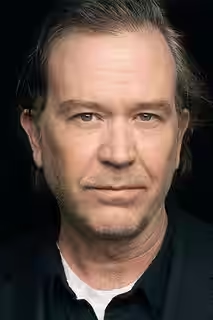
Mark Wahlberg’s Fletcher Chase is the trouble. He is a former CIA man turned Getty fixer, and the script gives him the film’s change of heart, from the old man’s errand boy to his accuser, when the mother has far more right to it. Wahlberg plays it in sideburns and a drawl and never convinces as a man who reads people for a living. Timothy Hutton, as Getty’s adviser Oswald Hinge, does more with less. The flashbacks explaining how Getty got rich and how his son (Andrew Buchan) fell apart land in the first act in a lump, and Claire Simpson’s cutting, quick elsewhere, cannot hide that the film has stopped to read us the family history.

Dariusz Wolski shoots Rome at night in smoky amber and Sutton Place in flat grey daylight, so the boy’s world is warm and the old man’s is cold. Arthur Max fills Getty’s rooms with marble and canvases and leaves the kidnappers’ farmhouse as bare stone and one chain. Janty Yates puts Gail in dark, sharp-shouldered coats and Getty in suits he has owned for decades. Daniel Pemberton’s score keeps a low, nagging pulse of strings under the ransom calls and drops out when Plummer is talking. None of this is the problem.

Charlie Plummer spends most of the film chained to a wall, and he is good at the slow business of a boy working out that nobody is coming. Romain Duris, as the kidnapper Cinquanta, offers him the only tenderness in the picture, and their scenes are the quietest and best after the old man’s. Then the negotiations drag, the second half takes a turn we will not describe, and the film works itself up to a chase through a hill town that belongs to a sillier picture. By then we had started checking the time, which we did not expect.

Scott’s best thrillers keep several places alive at once. Here Rome, Sutton Place and Calabria take turns, each waiting politely for the others to finish. At 132 minutes, with a 15 certificate, it has the shape of a thriller and the pace of a deposition. See it for Christopher Plummer and for Williams, at home, where you can get up during the flashbacks and nobody will mind.

Critical consensus AI synthesised

64
Positive
14
Mixed
9
Negative
5

Most critics come down on the positive side, if not by much, and almost all of them agree on one thing: Christopher Plummer. His J. Paul Getty, filmed in a hurry after the recasting, is named as the film’s best element more often than anything else, praised for its authority, its iciness and an unexpected pathos. Michelle Williams’s Gail draws the next most praise, and several reviews credit Ridley Scott with making the late reshoots invisible and keeping the thriller brisk.

The spread is wide. The reservations cluster on pace and feeling: a good number of critics find the film detached, plodding or mechanical, with the ransom plot slow to generate tension and the characters thinly drawn. Slant and The Ringer go furthest, finding it tasteless and flat, while Paste dissents on Plummer himself, calling the rushed performance out of place. Collider, among others, objects that Williams is sidelined when she should be central.

The Hollywood Reporter
19 December 2017 · Todd McCarthy
90*

McCarthy gives the film an enthusiastic verdict, calling it a gripping and propulsive thriller. He especially praises Christopher Plummer’s authoritative performance and Michelle Williams’s resourceful portrayal of Gail.

Read the full review →
Los Angeles Times
21 December 2017 · Kenneth Turan
82*

Turan finds the film worth seeing, praising Ridley Scott’s ability to make the last-minute recasting feel seamless. He particularly singles out Christopher Plummer’s portrayal of J. Paul Getty, while also commending Michelle Williams’s performance.

Read the full review →
Little White Lies
4 January 2018 · 3/4/3 · Hannah Strong
80

Strong finds flashes of greatness in the film but says its hero complex dampens them. She praises Christopher Plummer and Michelle Williams while criticizing the framing of Mark Wahlberg’s character as heroic.

Read the full review →
The i Paper
29 December 2017 · Geoffrey Macnab
80*

Macnab argues that replacing Spacey with Plummer was the right move and that the film benefits from Plummer’s performance. He especially praises Plummer’s portrayal of Getty as both a victim and a villain, with gravitas and pathos.

Read the full review →
Total Film
21 December 2017 · ★★★★ · Kevin Harley
80

Harley praises the film as a lean, intelligent thriller, with Scott directing it briskly despite the challenges surrounding its production. He singles out Christopher Plummer’s nuanced performance and Michelle Williams’s convincing lead turn.

Read the full review →
Empire
20 December 2017 · Nick de Semlyen
75*

The critic finds the thriller consistently gripping and its study of money and greed terrific, despite some reliance on cliché. Christopher Plummer’s complex, icy performance as J. Paul Getty is singled out as the film’s best element.

Read the full review →

Straight answers AI written, from our review

Is All the Money in the World worth watching?
All the Money in the World is worth watching for Christopher Plummer's performance as Jean Paul Getty, and we scored it 63. The rest is handsomely made but slack in the middle, unsure whether it belongs to the mother, the fixer or the boy, and best seen at home where you can step out during the flashbacks.
How long is All the Money in the World, and what is it rated?
All the Money in the World runs 2h 12m and is rated 12 by the FSK in Austria. It is a crime and history film.
Where can I watch All the Money in the World in Austria?
All the Money in the World is available to rent from Amazon Prime Video and Apple TV from €2.99. Availability is checked daily; the links above go straight to each service.
How violent or frightening is All the Money in the World, and is it suitable for children?
All the Money in the World carries a UK 15 certificate and is not for children. It is a kidnapping story about a sixteen-year-old held chained in a farmhouse, with a ransom plot and a late turn we will not describe, so expect menace and cruelty rather than constant bloodshed. Older teenagers should manage it; the squeamish may find one stretch hard.
How does All the Money in the World compare to Dog Day Afternoon?
All the Money in the World and Dog Day Afternoon are both true hostage stories, but Sidney Lumet's film is the better and the livelier of the two. Scott's picture is cool, handsome and airless, propped up by one great performance, while Lumet's is sweaty, funny and far more interested in its people. Choose Scott for Plummer, Lumet for the whole ensemble.
What should I watch after All the Money in the World?
After All the Money in the World, try Dog Day Afternoon (1975, Fi1m 90): Another true hostage case, this one sweaty, loud and far more interested in its people. Then There Will Be Blood (2007, Fi1m 88): Oil money as a disease; Daniel Day-Lewis makes Getty look positively clubbable; and Citizen Kane (1941, Fi1m 93): The original rich man surrounded by things; shorter, and sure of what it thinks.

Cast

Awards

Academy Awards, 2018

Nominated
Best Supporting Actor

If you liked this, try…

  1. Dog Day Afternoon (1975, Fi1m 90)Another true hostage case, this one sweaty, loud and far more interested in its people.

  2. Trust (2018) · not reviewed yetThe same kidnapping as a series, with Donald Sutherland as a Getty who enjoys himself.

  3. There Will Be Blood (2007, Fi1m 88)Oil money as a disease; Daniel Day-Lewis makes Getty look positively clubbable.

  4. Il Divo (2008) · not reviewed yetSorrentino on Italian power in the same decade, with the wit this film’s Rome lacks.

  5. Citizen Kane (1941, Fi1m 93)The original rich man surrounded by things; shorter, and sure of what it thinks.