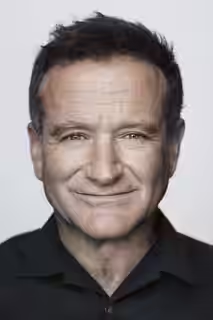
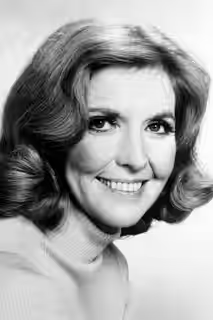
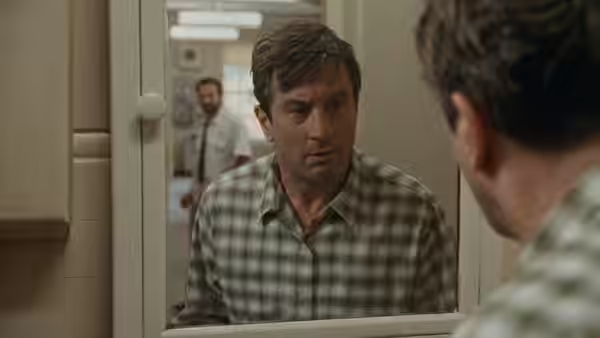
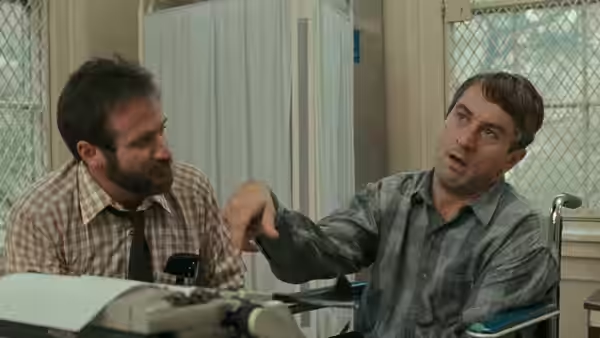
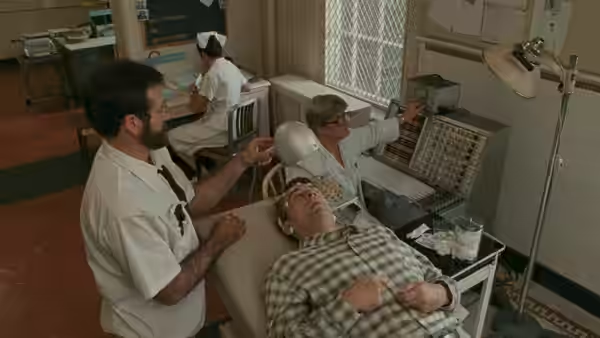
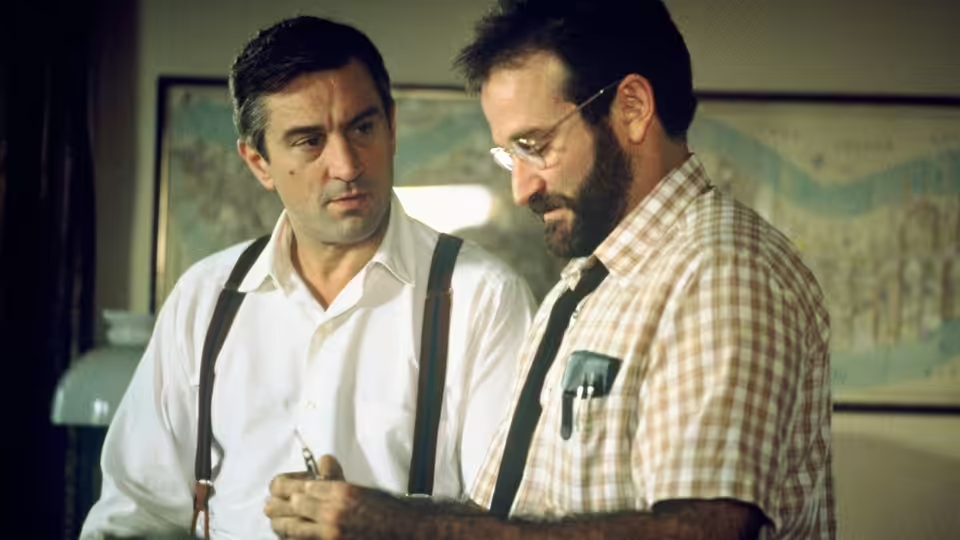
Malcolm Sayer (Robin Williams) standing beside a colleague holding a pen
Film review

Awakenings

1990 · Directed by Penny Marshall · 2h 00m

In a sentenceRobin Williams and Robert De Niro earn the tears, then the music asks for a few more

Malcolm Sayer (Robin Williams) works with patients affected by encephalitis, including Leonard Lowe (Robert De Niro). The drug L-DOPA offers the possibility of bringing them out of catatonia, raising questions about consciousness, identity and what treatment can restore. Sayer investigates its potential while trying to understand the people in his care. Penny Marshall directs Steven Zaillian’s dramatisation of Oliver Sacks’s work. Julie Kavner plays Eleanor Costello, with John Heard as Dr. Kaufman, Ruth Nelson as Mrs. Lowe and Penelope Ann Miller as Paula.

Fi1m review

Penny Marshall’s medical drama is worth an evening for Robert De Niro and Robin Williams, who make its concern for the patients convincing. The script and score could afford to press less hard.

Awakenings is a moving drama with a persistent habit of telling us how moved we ought to be. Penny Marshall approaches the treatment of post-encephalitic patients with tenderness, asking us to consider how much of a person can remain beyond anyone else’s reach. Steven Zaillian’s screenplay, drawn from Oliver Sacks’s work, makes a complicated medical subject accessible without burying us in explanations. It also makes the emotional questions rather tidier than we would like, particularly when illness becomes an invitation to appreciate ordinary life.

Robin Williams plays Malcolm Sayer with a reserve that makes his attention to other people matter. He allows uncertainty to remain visible, so the doctor’s concern does not feel like something the screenplay has simply instructed us to accept. We were moved by the awkward care he brings to his exchanges with De Niro, because he makes the effort of understanding another person seem difficult and worth continuing. Williams gives Sayer enough hesitancy to suggest that his own good intentions are not always much help to him.

Robert De Niro’s Leonard Lowe is the more visibly demanding part, with its considerable burden of physical expression. There is a risk that we will spend our time assessing the actor’s technique, and occasionally the effort does draw attention to itself. But De Niro keeps Leonard’s individuality clear enough that we want to know about him beyond his medical condition. His performance gives Marshall’s concern for the patients substance, especially when Zaillian’s writing seems ready to settle for a general declaration about the value of being alive.

Miroslav Ondříček’s cinematography makes the small changes in the actors’ faces count, supporting performances that need our close attention. Anton Furst’s production design gives the clinical setting a solidity that helps the medical work feel credible. We appreciate how little either contribution competes with the people we are watching. Marshall’s direction is strongest in this quieter approach, allowing an actor’s uncertainty to hold our attention without immediately resolving it into something comforting.

Editors Gerald B. Greenberg and Battle Davis keep the medical story intelligible, though the pacing leaves too little room to sit with its difficulties. The film moves so neatly between emotional points that we begin to notice how carefully our responses have been anticipated. Randy Newman’s score compounds the problem by insisting on tenderness already present in the acting. We wanted it to quieten down and leave Williams and De Niro to finish the job, particularly when their restraint was doing enough.

Most critics disagree with us, judging the sentimentality more damaging than we do. We share their irritation at being prompted, but think they undervalue what the central performances achieve. Medical dramas can reduce patients to problems for a gifted doctor to solve, and Marshall does not entirely escape that habit. Yet De Niro gives Leonard enough individual presence, and Williams makes Sayer sufficiently uncertain, for their relationship to remain interesting beyond the question of whether a treatment works.

The script’s simplifications will frustrate anyone hoping for a more searching account of medicine and responsibility. For an evening built around two careful performances, though, we recommend it. Marshall gives those actors enough space to make the concern for her patients believable, even when she cannot resist helping them along. Bring tissues, and allow for the occasional sigh at the score.

Critical consensus AI synthesised

56
Positive
2
Mixed
1
Negative
3

The reviews are divided, with more critics finding fault than offering a firm recommendation. Praise clusters around Williams and De Niro: even some detractors admire their performances, and De Niro receives particular credit for giving the film force despite its sentimentality. The more favourable accounts find an absorbing treatment of Oliver Sacks’s work, attentive to the fragility of personality and the extraordinary circumstances of the patients.

The wide spread rests largely on whether the emotion feels earned. RogerEbert.com regards the film as an intelligent exploration of consciousness, while The New York Times sees an extraordinary true story simplified into a sentimental fairy tale. Across the less favourable reviews, the recurring complaint is that emotional manipulation replaces a fuller engagement with the patients’ experience. Reservations extend to the direction and score, which critics fault for favouring reassurance and warmth over realism and the story’s more frightening implications.

RogerEbert.com
20 December 1990 · Roger Ebert
90*

The film intelligently examines the bizarre human condition of post-encephalitic patients awakened by L-DOPA, with strong performances from De Niro and Williams. It meditates on the wonder and fragility of human personality and consciousness.

Read the full review →
Radio Times
★★★★ · Peter Freedman
80

A powerful dramatisation of Oliver Sacks's real-life work that Williams and De Niro bring to life effectively, delivering an absorbing treatment of an intriguing subject despite some mixed original reviews.

Read the full review →
Los Angeles Times
11 January 1991 · Peter Rainer
45*

The raw material is powerful but the film reduces it to a sanitized, grade-A tear-jerker with too much reticence and condescension toward the patients. Marshall's direction keeps it from fully engaging with the terror or depth of the story.

Read the full review →
Empire
1 January 2000 · Phil Thomas
40*

The critic views the film as a clinical, manipulative exercise in emotional button-pushing with a sentimental score that prioritizes warmth over realism. De Niro's performance stands out as a major plus amid the forced sentimentality.

Read the full review →
The New York Times
20 December 1990 · Janet Maslin
40*

Marshall's film sentimentalizes and oversimplifies the true story from Oliver Sacks's book into a fairy tale. It turns extraordinary facts into banal, one-idea-at-a-time emotional manipulation despite some technical virtues.

Read the full review →
Time Out
10 September 2012 · BC
40*

The film is overly sentimental and manipulative, akin to Rain Man in its focus on catatonia and easy emotional appeals, though it features strong turns from Williams and De Niro.

Read the full review →

Straight answers AI written, from our review

Is Awakenings worth watching?
Awakenings is worth watching for two careful central performances, and we scored it 73. Robin Williams and Robert De Niro make Penny Marshall's concern for her patients believable, though Steven Zaillian's script tidies the emotional questions and Randy Newman's score presses for tears the acting has already earned. Suits anyone who can forgive a medical drama for nudging them.
How long is Awakenings, and what is it rated?
Awakenings runs 2h 00m. It is a drama film.
Where can I watch Awakenings in Belgium?
Awakenings is available to rent from Amazon Prime Video from €3.99. Availability is checked daily; the links above go straight to each service.
How violent or frightening is Awakenings, and is it suitable for children?
Awakenings carries a UK 12 certificate and contains no violence to speak of. It is a medical drama about patients in catatonia and the drug that may bring them out of it, so the distress is emotional rather than frightening. Older children should cope, though the subject of illness and what treatment can and cannot restore may upset younger or more sensitive viewers.
How does Awakenings compare to The Diving Bell and the Butterfly?
Awakenings is the gentler and more conventional of the two, while The Diving Bell and the Butterfly is the more adventurous account of a mind confined by a failing body. Julian Schnabel's film is funnier, occasionally frightening and keeps its subject a complicated man throughout; Marshall's simplifies its questions but rests on two performances of real care. Choose Schnabel for boldness, Marshall for warmth.
What should I watch after Awakenings?
After Awakenings, try The Diving Bell and the Butterfly (2007, Fi1m 87): A more adventurous approach to consciousness and personality under severe physical restriction. Then Ikiru (1952, Fi1m 92): A reserved man faces illness and the practical question of how to live usefully; and The Straight Story (1999, Fi1m 88): Patient observation and physical frailty give a modest journey considerable emotional weight.

Cast

Awards

Academy Awards, 1991

Nominated
Best Actor
Nominated
Best Picture
Nominated
Best Writing, Adapted Screenplay

If you liked this, try…

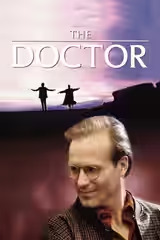
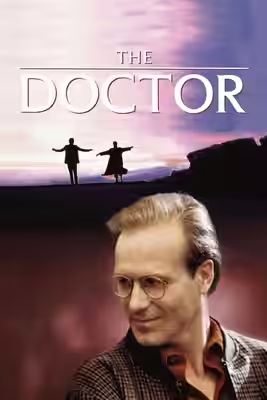
  1. The Doctor (1991) · not reviewed yetA doctor’s illness tests his bedside manner, with little room left for professional evasions.

  2. The Diving Bell and the Butterfly (2007, Fi1m 87)A more adventurous approach to consciousness and personality under severe physical restriction.

  3. Ikiru (1952, Fi1m 92)A reserved man faces illness and the practical question of how to live usefully.

  4. The Straight Story (1999, Fi1m 88)Patient observation and physical frailty give a modest journey considerable emotional weight.

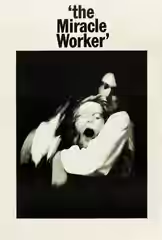
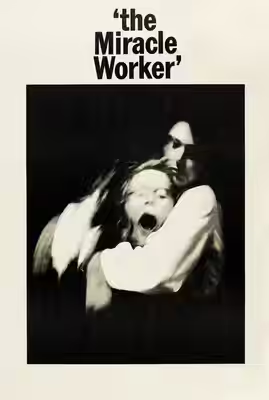
  5. The Miracle Worker (1962) · not reviewed yetTeaching becomes demanding physical work in a drama that earns its emotion.

Free account

Know what to watch tonight

Two lists that know where things are streaming, collections you can share, your own score beside ours, and Discover that remembers what you have seen.

  • Want to see, sorted by what is streaming now
  • Seen, with your score out of ten
  • No adverts, ever