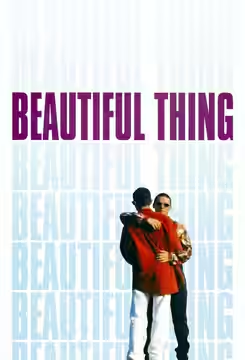
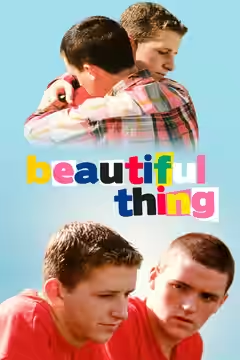
Two teenage boys in red shirts sit side by side on a bench
Film review

Beautiful Thing

1996 · Directed by Hettie Macdonald · 1h 32m

In a sentenceThe boys are trying to fall in love; Linda Henry is making it difficult to watch anyone else

Jamie Gangel (Glen Berry) and Steven Pearce (Scott Neal) are teenage neighbours on a working-class housing estate in Thamesmead, London. As they discover they are gay, their relationship develops into a romance. Around them are Sandra Gangel (Linda Henry), a single mother, Leah (Tameka Empson) and Tony (Ben Daniels). Their feelings take shape within a community whose other residents have lives and concerns of their own. Hettie Macdonald directs Jonathan Harvey’s screenplay, following the two boys as they begin to understand what they want from each other.

Plays from YouTube when you press play; nothing loads from them until then.

Fi1m review

Beautiful Thing is a funny, affecting teenage romance, with Linda Henry giving its tenderness some needed bite. The boys deserve fuller lives on the page, but the performances make their attraction matter.

Beautiful Thing makes a modest promise: two shy teenage neighbours might find love, even with everyone else carrying on around them. Hettie Macdonald’s film is warm, funny and worth an evening, though its central characters could have been written more fully. Jonathan Harvey’s screenplay places their attraction within a working-class London neighbourhood that has other people to worry about. The boys matter without everyone else having to become an obstacle or a lesson.

Glen Berry’s Jamie Gangel and Scott Neal’s Steven Pearce are persuasive because neither performance makes adolescent uncertainty look tidy. Their shyness gives the romance its pace, and the rawness of the acting suits characters who have not worked out how to be at ease with themselves. We were moved by how awkward they are together. Berry and Neal make being liked feel like something these boys can scarcely allow themselves to expect, which gives their attraction more weight than a polished declaration would.

Linda Henry, as Sandra Gangel, is the strongest reason to keep looking beyond the couple. She gives the single mother a force that makes affection and exasperation seem equally plausible, and she can dominate the comedy without seeming to have stepped into a different film. Harvey allows the supporting characters their own awkwardness and contradictions, rather than making them uniformly wise or cruel. Tameka Empson’s Leah belongs to that busier, less predictable part of the story, and helps stop the romance from becoming too solemn.

Chris Seager’s cinematography gives Thamesmead a useful familiarity: we can accept this estate as home without being asked to admire it. Mark Stevenson’s production design supports that everyday setting, keeping the neighbourhood credible alongside the broader comedy. Neither contribution calls much attention to itself, and that restraint suits a film so interested in its supporting characters. A stronger visual shape would have helped, but the setting gives these encounters a convincing place to happen.

Don Fairservice’s editing does not quite solve the problem of getting from one good exchange to the next. The film can feel loosely assembled, with individual performances doing more to hold our attention than the movement of the story. The more serious limitation is in Harvey’s writing of the leads, whose emerging sexuality is clearer than the rest of their personalities. Berry and Neal persuade us to care, but we wanted more of the ordinary detail that would distinguish them away from the romance.

John Altman’s score helps sustain the tenderness when the surrounding comedy threatens to overwhelm it. The songs by the Mamas & the Papas make the stronger impression, bringing a more immediate warmth to the boys’ hesitant romance. The music suits Macdonald’s willingness to be sentimental, which is one of her better decisions. It helps us accept tenderness as part of these lives without demanding that we forget their difficulties.

As a coming-out romance, this is refreshingly willing to let adolescent desire be funny without treating the adolescents as a joke. Macdonald does not need every neighbour to be admirable for the neighbourhood to contain affection. That makes a welcome change from dramas in which working-class life seems to offer nothing except another reason to be miserable. Choose it for a tender romance, with the caveat that the people beside the couple sometimes get the better writing.


Critical consensus AI synthesised

76
Positive
6
Mixed
2
Negative
0

With only 5 reviews in so far, most critics respond warmly to Beautiful Thing’s working-class teenage romance, praising the raw-edged performances, humour and lively supporting characters. The young leads earn praise, with Linda Henry’s single mother also singled out. Reservations concern depth and cinematic shape rather than the film’s warmth. Slant Magazine finds the adolescent emotions honest and the supporting characters complex. RogerEbert.com sees the central pair as underdeveloped and finds more interest in those around them. Variety enjoys the comedy and fresh performances but finds it lacking in cinematic shape. The spread is favourable to mixed, with no outright rejection.

Film Comment
25 April 2018 · Michael Koresky
90*

The critic praises the film's tender, rough-edged coming-out story and its unusually positive, non-miserabilist take on working-class queer youth in 1990s London. They single out the memorable use of Mamas & the Papas songs and the film's sense of place and hopeful ending as standout elements.

Read the full review →
Time Out
17 November 2015 · TCh
90*

The critic calls it a real winner and an urban fairytale set in Thamesmead. They single out the funny romantic screenplay and Linda Henry's formidable performance as the standout elements that make it a likely gay crossover hit.

Read the full review →
Little White Lies
21 June 2021 · Emily Maskell
85*

The critic praises Hettie Macdonald’s 1996 film as a grounded, kitchen-sink ode to queer youth and acceptance set on a South London council estate. She singles out its tender, non-explicit portrayal of the boys’ budding intimacy and the defiant, hopeful ending of communal acceptance.

Read the full review →
Slant Magazine
27 April 2003 · Eric Henderson
80*

The critic calls the film one of the most honest and moving gay youth dramas, praising its realistic take on adolescent agony giving way to romance and its complex supporting characters.

Read the full review →
The New York Times
9 October 1996 · Stephen Holden
75*

The film is a well-acted Cinderella story about two shy gay teenagers falling in love in a working-class London housing project, buoyed by strong performances from the young leads.

Read the full review →
Variety
4 March 1996 · festival review · Derek Elley
70*

This rough-and-ready working-class comedy with a feel-good gay theme features fresh performances from unknowns and an infectiously funny tone, though it lacks cinematic shape.

Read the full review →

Straight answers AI written, from our review

Is Beautiful Thing worth watching?
Beautiful Thing is worth watching for anyone who wants a funny, tender teenage romance, and we scored it 80. Glen Berry and Scott Neal make the boys' awkwardness moving, and Linda Henry's single mother is the reason to keep looking beyond the couple. The leads are thinly written away from the romance, and the film feels loosely put together, but the performances carry it.
How long is Beautiful Thing, and what is it rated?
Beautiful Thing runs 1h 32m. It is a comedy and drama film.
Where can I watch Beautiful Thing in Italy?
Beautiful Thing is not on any streaming or rental service in Italy at the moment. It is available in 8 other countries; change your country at the top of the page to see where. Availability is checked daily.
How violent or frightening is Beautiful Thing, and is it suitable for children?
Beautiful Thing is a UK 15 comedy-drama about two teenage boys falling in love on a London estate, and it is neither violent nor frightening. The certificate reflects adult language and sexual content rather than anything alarming, so it is not for young children but suits older teenagers. The squeamish have little to fear; the film's difficulties are emotional, not physical.
How does Beautiful Thing compare to My Beautiful Laundrette?
Beautiful Thing is the gentler and smaller of the two, a shy teenage romance in which the neighbours have the sharper lines; My Beautiful Laundrette is busier, funnier about money and more crowded with subplots. Choose the earlier film for a romance tangled up with class and ambition, and this one for something more tender and more modest. Both are let down slightly by their structure and saved by their casts.
What should I watch after Beautiful Thing?
After Beautiful Thing, try My Beautiful Laundrette (1985, Fi1m 85): Another London romance with class, desire and difficult relatives competing for attention. Then Weekend (2011, Fi1m 86): For the hesitant conversation and small risks that make a new attraction matter.

Cast

Awards

Young European Film of the Year, 1996

Nominated
Young European Film of the Year

If you liked this, try…

  1. My Beautiful Laundrette (1985, Fi1m 85)Another London romance with class, desire and difficult relatives competing for attention.

  2. Show Me Love (1998) · not reviewed yetFor teenage longing, social embarrassment and young performances allowed to remain awkward.

  3. The Way He Looks (2014) · not reviewed yetA gentler adolescent romance that takes wanting independence as seriously as wanting affection.

  4. Saving Face (2004) · not reviewed yetA warm queer romance whose family complications deserve as much attention as the couple.

  5. Weekend (2011, Fi1m 86)For the hesitant conversation and small risks that make a new attraction matter.

Free account

Know what to watch tonight

Two lists that know where things are streaming, collections you can share, your own score beside ours, and Discover that remembers what you have seen.

  • Want to see, sorted by what is streaming now
  • Seen, with your score out of ten
  • No adverts, ever