Beginners is worth an evening for its humour and Christopher Plummer, though its tentative romance sometimes becomes merely hesitant. Mike Mills finds real feeling in the pauses, but leaves a few too many of them.
Beginners is a good, occasionally over-careful romance about accepting affection when grief already takes up much of the day. Mike Mills, who writes and directs, allows unhappiness to make people awkward without treating that awkwardness as a permanent excuse. We recommend it with a reservation about how often its central romance stalls. There are stretches when the hesitancy becomes trying, but the humour usually arrives before the film grows solemn.
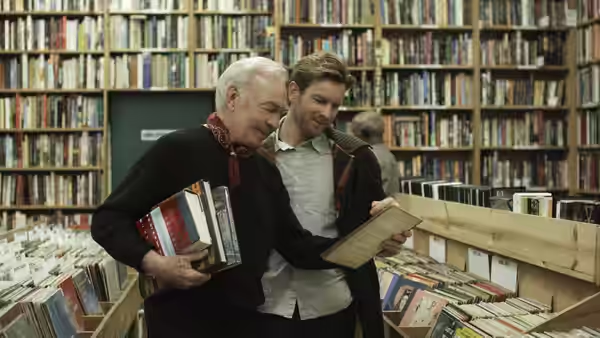
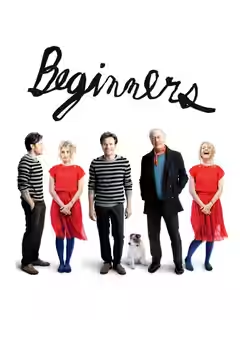
Christopher Plummer gives Hal Fields the warmth that keeps the film from becoming too pleased with its sensitivity. He seems interested in whoever is beside him, which gives his humour an ease some of the more tentative exchanges lack. The affecting passages are easier to accept because there is also such pleasure in watching him enjoy himself. He makes the film feel more sociable whenever he appears.
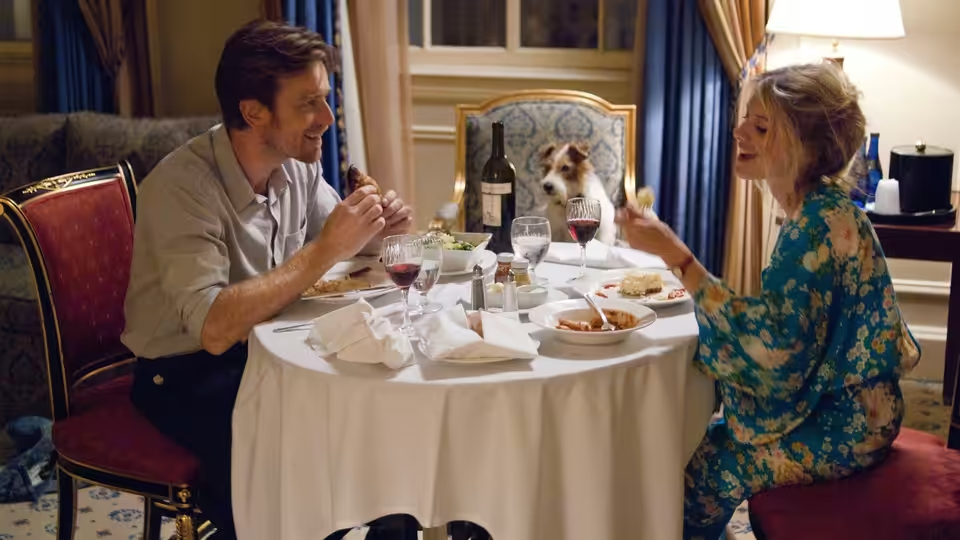
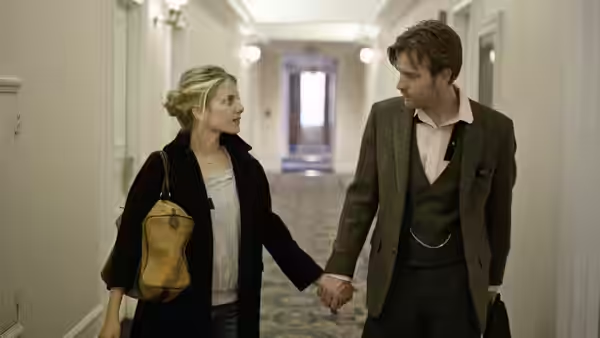
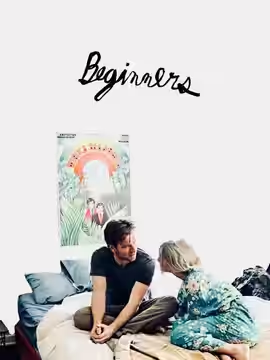
Ewan McGregor has a less immediately rewarding part in Oliver Fields, whose passivity is both understandable and occasionally frustrating. He makes uncertainty believable, but the writing sometimes leaves him circling a feeling that has already been clear for several scenes. Mélanie Laurent brings enough presence to Anna Wallace to make the romance worth following, even when the attention keeps returning to Oliver’s difficulty with it. We could have spent less time considering his reluctance and more time getting to know her.
Then there is the costume party, with its Sigmund Freud disguise. We laughed, and felt fonder of the film for permitting such an obvious joke among its more careful observations. A gathering of people trying to understand one another is a reasonable place to turn up dressed as Freud. Jennifer Johnson’s costume design has a welcome sense of humour here, and the choice needs little elaboration.
Kasper Andersen’s cinematography suits the film’s gentle manner, although the attractive images occasionally make the sadness feel too comfortably arranged. Shane Valentino’s production design contributes to that impression of carefully chosen surroundings for difficult feelings. The care is appreciable, but we sometimes wished the film would risk looking less tasteful. Its more playful images help loosen things up while Oliver hesitates.
Olivier Bugge Coutté handles the movement between timelines without making the shifts feel like interruptions imposed for their own sake. They suggest how a memory can intrude on a day that was going reasonably well. That helps the fragmented structure feel appropriate to these people and their uncertainty. The music from Brian Reitzell, Roger Neill and Dave Palmer is sympathetic, though its gentleness sometimes reinforces a tenderness the performances have already supplied. At 105 minutes, the film still has room for a few pauses we would shorten.
A conventional romantic comedy might hurry these people towards being ready for one another, and we appreciate the time they are allowed. The trouble comes when patience becomes repetition, particularly around Oliver. Even then, the cast make spending time with these people agreeable enough that we forgive more than we would on the page. Choose it for a quiet evening, and allow Christopher Plummer to be the most sociable person present.