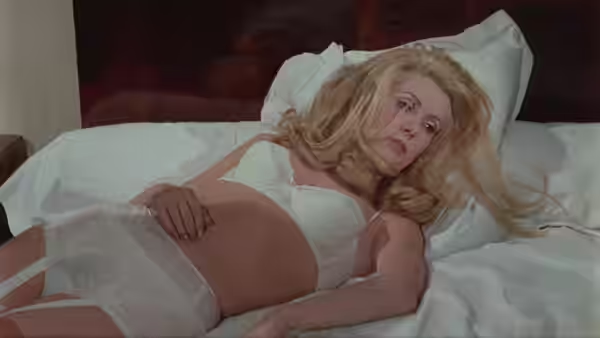
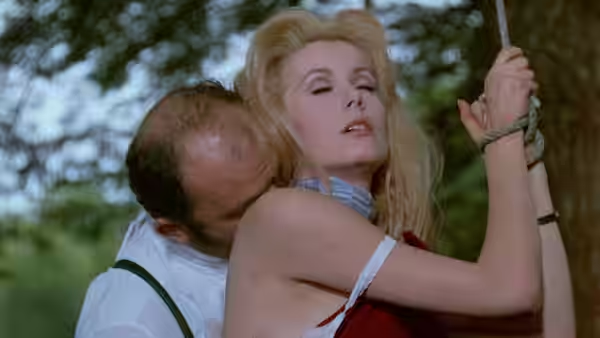
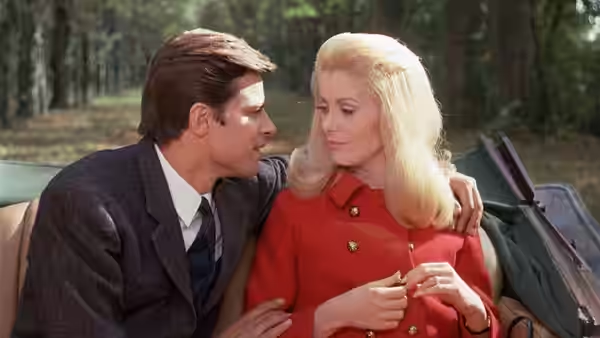
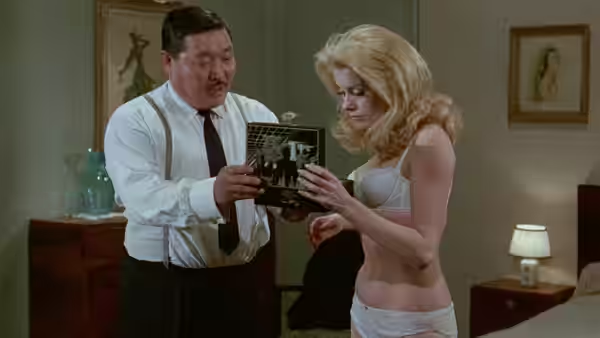
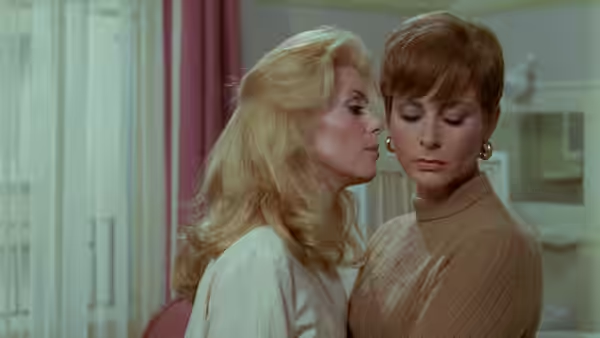
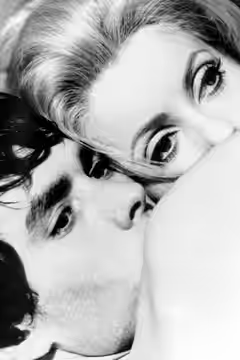
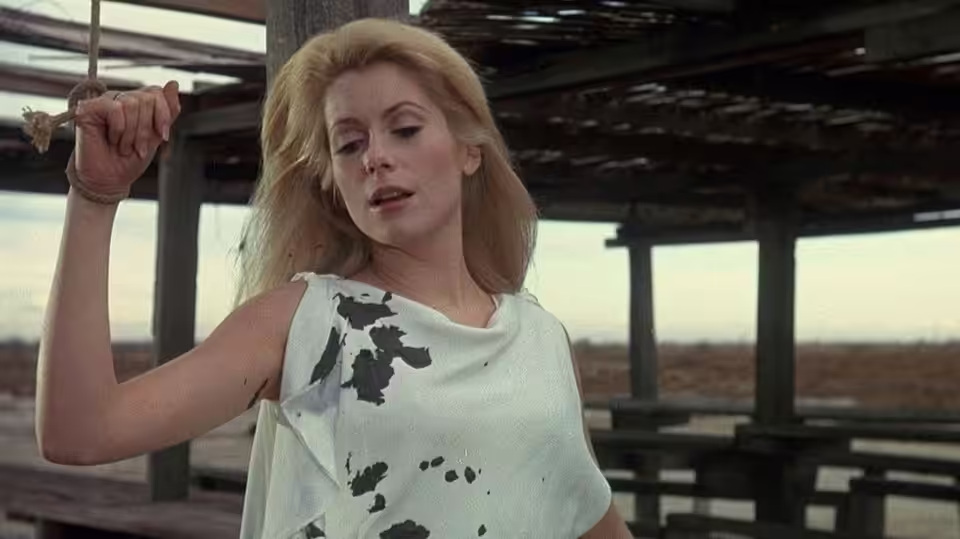
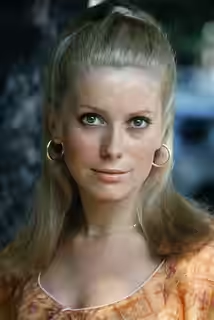
Séverine (Catherine Deneuve) raises a hand beside a glass-walled interior
Film review

Belle de Jour

1967 · Directed by Luis Buñuel · 1h 41m

In a sentenceCatherine Deneuve is impeccably dressed for thoughts nobody wants discussed over dinner

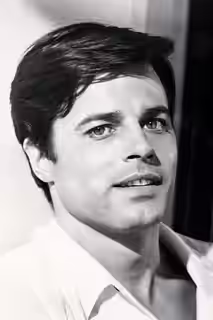
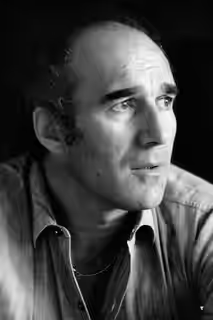
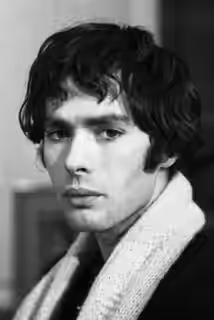
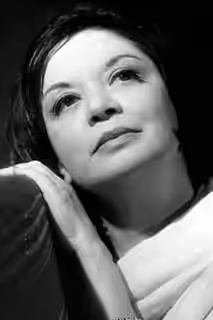
Séverine Serizy (Catherine Deneuve) leads a double life, her private sexual desires at odds with the respectable appearance she maintains. Around her are Pierre Serizy (Jean Sorel), Henri Husson (Michel Piccoli) and Madame Anais (Geneviève Page). What Séverine imagines begins to mingle with what she experiences, while memories further complicate the distinction. She seeks space for desires she cannot openly acknowledge, but the power men hold in her life also enters her fantasies. The story follows her between these experiences without consistently separating the events taking place from those unfolding in her mind.

Plays from YouTube when you press play; nothing loads from them until then.

Fi1m review

Luis Buñuel’s Belle de Jour is funny, unsettling and worth the discomfort, with Catherine Deneuve giving its sexual fantasies a troubling calm. The coolness can keep us at a distance, but the film’s suspicion of respectable behaviour remains persuasive.

Belle de Jour is a sly, unsettling film about a woman’s desires and the respectable behaviour expected of her, and we recommend it with one reservation: its coolness sometimes keeps us further away than it needs to. Luis Buñuel lets Séverine’s imagined experiences enter her daily life without giving us a reliable way to separate them. He also declines to make her explain herself. Catherine Deneuve makes her worth watching closely.

Her performance is controlled enough to make a small change of expression worth watching. We found her composure unsettling, because her face remains so guarded as the film moves into sexual fantasy; it gives us no comfortable cue for how to react. The temptation is to call Séverine cold and think we have understood her. The performance makes that judgement feel premature. Her restraint allows us to sense a private life without pretending we have been given unrestricted access to it.

Sacha Vierny’s colour photography and Yves Saint Laurent’s costumes make the attention paid to appearances tangible. The couture gives us something precise to look at when Séverine’s thoughts become difficult to follow, and its elegance makes the contrast with her fantasies uncomfortable. Robert Clavel’s production design supports that concern with how things look to other people. We admire the polish, though sometimes we become absorbed in it and lose touch with Séverine’s discomfort.

Louisette Hautecoeur’s editing does crucial work in the movement between memory, fantasy and ordinary experience. The transitions do not behave like helpful labels, and trying to classify every passage soon becomes a distraction. What matters is that Séverine cannot imagine desire entirely free of the pressures around her. The director keeps the uncertainty clear enough to follow, which is a harder task than simply confusing us, and the editing gives those changes an unforced rhythm.

The screenplay by Luis Buñuel and Jean-Claude Carrière is particularly sharp about the power men retain even in Séverine’s fantasies. Even in imagination, she has not simply left other people’s demands behind. There is dry comedy in the failure of respectable behaviour to settle any of this, though the humour never makes Séverine’s unease seem trivial. Anyone expecting an erotic drama to reveal a secret and then explain its heroine will have to adjust; the writers leave a good deal unexplained.

Our reservation concerns that same distance. The writers give us plenty to think about, but at times the cool handling makes Séverine seem like someone being studied, and we wanted more contact with her ordinary feelings. Catherine Deneuve’s restraint remains absorbing even when the film around her risks becoming too pleased with its ambiguity. A little more warmth would have helped in these stretches without requiring her to explain every thought.

At 101 minutes, it does not overstay its uncertainties. The pleasure lies in attending to the central performance, the careful costumes and the way the film quietly makes our judgements less secure. We would recommend it to anyone prepared for an erotic drama that can be funny without becoming comfortable. If you need a firm explanation before the evening is over, choose something else.
Critical consensus AI synthesised

84
Positive
10
Mixed
1
Negative
0

Most critics respond warmly to Belle de Jour, with praise centred on Catherine Deneuve’s controlled performance and Buñuel’s dry, subversive handling of sexual desire and social hypocrisy. The reviews repeatedly admire the movement between fantasy and reality, finding its ambiguity compelling rather than confusing. Deneuve’s cool elegance is a recurring point of agreement, while the photography, colour, production design and editing also draw praise for giving the heroine’s double life such a precise visual form.

The spread runs from strong enthusiasm to qualified admiration, with only one mixed assessment and no negative reviews. The clearest reservation comes from the Los Angeles Times, which finds the film interesting and provocative but considers its detached, cerebral approach a limitation. Even that review praises the acting and use of colour; the disagreement is chiefly over how much Buñuel’s coolness limits the film’s impact.

Radio Times
★★★★★ · David Parkinson
100

The critic regards the film as a complex, acclaimed masterpiece. They single out Catherine Deneuve’s beguiling performance and the film’s deft shifts between dream and reality.

Read the full review →
Slant Magazine
9 September 2003 · ★★★★/4 · Ed Gonzalez
100

The critic calls the film radical and compelling despite some flaws. They praise how Buñuel shows patriarchal power spilling into Séverine’s fantasies.

Read the full review →
The Guardian
6 September 2017 · ★★★★★ · Peter Bradshaw
100

Bradshaw finds the film strange and captivating, with a shrewd, scabrous critique of social hypocrisy and sexual politics. He especially praises Catherine Deneuve’s extraordinary, ghostlike performance.

Read the full review →
Sight and Sound
7 September 2017 · Jan Dawson
90*

Dawson praises the film’s seamless blending of fantasy, memory and reality. She singles out Catherine Deneuve’s controlled performance and Sacha Vierny’s camerawork.

Read the full review →
The New Yorker
9 April 2006 · Anthony Lane
90*

Lane welcomes the film’s return and regards its subversion as enduringly fresh. He singles out the deadpan precision of Buñuel and Catherine Deneuve as the reason it has not dated.

Read the full review →
Empire
1 January 2000 · Ian Nathan
85*

Nathan highly recommends the film as witty, erotic and elegant. He praises its effortless style and the contrast between Deneuve’s delicate beauty and her character’s carnal desires.

Read the full review →

Straight answers AI written, from our review

Is Belle de Jour worth watching?
Belle de Jour is worth watching for Catherine Deneuve’s controlled performance and its unsettling treatment of sexual fantasy; we score it 86 out of 100. We recommend it to those who enjoy dry humour and uncertainty in an erotic drama, though its coolness can keep us at a distance and it leaves much unexplained.
How long is Belle de Jour, and what is it rated?
Belle de Jour runs 1h 41m. It is a drama and romance film.
Where can I watch Belle de Jour in Israel?
Belle de Jour is not on any streaming or rental service in Israel at the moment. It is available in 9 other countries; change your country at the top of the page to see where. Availability is checked daily.
How violent or frightening is Belle de Jour, and is it suitable for children?
Belle de Jour carries a UK 18 certificate and is not suitable for children, with sexual fantasies and troubling questions about desire and male power central to the drama. We find Deneuve’s guarded composure unsettling rather than reassuring; the discomfort described in our review is psychological and sexual, without enough detail to assess the extent of violence.
How does Belle de Jour compare to The Piano Teacher?
Belle de Jour is the better choice for dry humour and elusive sexual fantasy, while The Piano Teacher offers a harsher, more punishing study of secrecy and control. We find Deneuve absorbing despite the former’s emotional distance; Isabelle Huppert’s vulnerability gives the latter a stronger emotional connection, though Walter is less convincing as a character.
What should I watch after Belle de Jour?
After Belle de Jour, try The Piano Teacher (2001, Fi1m 82): A harsher study of sexual secrecy, control and desires that resist explanation. Then The Double Life of Véronique (1991, Fi1m 86): For another elusive heroine whose inner life refuses a tidy explanation; and The Handmaiden (2016, Fi1m 85): Sexual power and elaborate appearances, handled with more overt mischief and suspense.

Cast

Awards

Venice Film Festival, 1967

Won
Golden Lion

If you liked this, try…

  1. The Piano Teacher (2001, Fi1m 82)A harsher study of sexual secrecy, control and desires that resist explanation.

  2. The Double Life of Véronique (1991, Fi1m 86)For another elusive heroine whose inner life refuses a tidy explanation.

  3. The Handmaiden (2016, Fi1m 85)Sexual power and elaborate appearances, handled with more overt mischief and suspense.

  4. Persona (1966, Fi1m 89)Two women, closely watched, make silence and uncertain identity difficult to escape.

  5. The Servant (1963, Fi1m 89)Respectable interiors become distinctly uncomfortable as class power and desire change hands.