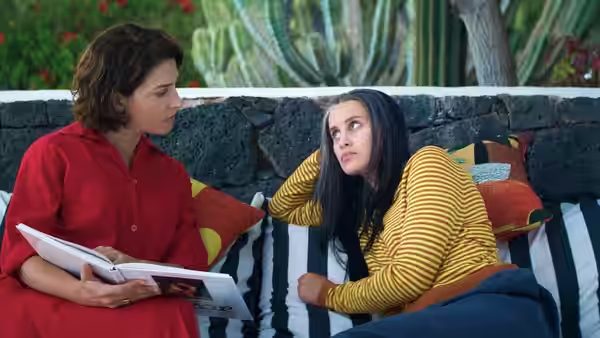
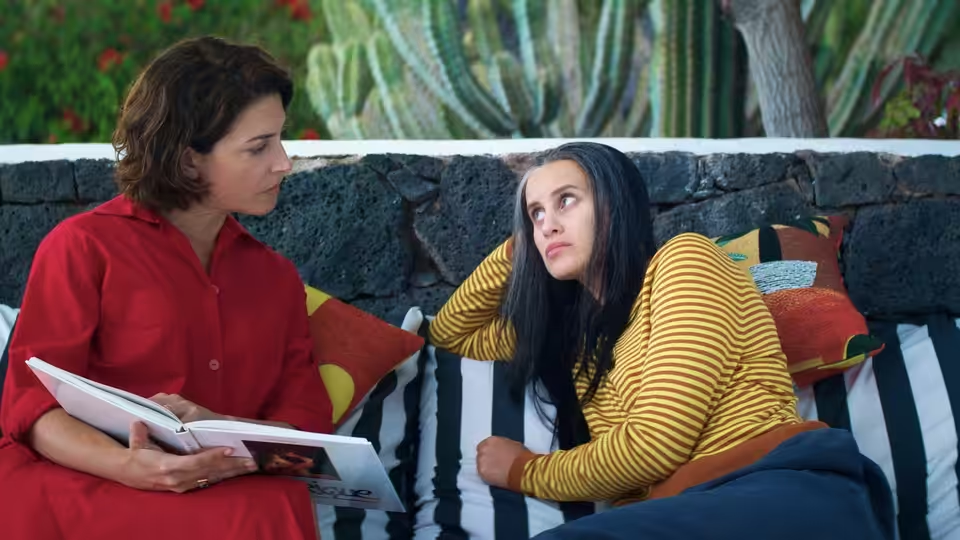
Woman in red holds open magazine beside woman reclining on striped outdoor couch
Film review

Bitter Christmas

2026 · Directed by Pedro Almodóvar · 1h 51m

In a sentencePedro Almodóvar writes a film about a man who cannot write a film, and for an hour nearly proves the point

It is Christmas, and Elsa (Bárbara Lennie) has just lost her mother (Gloria Muñoz). She sees a doctor (Carmen Machi) and does not know what to do with the days. In another strand, set in a different era, Raúl Durán (Leonardo Sbaraglia), a film director, is writing a screenplay about another filmmaker and cannot get it right, so he writes it again, and again. The film moves between the two stories. Around the pair are Mónica (Aitana Sánchez-Gijón), Patricia (Victoria Luengo), Natalia (Milena Smit), Gabriela (Rossy de Palma) and a young man everyone calls Beau (Patrick Criado). What Raúl wants is a finished script. What stands in the way is that the material he is reaching for belongs to somebody else’s life, and to her grief.

Plays from YouTube when you press play; nothing loads from them until then.

Fi1m review

Almodóvar’s film about a director who cannot finish a script about a director is handsome, often funny and honest about its maker. It is also slack through the middle and keeps nearly everything it has to say for the last half hour. Bárbara Lennie carries it.

Pedro Almodóvar has made a film about a director who is writing a film about a director, and he has cast himself, in all but name, as the one holding the pen. Raúl Durán (Leonardo Sbaraglia) cannot finish his screenplay. He rewrites it, doubts it, and reaches into a grieving woman’s life for the material he needs. Almodóvar has done this before, most directly in Pain and Glory (2019), and he knows we know. Bitter Christmas is handsome, often funny and honest about its maker’s failings; it is also slack for a long stretch in the middle, and it saves nearly everything it has to say for the final half hour.

The best of it belongs to Bárbara Lennie. Elsa has lost her mother (Gloria Muñoz) at Christmas, and Lennie plays the weeks after as a woman going through the motions with great care, so that nobody around her has to worry. Carmen Machi has one scene as a doctor and gets more out of it than the script hands her. Rossy de Palma, as Gabriela, walks in and the temperature rises a degree or two, as it has in Almodóvar’s films since the 1980s. Patrick Criado, as the young man called Beau, is loose and amused where everyone else is fretting.

Antxón Gómez builds the rooms in the colours Almodóvar has always liked, reds and greens and blues that no real flat would dare, and Pau Esteve Birba lights them so that the people look slightly more alive than the furniture, which is the right way round. Paco Delgado’s costumes are chosen to sit inside those rooms rather than against them. Teresa Font cuts between the two eras cleanly enough that we always knew where we were; the trouble is that we did not always know why we had moved. Alberto Iglesias’s score is lush and full of strings, and in the quietest scenes it pushes where the picture wanted to be left alone.

The trouble is the frame. Every time Raúl sits down at his desk the film stops being about a woman and her dead mother and starts being about whether a man should write about a woman and her dead mother. That is a real question and Almodóvar means it, but he asks it in dialogue, repeatedly, and for the middle hour the asking replaces the drama. The tagline, “You’re confusing fiction with reality”, is the whole subject in six words, and the script never quite trusts us to have got it.

Here is what we felt. Somewhere past the hour we were bored, and mildly cross about it, because the people on screen were good company and the film kept interrupting them to explain what it was doing with them. Then a Chavela Vargas song arrives, and we were caught off guard and moved, more than the preceding hour had any right to expect. For the length of that song the two stories are in the same feeling, and the film is what it wanted to be all along. It does not last, but the last half hour that follows is far better than what came before, and the self-criticism, when it finally lands, is sharp and aimed squarely at the man behind the camera.

Against his own record this sits below Pain and Glory, which turned self-examination into a story with a shape, and well below Parallel Mothers (2021), which had no interest in the director at all and was the better for it. In construction it is closer to Bad Education (2004), but without the menace. The confession here is sincere; what is missing is a reason for anyone who is not Almodóvar to care about it before the last act. Most critics have been a little warmer than we are, and we understand why: spending time in these rooms with these people is no hardship.

For the faithful, and there are many of us, this is worth the evening: 111 minutes, a 15 certificate, subtitled, with one great performance and one great song. For everyone else, watch the mother and the daughter and forgive the man at the desk when he interrupts. He gets to the point in the end.

Critical consensus AI synthesised

69
Positive
11
Mixed
7
Negative
0

Most critics like Bitter Christmas without being swept up by it. The reviews agree on what it is: Almodóvar writing about a filmmaker writing about a filmmaker, and using the layers to take himself to task over what an artist owes the people whose lives he borrows. Praise gathers around the craft: the art direction, the nested structure, and the performances, with Bárbara Lennie, Rossy de Palma and Patrick Criado singled out.

The reservations cluster around feeling. Many find the meta framing keeps the film at arm’s length, the payoff muted, and what matters held back until the final act. The word familiar recurs, and more than one review says this is one for those invested in the director. The spread is moderate: nobody dislikes it, but The Wrap is warmest, finding the dissolving layers thrilling, while Empire and The Hollywood Reporter sit coolest, one calling it meandering, the other elegant but seldom affecting.

IndieWire
19 May 2026 · B+ · David Ehrlich
83

The critic calls it a fun and twisty meta-drama and satisfying late-career gem in which a filmmaker writes and rewrites a screenplay about another filmmaker. It highlights the playful self-critique and satisfying structure.

Read the full review →
Little White Lies
19 May 2026 · 4/4/5 · David Jenkins
80

The review calls it a sombre, self-lacerating drama on the ethics of storytelling and creative inspiration, praising Almodóvar's refined technique and formal poise in this late-period work.

Read the full review →
Radio Times
24 August 2026 · ★★★★
80

The review describes it as Almodóvar’s most introspective film yet, a meta exercise flexing between fiction and reality, praising its visual beauty and exploration of creative spark.

Read the full review →
The Observer
28 August 2026 · Vanessa Thorpe
80*

A witty and sensitive mea culpa exploring self-doubt, grief, and the auteur’s struggle, with sweet melancholy rather than bitterness, tributing older women who facilitate artists' lives.

Read the full review →
Time Out
19 May 2026 · ★★★★ · Phil de Semlyen
80

The critic sees it as a stylish, spiky meta tragicomedy that turns the lens on the artist, praising its ability to surprise and provoke while exploring boundaries between art and life.

Read the full review →
Screen Daily
23 March 2026
75*

The critic finds the multi-layered, self-conscious drama a return to Almodóvar’s signature world, praising its cunningly crafted exploration of the relationship between artistic creation and life’s messiness.

Read the full review →

Straight answers AI written, from our review

Is Bitter Christmas worth watching?
Bitter Christmas is worth watching for Almodóvar's regular admirers, and we scored it 64. It is handsome, often funny and honest about its maker, with a fine performance from Bárbara Lennie as a woman who has just lost her mother, but the middle hour sags while the director at the desk keeps explaining what the film is doing. It is subtitled and runs 111 minutes.
How long is Bitter Christmas, and what is it rated?
Bitter Christmas runs 1h 51m. It is a drama and comedy film.
Where can I watch Bitter Christmas in South Africa?
Bitter Christmas is not on any streaming or rental service in South Africa at the moment. It is available in 2 other countries; change your country at the top of the page to see where. Availability is checked daily.
How violent or frightening is Bitter Christmas, and is it suitable for children?
Bitter Christmas carries a UK 15 certificate, and it is a drama about grief and a stalled screenplay rather than a violent or frightening film. Our review notes nothing alarming beyond the subject of a mother's death at Christmas, so the certificate reflects adult themes and language rather than anything that would scare. It is not for children, and most teenagers would find it slow.
How does Bitter Christmas compare to Pain and Glory?
Bitter Christmas and Pain and Glory are both Almodóvar films about a director examining himself, and the earlier film is the better of the two. Pain and Glory gives its self-examination a story with a shape and a restrained Antonio Banderas at its centre; Bitter Christmas asks its questions in dialogue for an hour before the last act finally lands. Start with Pain and Glory unless you already know and love this director.

Cast

If you liked this, try…

Bitter Christmas (2026) review: Almodóvar puts himself on trial, gentl (South Africa) | Fi1m