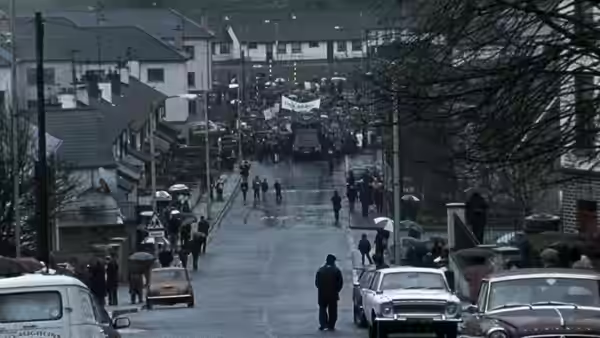
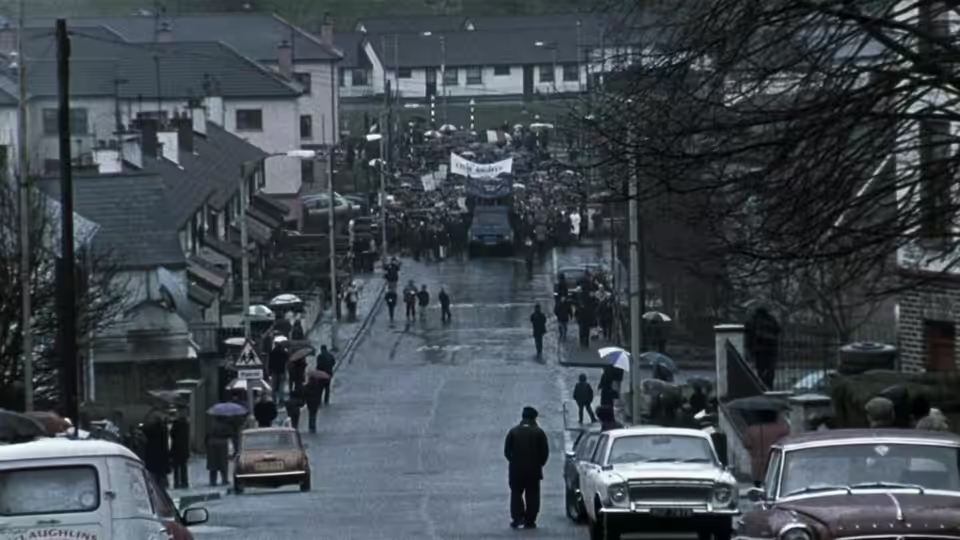
Marchers carrying banners walk down a residential street as people watch beneath umbrellas
Film review

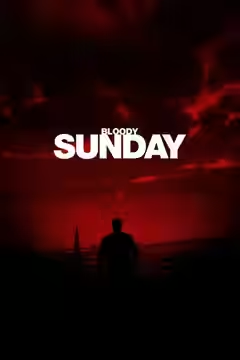
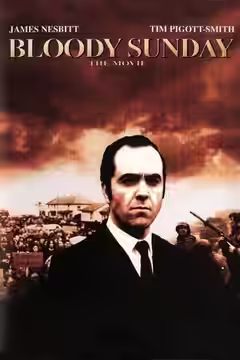
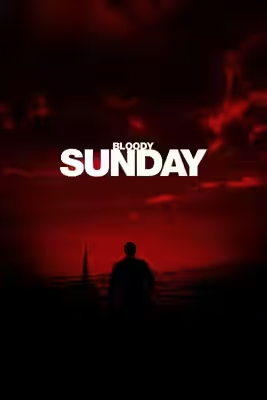
Bloody Sunday

2002 · Directed by Paul Greengrass · 1h 47m

In a sentenceEveryone keeps saying it will be a peaceful day, and the camera has already stopped believing them

Derry, Sunday 30 January 1972. Ivan Cooper (James Nesbitt), a Protestant MP, is leading a civil rights march against internment from the Creggan to the Guildhall, and he has promised everyone it will be peaceful. The march has been banned. Major General Ford (Tim Pigott-Smith) has brought the Parachute Regiment into the city to arrest rioters, over the doubts of Brigadier Maclellan (Nicholas Farrell). Gerry Donaghy (Declan Duddy), seventeen and just out of prison, promises his sister Mary (Joanne Lindsay) and his girl (Edel Frazer) that he will stay away from trouble. Bernadette Devlin (Mary Moulds) and Eamonn McCann (Gerard Crossan) are due to speak. The morning is stewards, placards, priests and barricades of burnt-out cars; the soldiers wait behind the wire on William Street.

Fi1m review

Paul Greengrass reconstructs a day in Derry in 1972 handheld, almost unscored and cut to black between scenes, with James Nesbitt as march organiser Ivan Cooper. It left us shaking. Its weakest scenes are those that try hardest to be fair to the army.

The film came out in Britain on 25 January 2002, thirty years almost to the day after the event. Paul Greengrass, who wrote and directed, took a decision early that governs everything else: no flashbacks, no captions, no narrator, one Sunday in Derry from dark to dark in 107 minutes. It is a hard, honest film and we recommend it. It also has a flaw, and the flaw is the army; we will come to that.

Ivan Strasburg shoots everything handheld, in daylight that looks as if it came through net curtains, and the camera is usually half a second late, swinging to find whoever has just spoken. Clare Douglas cuts each scene into black before it has finished. A kitchen, dark. A barracks briefing, dark. The day comes to us in pieces with gaps between them, which is how witnesses remember, and it means we never settle. Dominic Muldowney is credited with the music and we noticed almost none of it; what we heard was Land Rovers, loudhailers and radio traffic. John Paul Kelly’s Bogside is wrecked cars across the road, grey flats and painted gable ends, and within twenty minutes we knew which street led where. That matters later.

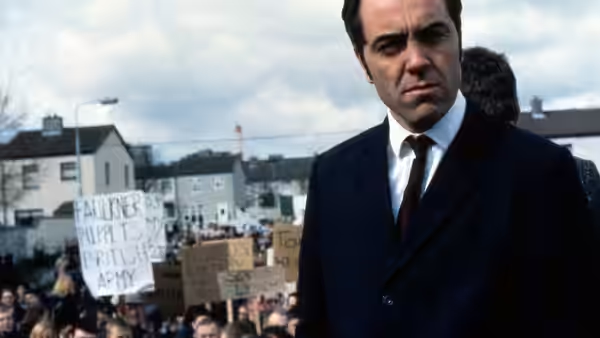
James Nesbitt plays Ivan Cooper, the Protestant MP leading the march, as a man who cannot stand still. He is out before his wife is awake, in Dinah Collin’s good dark overcoat, shaking hands at every corner, telling the priests it will be fine and the young men at the barricade that the march is theirs if they stay in it. He has a joke for everyone and we believed he had used all of them before. Around him Greengrass sets Mary Moulds as Bernadette Devlin and Gerard Crossan as Eamonn McCann, sharper and less hopeful than he is, and Allan Gildea as his fellow organiser Kevin McCorry. Declan Duddy’s Gerry Donaghy, seventeen and just home from prison, spends the morning promising his sister Mary (Joanne Lindsay) and his girl (Edel Frazer) that he will keep out of trouble.

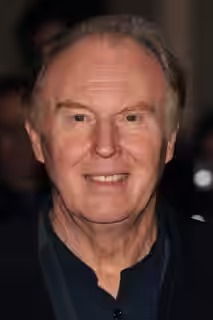
Behind the wire, Tim Pigott-Smith’s Major General Ford wants the Parachute Regiment sent in to arrest stone-throwers, and Nicholas Farrell’s Brigadier Maclellan does not want to give the order and knows he will. Pigott-Smith plays Ford with the calm of a man who has already written his report, and these scenes are good. The ones below them are not. Greengrass gives us the paratroopers in the back of their lorries, one keen, one uneasy, one saying nothing, and the writing thins until we could feel the film being fair. Some critics call it even-handed; we found it dutiful, and we think the film would lose nothing if the army were Ford, Maclellan, Christopher Villiers’s Major Steele and James Hewitt’s Colonel Tugwell, and nobody below the rank of major.

Then the march reaches the barrier, part of it turns for Free Derry Corner and part of it does not, and the film changes. We will not describe who the day takes. The title tells you what happens, and knowing does not help. What got at us was the plainness: no slow motion, no music, no cutaway to a face for our benefit, just Strasburg running with people who are running and Douglas cutting on where they are, so we always knew who was behind which wall. We came out shaking, and not in the way action films mean. We were angry too, which is what Greengrass wanted, and he had earned it.

Two things to know before you start. The film assumes you know what internment was, why the march was banned and who Bernadette Devlin was, and it will not stop to tell you; a viewer coming to it cold will spend the first twenty minutes catching up. And it takes a side without pretending otherwise. The one speech it stops for is Cooper’s, to a room of journalists late that night, and Nesbitt delivers it in the voice of a man who has not sat down since dawn. We thought it the right speech. Not everyone will.

It is a 15, and there is less blood on screen than the certificate suggests; the horror is in the sound and in the sudden emptiness of a street. Watch it in one sitting with the volume up, and keep the rest of the evening free. You will not want to do anything else with it.

Critical consensus AI synthesised

75
Positive
6
Mixed
2
Negative
0

Most critics come away shaken and persuaded. Six of the eight reviews are positive, none negative, and the praise falls in two places. The first is the camerawork: the jittery handheld style is credited with making the day feel immediate while keeping the chaos clear, and the Los Angeles Times calls the result exceptional advocacy cinema. The second is James Nesbitt as Ivan Cooper, the harassed idealist leading the march, whose frazzled, naturalistic performance is singled out by nearly every reviewer as the film’s emotional centre; Empire calls it his best work.

The reservations are modest and scattered. The AV Club thinks the attempt to humanise the British soldiers is unnecessary; Slant notes how little historical context the film supplies; IndieWire finds the visual approach sometimes slows the momentum rather than driving it. The spread is narrow, running from approving to enthusiastic, and the two more muted reviews offer description rather than complaint.

Los Angeles Times
18 October 2002 · Kenneth Turan
90*

Turan calls the film compelling, exceptional advocacy cinema that does full justice to the day’s tragedy. He especially praises the jittery handheld camerawork for making the events feel immediate while keeping the chaos dramatically clear.

Read the full review →
The Guardian
25 January 2002 · Peter Bradshaw
88*

Bradshaw finds the film visceral and compelling, and says it demands to be seen. He singles out James Nesbitt’s performance as the harassed idealist leading the march.

Read the full review →
Slant Magazine
5 September 2002 · ★★★/4 · Ed Gonzalez
75

Gonzalez finds the film gripping and overwhelmingly dread-filled, while noting its limited historical context. He praises James Nesbitt’s naturalistic, frazzled performance as Ivan Cooper.

Read the full review →
The AV Club
11 October 2002 · Scott Tobias
75*

Tobias finds the film powerful and immediate, while faulting it for an unnecessary attempt to humanize the British soldiers. He especially praises its documentary-style camera work and the emotional center provided by James Nesbitt’s performance.

Read the full review →
Empire
1 January 2000 · Alan Morrison
70*

Morrison finds the film emotionally effective as a human tragedy that transcends sectarian divisions. He singles out James Nesbitt’s career-best performance for grounding the story in a personal response.

Read the full review →
IndieWire
8 February 2002 · festival review · Eddie Cockrell
70*

Cockrell finds the film a vivid, timely and even-handed account of a tragic confrontation, though its visual approach sometimes undercuts the conflict’s momentum. He praises its urgent, eye-opening portrayal of regional history and its effort to convey competing perspectives.

Read the full review →

Straight answers AI written, from our review

Is Bloody Sunday worth watching?
Bloody Sunday is worth watching for anyone prepared for a hard, plain reconstruction of one day in Derry in 1972, and we scored it 83. It assumes you know what internment was and why the march was banned, so a viewer coming to it cold spends the first twenty minutes catching up. The scenes among the ordinary paratroopers are its weakest; the rest left us shaking and angry, as Greengrass intended.
How long is Bloody Sunday, and what is it rated?
Bloody Sunday runs 1h 47m. It is a drama and history film.
Where can I watch Bloody Sunday in Ecuador?
Bloody Sunday is not on any streaming or rental service in Ecuador at the moment. It is available in 2 other countries; change your country at the top of the page to see where. Availability is checked daily.
How violent or frightening is Bloody Sunday, and is it suitable for children?
Bloody Sunday is a 15 in the UK and R in the US, and it is not for children. There is less blood on screen than the certificate suggests; the horror is in the sound of the shooting and the sudden emptiness of a street, and that is harder to shake off. Teenagers who know something of the history will cope, but it is not a film to leave on in the background.
What should I watch after Bloody Sunday?
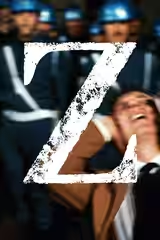
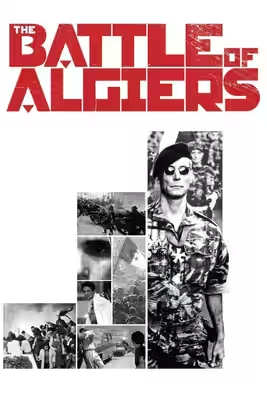
After Bloody Sunday, try The Battle of Algiers (1966, Fi1m 93): Pontecorvo’s reconstruction of a city uprising, shot like newsreel, and still the model. Then Z (1969, Fi1m 84): Costa-Gavras on a political killing and the inquiry that follows, paced like a thriller; and Hunger (2008, Fi1m 86): Steve McQueen’s Maze prison film, mostly silent, with one conversation that lasts a reel.

Cast

Awards

Berlin International Film Festival, 2002

Won
Golden Bear

British Independent Film Awards, 2002

Won
Best Performance by an Actor in a British Independent Film

European Film Award for Best Cinematographer, 2002

Nominated
European Film Award for Best Cinematographer

European Film Award for Best Film, 2002

Nominated
European Film Award for Best Film

European Film Award for Best Screenwriter, 2002

Nominated
European Film Award for Best Screenwriter

European Film Award - People's Choice Award for Best Director, 2002

Nominated
European Film Award - People's Choice Award for Best Director

Sundance World Cinema Audience Award, 2002

Won
Sundance World Cinema Audience Award

If you liked this, try…

  1. The Battle of Algiers (1966, Fi1m 93)Pontecorvo’s reconstruction of a city uprising, shot like newsreel, and still the model.

  2. Z (1969, Fi1m 84)Costa-Gavras on a political killing and the inquiry that follows, paced like a thriller.

  3. Hunger (2008, Fi1m 86)Steve McQueen’s Maze prison film, mostly silent, with one conversation that lasts a reel.

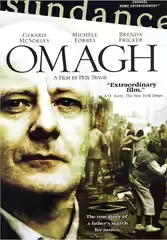
  4. Omagh (2004) · not reviewed yetGreengrass co-wrote this account of the 1998 bombing and the families’ fight afterwards.

  5. United 93 (2006, Fi1m 88)Greengrass applies the same method to 11 September; harder to watch, no less honest.

Free account

Know what to watch tonight

Two lists that know where things are streaming, collections you can share, your own score beside ours, and Discover that remembers what you have seen.

  • Want to see, sorted by what is streaming now
  • Seen, with your score out of ten
  • No adverts, ever