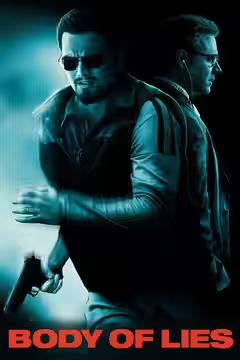
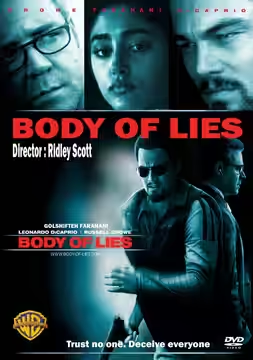
Ridley Scott gives this espionage thriller enough force to hold our attention, and Mark Strong gives it some danger. But the crowded screenplay and thin personal drama make it a qualified choice for anyone beyond the genre’s regulars.
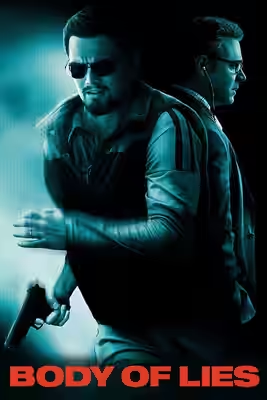
Ridley Scott’s Body of Lies is a capable espionage thriller that keeps making promises its screenplay cannot quite fulfil. There is enough urgency to justify an evening for those who enjoy the genre, but the film is too cluttered to become the searching account of intelligence work it seems to want to be. William Monahan gives the characters plenty to say and too little time to make it matter. The trouble is already apparent in the dialogue, which frequently mistakes professional jargon for useful information.
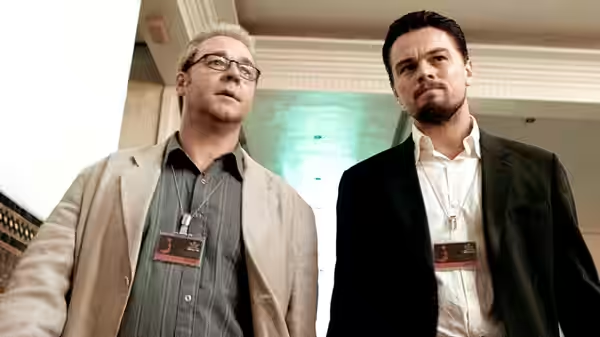
Leonardo DiCaprio works hard as CIA operator Roger Ferris, and that effort is useful: we believe in the strain even when we are less sure of the man. He gives the danger an immediate physical urgency, without resolving the uncertainty about what Ferris wants beyond the next demand of the job. Russell Crowe’s Ed Hoffman is a slyer presence, and their exchanges provide welcome friction. The two performances suggest a more absorbing relationship than the busy screenplay has time to explore.
Mark Strong provides the strongest reason to stay interested. As Hani, he brings such calm to his scenes with Leonardo DiCaprio that the other man’s exertions suddenly become more revealing. We felt properly uneasy during their exchanges; Hani’s composure makes every attempt to read him seem risky. Watching the actors respond to each other gives these scenes a tension that requires little assistance from the surrounding action.
Alexander Witt’s cinematography helps us read the action through bodies and distances, giving the violence an immediate force. Ridley Scott has a firm sense of where to put people when danger arrives, and the physical impact of those passages is hard to dismiss. Arthur Max’s production design gives the action credible surroundings, though the care spent on them makes the thin characterisation more noticeable. The film looks convincing well before its account of the people involved becomes persuasive.
Pietro Scalia’s editing keeps pressing ahead, but speed cannot make each new complication equally interesting. Following the plot begins to feel like work, especially when William Monahan’s dialogue gets tangled in the mechanics of the operation. Marc Streitenfeld’s music helps sustain the pressure, although we would have welcomed more room for the actors to generate it unaided. The scenes involving Hani suggest how effective a little restraint can be.
The personal material does little to help. The romantic subplot is too lightly developed to give Ferris much of a life outside his work, leaving Leonardo DiCaprio to supply depth through sheer commitment. A quieter relationship might have allowed the character to become more understandable, but the writing is impatient with that possibility. Without that material doing its share, the demands of the operation occupy space that could have made Ferris worth caring about.
By the standards of the espionage thriller, the disappointment is familiar: capable actors, serious subject matter, and an increasing dependence on conventional plotting. Ridley Scott can make the danger convincing, but the film’s attempts to explain its people are less assured. At 128 minutes, it has enough room to do more with both. Try it for Mark Strong and the bursts of action, provided unfinished character work will not spoil the evening.