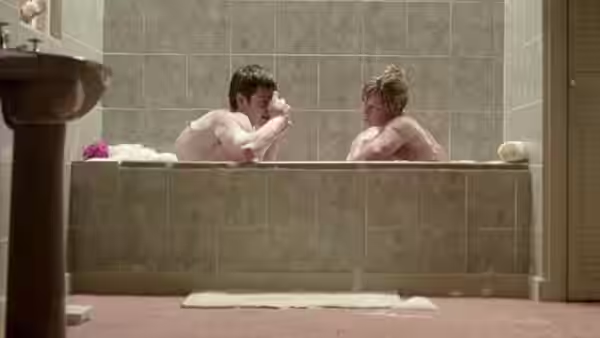
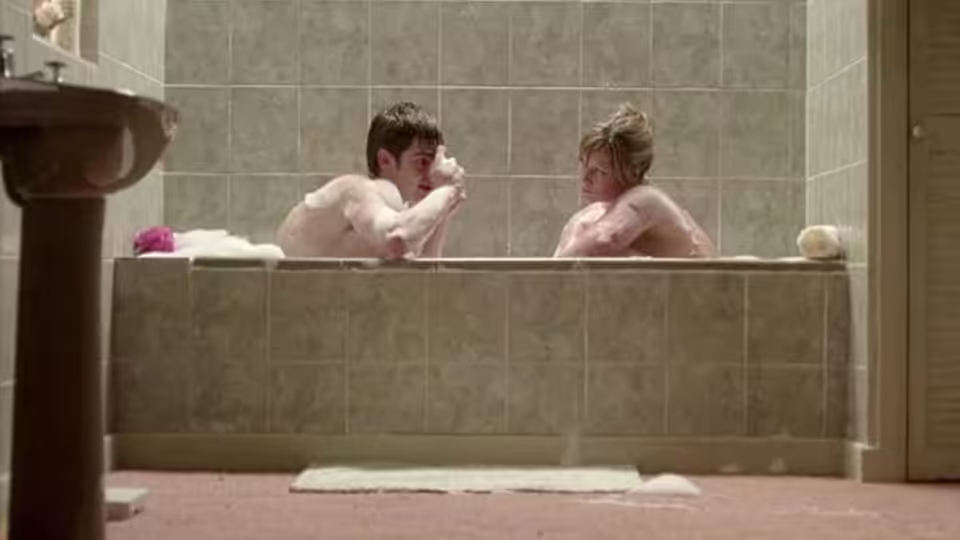
A young man and woman sit facing each other in a bathtub
Film review

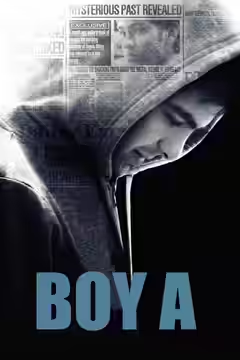
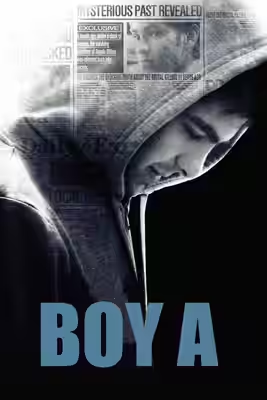
Boy A

2008 · Directed by John Crowley · 1h 46m · IFCO 15

In a sentenceNew name, new trainers, new bedsit; the past arrives by tabloid

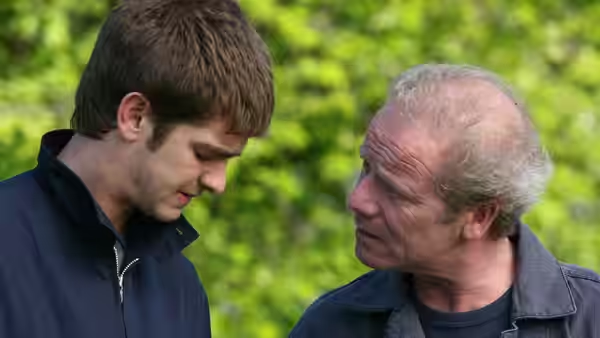
A young man walks out of custody with a new pair of trainers and no name. He has been locked up since he was a boy for a crime the whole country remembers, and the papers called him Boy A. Terry (Peter Mullan), the caseworker who has looked after him inside, sets him up in Manchester with a flat, a job at a delivery firm and a fresh identity: Jack Burridge (Andrew Garfield). At work Jack is befriended by Chris (Shaun Evans), and he falls for Michelle (Katie Lyons), the receptionist. Terry’s own son, Zeb (James Young), watches the attention his father gives this stranger. In flashback, the boy Jack was, Eric Wilson (Alfie Owen), is bullied at school until Philip Craig (Taylor Doherty) befriends him.

Fi1m review

John Crowley’s film about a man released and renamed after a childhood crime is quiet, decent and held together by Andrew Garfield, who plays a grown man with a boy’s reflexes. The ending hurries what the first hour earned.

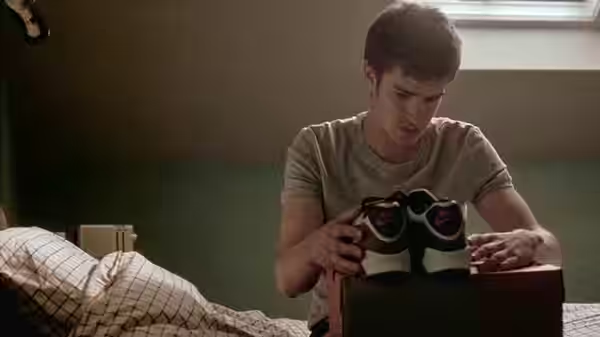
John Crowley’s film, adapted by Mark O’Rowe from Jonathan Trigell’s novel, begins with a young man being handed trainers and asked what he wants to be called. He picks Jack. He has been inside since he was a boy, for something the whole country remembers, and Terry (Peter Mullan), his caseworker, sets him down in Manchester with a flat, a job and a name nobody will recognise. The tagline asks who decides whether he gets a second chance. The film’s answer is that everyone does, including people who have never met him.

It is a good film, plainly made, and for most of its 106 minutes it trusts its actors to carry it. Andrew Garfield plays Jack as someone who learned his manners from staff and nothing from friends. He says thank you too often. He stands in doorways waiting to be asked in. When Chris (Shaun Evans), from the delivery firm, drags him to a club and puts a pill in his hand, Garfield’s face does the thing the film depends on: a grown man having a first time at everything, pleased, and terrified of being seen to be pleased. For the first hour Crowley simply watches him, and he is right to.

We were moved by it, more than the modest filmmaking led us to expect, and we can say where. It was Jack alone in the flat on his first night, trying the trainers on and saying nothing. Later it was Michelle (Katie Lyons), the receptionist, asking where he grew up, and Jack building an answer out of what Terry told him to say. Lyons plays Michelle as a woman who has decided to like him before she has worked him out, and their courtship, over sandwiches and bad jokes in the firm’s kitchen, is written without condescension. Mullan plays a man whose kindness has a cost at home, paid by his son Zeb (James Young), who watches his father give a stranger what he never got himself.

Rob Hardy shoots the present in grey Manchester daylight, handheld and close, so that Jack is nearly always in frame with something behind him he cannot see. The flashbacks, in which Alfie Owen plays the boy he was, Eric Wilson, and Taylor Doherty the friend, Philip Craig, who finds him being bullied, are warmer and hazier, summer light on scrubland and railway cuttings. That is right: this is how Jack remembers it, the one good year. Lucia Zucchetti cuts between the two times without announcement, often on a sound, the best thing in the film’s construction; we simply find ourselves in the past. Jon Henson gives Jack a bedsit with a kettle and nothing on the walls, and the firm a yard of vans and a kitchen. Paddy Cunneen’s score is spare, piano mostly, and stays out of the way until the end, when it does not.

The trouble is the plot, which in the second half starts arranging things. A stroke of luck puts Jack’s face in the local paper, and from there the script moves him towards the ending it wants rather than the one the character would find. The childhood crime, when we see it, is staged as though the film did not trust us to have felt its weight. And the finish, which we will not describe, is played and scored at a size the film had until then refused. The last ten minutes belong to a louder, lesser film.

The reviews so far are split between warm and cool, and the cool ones are not wrong about the contrivances. We think they underrate how much the first hour does, and how seldom a British film about a working-class young man makes nobody a type. Crowley and O’Rowe made Intermission (2003) together, a noisy ensemble piece; this is its opposite, small and watchful, and it suits them both.

See it for Garfield, Mullan and Lyons, and for the hour in which it lets them be people. When the music swells, the script has taken over. It carries a 15.

Critical consensus AI synthesised

66
Positive
2
Mixed
3
Negative
0
The AV Club
31 July 2008 · B · Noel Murray
77

Murray finds the film’s redemption story emotionally compelling but criticizes its overheated plot and implausible climax. He praises its portrayal of the adult protagonist as socially engineered and still haunted by childhood events.

Read the full review →
The Hollywood Reporter
16 September 2007 · festival review · The Associated Press
75*

The critic finds the film eloquent and quietly compelling, effectively drawing viewers into Jack’s new life and troubled past. They single out Garfield’s tender performances with Lyons and Mullan, along with the fluent editing between past and present.

Read the full review →
RogerEbert.com
64*

The page appears to review the specified film, but its verdict is unavailable. No praise or complaint can be verified from the blocked page.

Read the full review →
Time Out
19 October 2007 · Natasha Kaufman
64*

The available page does not reveal the critic’s verdict. Its description identifies the film’s exploration of whether someone can escape their past, but provides no specific praise or complaint.

Read the full review →
Slant Magazine
16 April 2008 · ★★/4 · Nick Schager
50

Schager finds the film sensitive and well-acted but ultimately undermined by contrivances and clichés. He singles out Andrew Garfield’s fragile, tremulous performance for praise.

Read the full review →

Straight answers AI written, from our review

Is Boy A worth watching?
Boy A is worth watching for anyone who wants a quiet, plainly made drama about a man rebuilding a life after a childhood crime, and we scored it 73. Andrew Garfield, Peter Mullan and Katie Lyons carry the first hour, which is the film's best. The second half arranges its plot too neatly and the ending is played louder than the film had earned.
How long is Boy A, and what is it rated?
Boy A runs 1h 46m and is rated 15 by the IFCO in Ireland. It is a crime and drama film.
Where can I watch Boy A in Ireland?
Boy A is not on any streaming or rental service in Ireland at the moment. It is available in 12 other countries; change your country at the top of the page to see where. Availability is checked daily.
How violent or frightening is Boy A, and is it suitable for children?
Boy A carries a UK 15 certificate and a US R, and it is not for children. It is about a man released after a crime committed when he was a boy, and the childhood crime is shown; the film is not frightening in the horror sense, but the subject is heavy and there is drug use and adult material. Older teenagers who can take a serious drama will manage it.
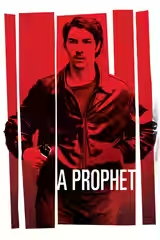
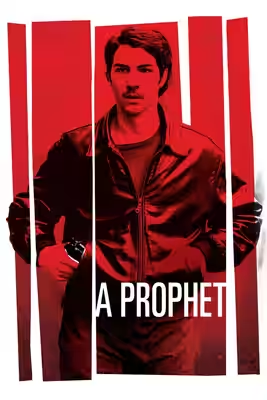
How does Boy A compare to A Prophet?
Boy A is the smaller and quieter of the two, and A Prophet the better film. Audiard's prison drama is gripping and brutal and shows every step of how its young man is made inside; Crowley's film is about what happens after release, watchful and modest, and depends on its actors rather than its plotting. Both become a little too tidy late on, but A Prophet has more to show for it.
Is Boy A based on a true story or a book?
Boy A is based on Jonathan Trigell's novel of the same name, adapted for the screen by Mark O'Rowe; it is not presented as a true story. Our review does not measure the adaptation against the book, so we cannot say how faithful it is. Knowing the novel is not needed; the film sets out its situation in its first minutes.
What should I watch after Boy A?
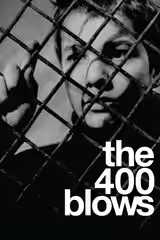
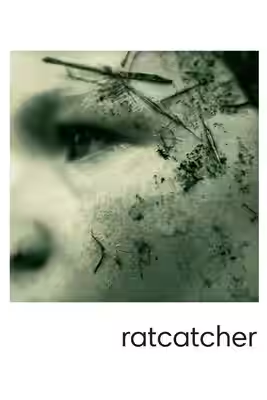
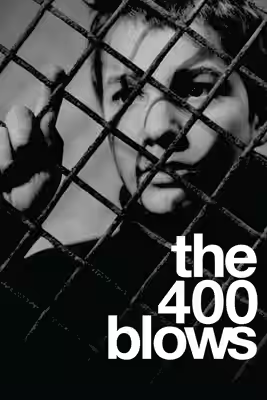
After Boy A, try A Prophet (2009, Fi1m 86): A French prison makes a man; Audiard shows every step of the making. Then Ratcatcher (1999, Fi1m 88): Lynne Ramsay’s Glasgow childhood, a canal, a death, and summer light that lies; and The 400 Blows (1959, Fi1m 91): Truffaut’s boy, the reformatory and the beach; where this kind of film began.

Cast

If you liked this, try…

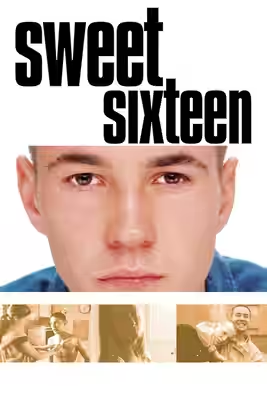
  1. Sweet Sixteen (2002) · not reviewed yetKen Loach’s boy on the edge of Greenock, loved and doomed in equal measure.

  2. A Prophet (2009, Fi1m 86)A French prison makes a man; Audiard shows every step of the making.

  3. Ratcatcher (1999, Fi1m 88)Lynne Ramsay’s Glasgow childhood, a canal, a death, and summer light that lies.

  4. The 400 Blows (1959, Fi1m 91)Truffaut’s boy, the reformatory and the beach; where this kind of film began.

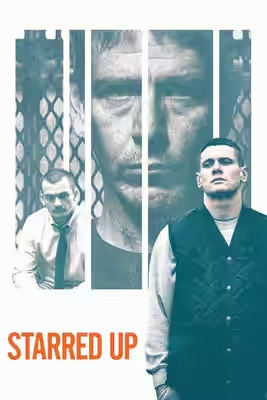
  5. Starred Up (2013, Fi1m 84)Jack O’Connell inside, father on the same wing; brutal, exact and unexpectedly tender.

Free account

Know what to watch tonight

Two lists that know where things are streaming, collections you can share, your own score beside ours, and Discover that remembers what you have seen.

  • Want to see, sorted by what is streaming now
  • Seen, with your score out of ten
  • No adverts, ever