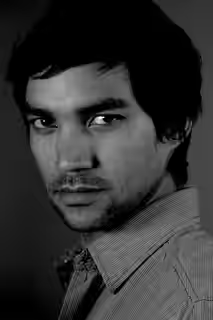
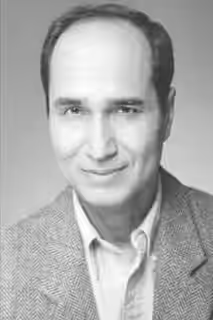
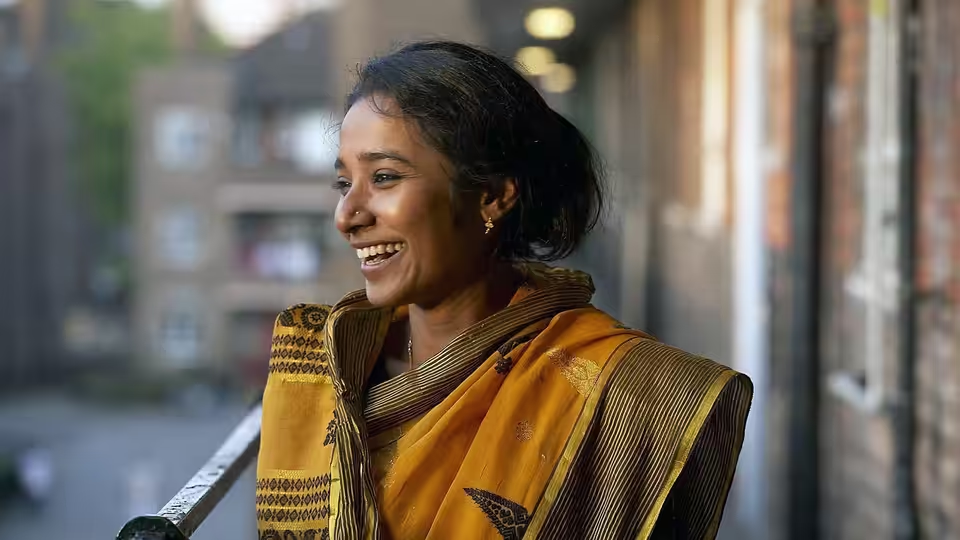
Nazneen (Tannishtha Chatterjee) smiles beside a window in her yellow sari
Film review

Brick Lane

2007 · Directed by Sarah Gavron · 1h 42m · MPA PG-13

In a sentenceThe wife looks out of the window for ninety minutes and the husband nobody asked for steals the film

Nazneen Ahmed (Tannishtha Chatterjee) is a teenager in a Bangladeshi village when her father marries her off to Chanu Ahmed (Satish Kaushik), an older man with a degree and a job in London. The film jumps to 2001 and a council flat in Tower Hamlets, where Nazneen has two daughters, Shahna (Naeema Begum) and Bibi (Lana Rahman), a husband who talks of going home and never does, and a view of the estate she rarely leaves. She remembers the paddy fields and the sister she left behind. She buys a sewing machine and takes in piecework, delivered by Karim (Christopher Simpson), a young man from the estate. Her friend Razia (Harvey Virdi) encourages her; the moneylender Mrs Islam (Lalita Ahmed) is harder to shake off.

Fi1m review

Sarah Gavron’s film of Monica Ali’s novel is gentle, handsome and well acted, and gentleness is also its limit. Tannishtha Chatterjee holds the centre with almost nothing to say; Satish Kaushik, as the husband she never chose, runs off with the picture.

Monica Ali’s novel followed a Bangladeshi village girl into an arranged marriage and a Tower Hamlets flat, and gave her years and several hundred pages to find a voice. Brick Lane is a careful, handsome, well-meant piece of work, kind to everyone in it, and kindness is a virtue in a person and a limit in a film. We liked it, and we kept waiting for it to raise its voice. It is Sarah Gavron’s first film, from a script by Abi Morgan and Laura Jones.

Tannishtha Chatterjee plays Nazneen almost entirely with her face. The script gives her a voiceover and little else to say aloud for the first half hour, and there were stretches where we were watching an actress wait. Chatterjee makes the waiting watchable. She holds still in a way that reads as attention rather than absence, and when she finally does something for herself, buying a sewing machine so the family has a second income, the small act lands. Until then her days are Chanu’s monologues, the girls’ meals and the view of the estate from the balcony.

Satish Kaushik’s Chanu is the reason to see it, and the best thing in it. He is introduced as a joke: a round, fussy man with a degree from Dhaka he brings up in every conversation, a job that never produces the promotion he expects, and a plan to take the family home that has been imminent for as long as anyone can remember. Kaushik plays all of that, and under it he plays a man who knows exactly how he sounds and cannot stop. He does it mostly with his shoulders, which drop a little every time someone looks away. We did not expect to be moved by him and we were, in a scene where he tries to teach his elder daughter about Bengal and she looks at him the way teenagers look at fathers everywhere.

Robbie Ryan shoots the estate in flat grey English daylight and the memories of Bangladesh in gold and green so saturated they look like a different film. Simon Elliott fills the flat with printed cloth and plastic so that it is crowded without being warm, and Michael O’Connor puts Nazneen in saris that are the brightest thing on any landing. Jocelyn Pook’s score, strings and a wordless voice, is used sparingly and sits under the film rather than on top of it. Melanie Oliver cuts the village memories short, a few seconds of paddy field or a running child, and for an hour they work. After that they become a habit: each one tells us Nazneen is thinking of home when we already knew, and there are a good many of them in the second half.

Where the film falls short is in the two things meant to change her. Karim (Christopher Simpson), the young man who brings the jeans for her to hem, is written as a political awakening and a love affair and plays as neither. Simpson is handsome and earnest, the scenes are lit like an advertisement for bed linen, and there is no heat in them; we never believed this careful woman would risk her daughters for this man. When the autumn of 2001 arrives and anger rises on the estate, it is handed to a couple of meetings in a community hall and leaflets. Naeema Begum’s Shahna, the elder daughter, a London girl furious at being told she belongs somewhere else, is the sharpest presence in the flat and spends most of the film in the next room. Harvey Virdi’s Razia gets the few laughs.

Gavron’s people murmur, and the film murmurs with them. Set against East Is East (1999) and My Beautiful Laundrette (1985), it is the quietest and most tasteful of the British films about families caught between two countries. Those two films had rows in them; this one has a husband who lectures and a wife who listens, and the volume rarely changes from one scene to the next.

It is worth an evening, particularly at home, where its smallness suits the screen. Watch it for Kaushik, for Ryan’s two palettes and for Chatterjee’s stillness. We left wanting to hear what the woman at the centre of it would have said if anyone had let her finish a sentence. It runs 102 minutes and carries a 15 certificate.

Critical consensus AI synthesised

58
Positive
5
Mixed
4
Negative
3
Radio Times
★★★★ · Susannah Straughan
80

The review praises Sarah Gavron’s accomplished debut for capturing the spirit of Monica Ali’s novel. It singles out the film’s adaptation of the novel as its central strength.

Read the full review →
Empire
28 October 2007 · Anna Smith
75*

Smith finds the adaptation sensitive, intelligent and involving, presenting a sober portrait of immigrant life. She particularly praises the sympathetic depiction of Nazneen and Chanu’s routine relationship.

Read the full review →
The Guardian
2 March 2008 · Mark Kermode
75*

Kermode finds the film heartfelt and ultimately uplifting despite its slow burn and flaws. He praises its vibrant sights and sounds and its affirmation of independent sisterhood and self-determination.

Read the full review →
The Hollywood Reporter
10 September 2007 · festival review · Kirk Honeycutt
70*

Honeycutt finds the film shrewd, poignant, and warmly observed, with its themes handled subtly rather than melodramatically. He particularly praises the performances, singling out Tannishtha Chatterjee’s expressive portrayal of Nazneen.

Read the full review →
Screen Daily
10 September 2007 · Allan Hunter
64*

The accessible text does not reveal the critic’s verdict. It notes the source novel’s blend of personal and political themes, but the review is behind a paywall.

Read the full review →
The AV Club
19 June 2008 · C+ · Tasha Robinson
63

Robinson finds the film slight and overstuffed, though worth a look for its avoidance of obvious choices. She praises its sensory portrayal of the protagonist’s memories, while criticizing the director’s distracting visual flourishes.

Read the full review →

Straight answers AI written, from our review

Is Brick Lane worth watching?
Brick Lane is worth an evening for the interested rather than everyone, and we scored it 64. Sarah Gavron's film of Monica Ali's novel is gentle, handsome and well acted, with Satish Kaushik's Chanu the best reason to see it, but it murmurs where it should raise its voice. Watch it at home, where its smallness suits the screen.
How long is Brick Lane, and what is it rated?
Brick Lane runs 1h 42m and is rated PG-13 by the MPA in the US. It is a drama film.
Where can I watch Brick Lane in the US?
Brick Lane is available to rent from Amazon Prime Video from $3.99. Availability is checked daily; the links above go straight to each service.
How violent or frightening is Brick Lane, and is it suitable for children?
Brick Lane carries a 15 certificate in the UK and is neither violent nor frightening; it is a quiet domestic drama about an arranged marriage in a Tower Hamlets flat. The certificate reflects adult themes, including an attempted love affair, rather than anything on screen to alarm the squeamish. Children would find little to trouble them and less to hold them.
How does Brick Lane compare to East Is East?
Brick Lane is the quieter and more tasteful of the two, and East Is East is the livelier and, for most viewers, the better evening. Both follow families caught between two countries, but the Salford film has rows and laughs where this one has a husband who lectures and a wife who listens. Choose Brick Lane for stillness and Kaushik; choose the other for noise.
What should I watch after Brick Lane?
After Brick Lane, try East Is East (1999, Fi1m 74): A Salford family in the same bind, played for shouting rather than silence. Then Brooklyn (2015, Fi1m 83): Another quiet young woman torn between the home she left and the one she has made; and Mustang (2015, Fi1m 84): Five Turkish sisters against the marriage market, with the anger Nazneen is never allowed.

Cast

If you liked this, try…

  1. East Is East (1999, Fi1m 74)A Salford family in the same bind, played for shouting rather than silence.

  2. The Namesake (2006) · not reviewed yetMira Nair follows a Bengali couple to America and lets the parents’ marriage carry the film.

  3. Ae Fond Kiss... (2004) · not reviewed yetKen Loach in Glasgow: a cross-cultural love affair with the heat this one lacks.

  4. Brooklyn (2015, Fi1m 83)Another quiet young woman torn between the home she left and the one she has made.

  5. Mustang (2015, Fi1m 84)Five Turkish sisters against the marriage market, with the anger Nazneen is never allowed.

Free account

Know what to watch tonight

Two lists that know where things are streaming, collections you can share, your own score beside ours, and Discover that remembers what you have seen.

  • Want to see, sorted by what is streaming now
  • Seen, with your score out of ten
  • No adverts, ever