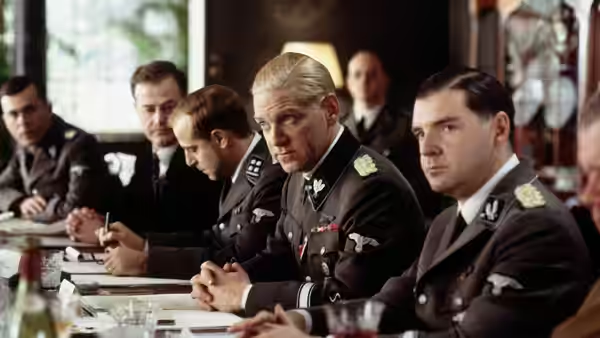
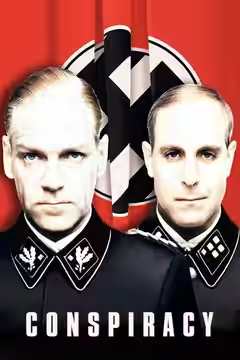
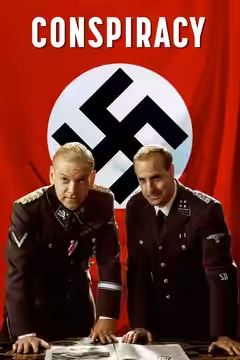
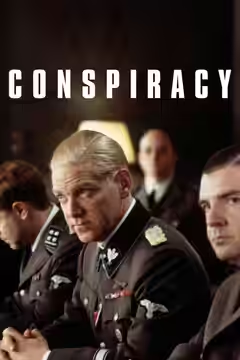
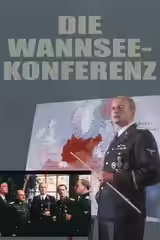
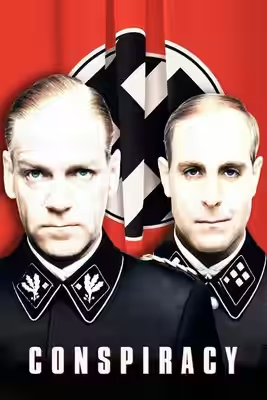
Frank Pierson puts fifteen Nazis round a table for an hour and a half and lets them talk the Holocaust into existence between courses. Quiet, exact and horrifying, with Kenneth Branagh’s Heydrich a host we will not forget.
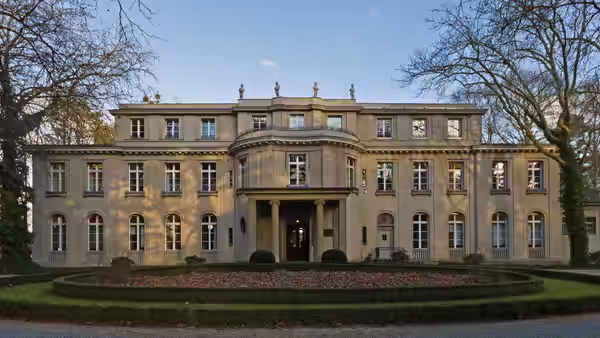
On 20 January 1942 fifteen men met in a villa beside the Wannsee, on the edge of Berlin, and over lunch settled the administration of the murder of Europe’s Jews. Frank Pierson’s film, from a script by Loring Mandel, stages that meeting and almost nothing else: one house, one morning, one table, 96 minutes. It shows no camp, no train, no body. It is a fine film and we recommend it with only a small reservation. What it understands is that the horror is in the minutes.
Mandel built his script on the one surviving copy of the minutes Eichmann kept, which is why the dialogue sounds like a meeting rather than a play. Men ask about budgets, train capacity, the legal position of a Jew married to a German. Nobody says the word murder until somebody does, and Heydrich suggests, pleasantly, that he find another. The approved words are evacuation, resettlement, the East. The film lets us hear what the men have decided not to say.
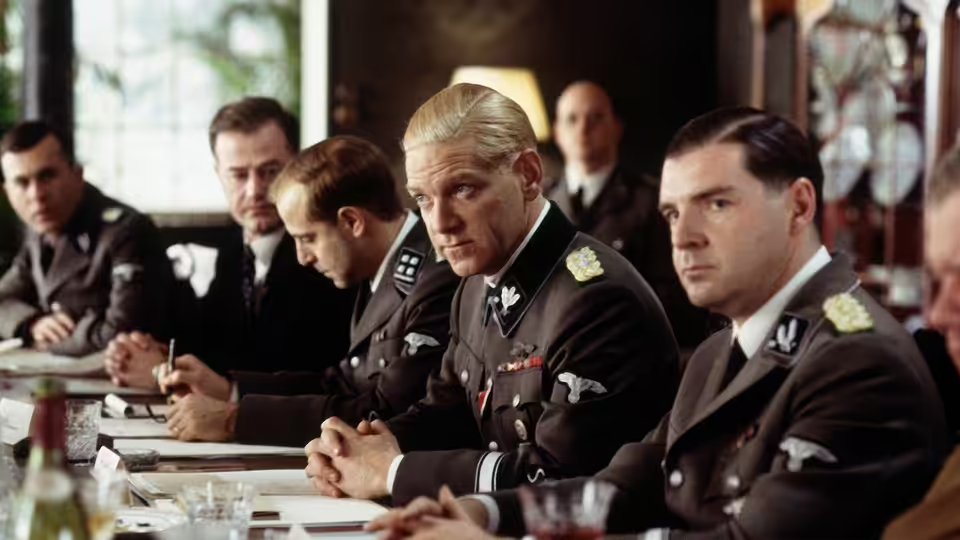
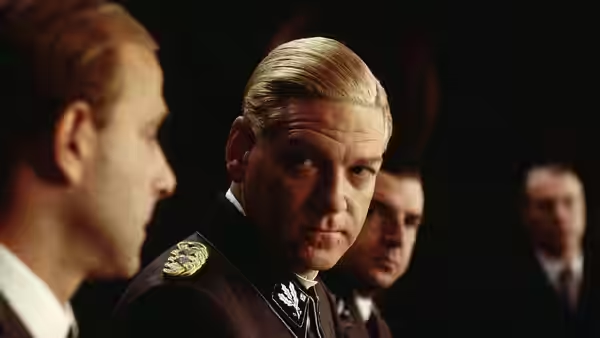
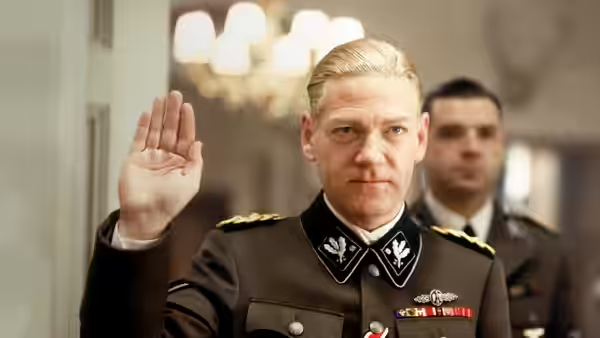
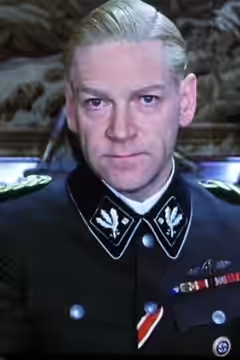
Kenneth Branagh plays Heydrich as a man having a good day. He arrives late, smiles at everyone, pours the wine himself and never once raises his voice. When a minister objects he agrees that the objection is an excellent one and then moves on as if it had been withdrawn. Branagh’s trick is to make the charm and the threat the same thing: the warmer he is, the clearer it becomes what happens to the man who keeps arguing. We have not seen him this frightening.
Stanley Tucci’s Eichmann is the clerk at the elbow, writing everything down and pleased to be at the table. Some critics found him mannered; we thought the smallness was the performance, a man who has decided his job is logistics and has no further questions, though there are stretches where he goes so quiet he nearly leaves the frame. Colin Firth has the hardest part and the best scene. His Stuckart, the lawyer who helped draft the race laws, objects to the whole proceeding, and for a minute we lean towards him, and then we hear what he is proposing instead.
That was the moment that got us. We were horrified, and the horror was quiet: not a scream, not an image, but a lawyer insisting on a procedural distinction while a waiter cleared the plates. We had expected the film to be upsetting. We had not expected it to be upsetting in the manner of a planning meeting we might have sat through ourselves. Afterwards we found we did not want supper.
Stephen Goldblatt shoots it in grey winter light through tall windows and keeps the camera moving slowly round the table, so that a line arrives in profile and its effect arrives on the face opposite. Peter Zinner cuts on those faces; the editing is almost entirely reaction, and it tells us who is frightened and who is bored. Peter Mullins’s villa is polished parquet, a fire, a long table and a buffet in the next room, a house built for a pleasant weekend. Rosalind Ebbutt dresses half the table in uniform and half in good suits, the SS in grey and the civil service in flannel, each side despising the other. Dennis McCarthy’s score barely exists, a little music at the start and the finish and silence while the men talk, which is the right decision.
It was made for television and in places it looks it. The exterior shots of cars on the snow are thin, and when the men step outside into what we are told is a bitter January no breath comes from their mouths, a small thing that undermines a film whose whole method is detail. The actors speak in their own voices, mostly English, so that the Third Reich sounds for stretches like a Whitehall committee; that is partly the design and partly a limit, and a few of the smaller parts, Brian Pettifer’s Meyer and Peter Sullivan’s Schöngarth among them, are given little to do but nod. The closing minutes also tell us slightly more than they needed to, in a film that had trusted us until then.
A West German television film covered the same meeting in 1984, cooler and closer to the record. Pierson’s is more of a chamber piece, nearer to 12 Angry Men (1957) than to a documentary, and it is the better evening for it. Watch it at home with the lights on. It runs 96 minutes and needs every one of them, and we would not advise eating during it.