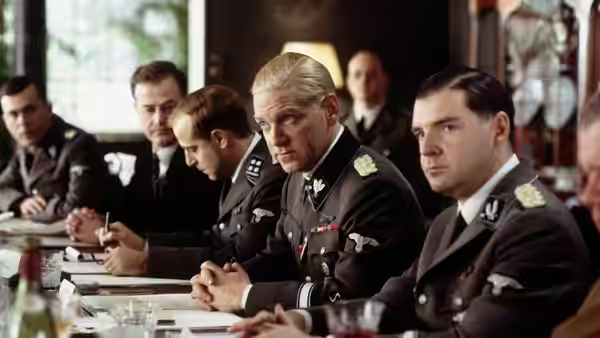
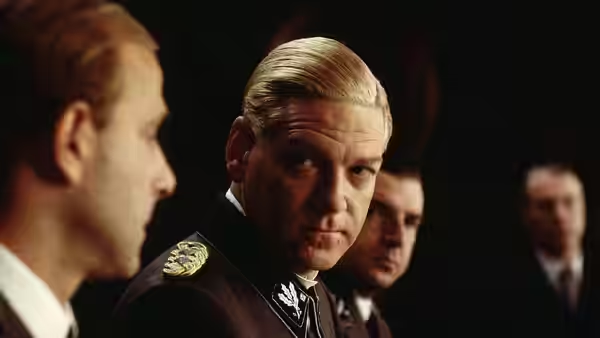
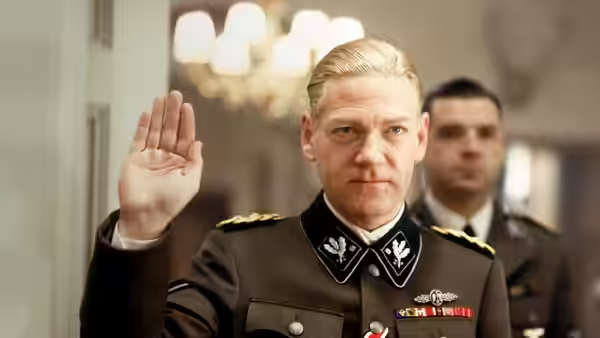
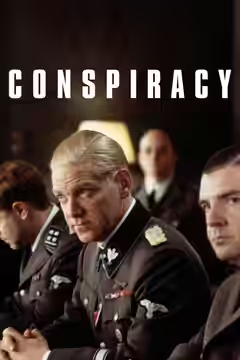
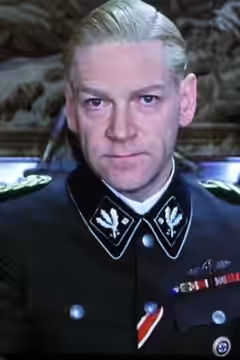
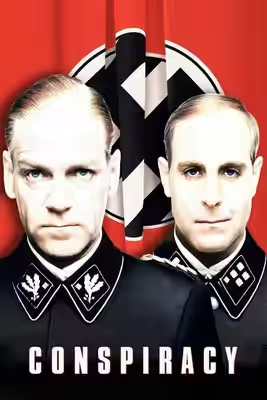
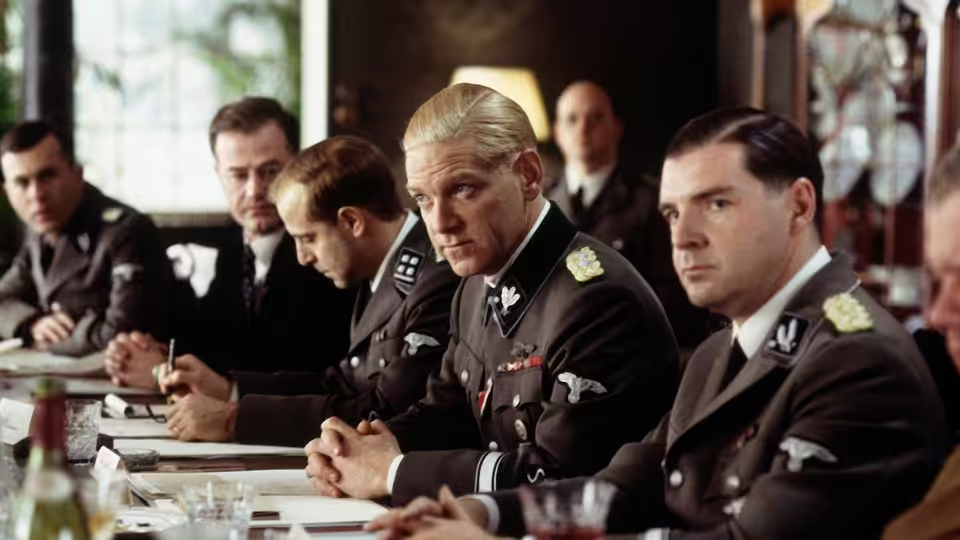
Reinhard Heydrich (Kenneth Branagh) sits with uniformed officials around a conference table
Film review

Conspiracy

2001 · Directed by Frank Pierson · 1h 36m

In a sentenceFifteen men agree to murder a people and the chief anxiety at the meeting is who gets to sign the memo

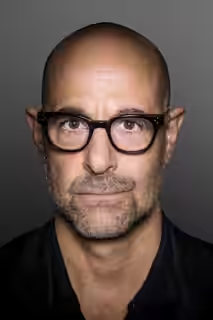
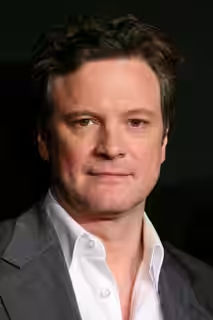
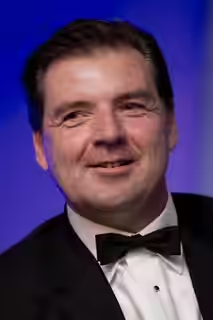
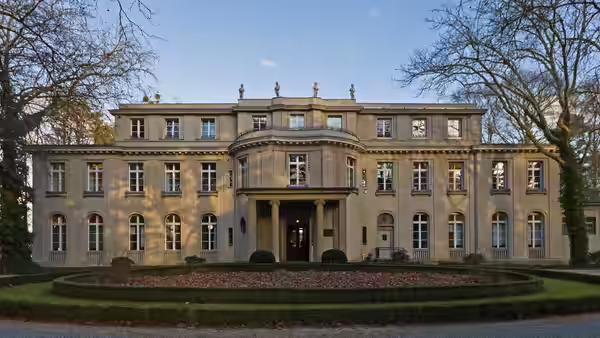
The morning of 20 January 1942, at a villa on the shore of the Wannsee outside Berlin. Staff lay a long table and set out a buffet while Adolf Eichmann (Stanley Tucci) checks the seating plan. Cars bring men from the SS, the Party and the ministries, among them Dr. Wilhelm Stuckart (Colin Firth) of the Interior Ministry, Heinrich Müller (Brendan Coyle) of the Gestapo and Josef Bühler (Ben Daniels) from occupied Poland. Reinhard Heydrich (Kenneth Branagh) arrives last and takes the head of the table. He wants to leave the meeting with all fifteen men agreeing that the SS now directs what he calls the final solution of the Jewish question. The ministries have questions about law, jurisdiction and who answers to whom.

Fi1m review

Frank Pierson puts fifteen Nazis round a table for an hour and a half and lets them talk the Holocaust into existence between courses. Quiet, exact and horrifying, with Kenneth Branagh’s Heydrich a host we will not forget.

On 20 January 1942 fifteen men met in a villa beside the Wannsee, on the edge of Berlin, and over lunch settled the administration of the murder of Europe’s Jews. Frank Pierson’s film, from a script by Loring Mandel, stages that meeting and almost nothing else: one house, one morning, one table, 96 minutes. It shows no camp, no train, no body. It is a fine film and we recommend it with only a small reservation. What it understands is that the horror is in the minutes.

Mandel built his script on the one surviving copy of the minutes Eichmann kept, which is why the dialogue sounds like a meeting rather than a play. Men ask about budgets, train capacity, the legal position of a Jew married to a German. Nobody says the word murder until somebody does, and Heydrich suggests, pleasantly, that he find another. The approved words are evacuation, resettlement, the East. The film lets us hear what the men have decided not to say.

Kenneth Branagh plays Heydrich as a man having a good day. He arrives late, smiles at everyone, pours the wine himself and never once raises his voice. When a minister objects he agrees that the objection is an excellent one and then moves on as if it had been withdrawn. Branagh’s trick is to make the charm and the threat the same thing: the warmer he is, the clearer it becomes what happens to the man who keeps arguing. We have not seen him this frightening.

Stanley Tucci’s Eichmann is the clerk at the elbow, writing everything down and pleased to be at the table. Some critics found him mannered; we thought the smallness was the performance, a man who has decided his job is logistics and has no further questions, though there are stretches where he goes so quiet he nearly leaves the frame. Colin Firth has the hardest part and the best scene. His Stuckart, the lawyer who helped draft the race laws, objects to the whole proceeding, and for a minute we lean towards him, and then we hear what he is proposing instead.

That was the moment that got us. We were horrified, and the horror was quiet: not a scream, not an image, but a lawyer insisting on a procedural distinction while a waiter cleared the plates. We had expected the film to be upsetting. We had not expected it to be upsetting in the manner of a planning meeting we might have sat through ourselves. Afterwards we found we did not want supper.

Stephen Goldblatt shoots it in grey winter light through tall windows and keeps the camera moving slowly round the table, so that a line arrives in profile and its effect arrives on the face opposite. Peter Zinner cuts on those faces; the editing is almost entirely reaction, and it tells us who is frightened and who is bored. Peter Mullins’s villa is polished parquet, a fire, a long table and a buffet in the next room, a house built for a pleasant weekend. Rosalind Ebbutt dresses half the table in uniform and half in good suits, the SS in grey and the civil service in flannel, each side despising the other. Dennis McCarthy’s score barely exists, a little music at the start and the finish and silence while the men talk, which is the right decision.

It was made for television and in places it looks it. The exterior shots of cars on the snow are thin, and when the men step outside into what we are told is a bitter January no breath comes from their mouths, a small thing that undermines a film whose whole method is detail. The actors speak in their own voices, mostly English, so that the Third Reich sounds for stretches like a Whitehall committee; that is partly the design and partly a limit, and a few of the smaller parts, Brian Pettifer’s Meyer and Peter Sullivan’s Schöngarth among them, are given little to do but nod. The closing minutes also tell us slightly more than they needed to, in a film that had trusted us until then.

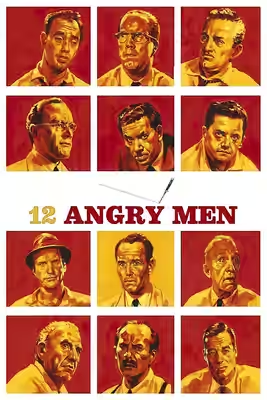
A West German television film covered the same meeting in 1984, cooler and closer to the record. Pierson’s is more of a chamber piece, nearer to 12 Angry Men (1957) than to a documentary, and it is the better evening for it. Watch it at home with the lights on. It runs 96 minutes and needs every one of them, and we would not advise eating during it.

Critical consensus AI synthesised

72
Positive
2
Mixed
2
Negative
0
The Guardian
27 January 2002 · Kathryn Flett
90*

The critic calls Conspiracy a near-faultless and deeply affecting drama. She especially praises its restraint and Kenneth Branagh’s performance, with only the lack of visible breath in icy exterior shots drawing complaint.

Read the full review →
The New Yorker
22 August 2018 · Melvin Backman
75*

Backman presents the film as a powerful study of how bureaucratic coordination enabled the Holocaust. He praises Kenneth Branagh’s chilling portrayal of Heydrich and the film’s depiction of coercion in the meeting room.

Read the full review →
The New York Times
19 October 2001
64*

The page could not be accessed, so its critical verdict and specific praise or complaint are unavailable. The URL identifies this as a film review of Conspiracy.

Read the full review →
Radio Times
★★★ · David Parkinson
60

The review calls the drama a laudable, dispassionate examination of the planning of the Final Solution. It praises the effort to avoid caricature but says some performances feel mannered, contrasting Kenneth Branagh’s charismatic Heydrich with Stanley Tucci’s portrayal.

Read the full review →

Straight answers AI written, from our review

Is Conspiracy worth watching?
Conspiracy is worth watching for anyone who can sit through 96 minutes of men talking round a table, and we scored it 83. Kenneth Branagh's Heydrich and Colin Firth's Stuckart carry it, and the horror comes from the minutes rather than from anything shown. It was made for television and in places looks it, which is our only real reservation.
How long is Conspiracy, and what is it rated?
Conspiracy runs 1h 36m. It is a history and drama film.
Where can I watch Conspiracy in Hong Kong?
Conspiracy is streaming on HBO Max in Hong Kong. Availability is checked daily; the links above go straight to each service.
How violent or frightening is Conspiracy, and is it suitable for children?
Conspiracy contains no violence on screen, no camp, no train and no body, but it is one of the most disturbing films about the Holocaust we have seen. It carries no UK certificate and an R in America, and the subject is fifteen men planning mass murder over lunch. It is not for children; older teenagers studying the period will find it hard and valuable.
How does Conspiracy compare to 12 Angry Men?
Conspiracy is the darker and quieter of the two, a chamber piece modelled on the one-room argument that 12 Angry Men perfected. Lumet's film is the more gripping and the easier to recommend to almost anyone, since its men are arguing for a life rather than arranging a murder. Pierson's is the more horrifying, and the one you will not want supper after.
What should I watch after Conspiracy?
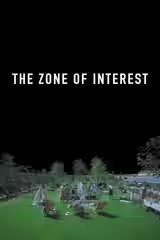
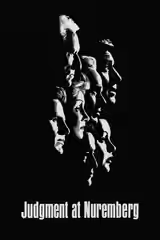
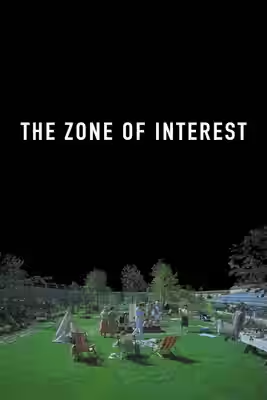
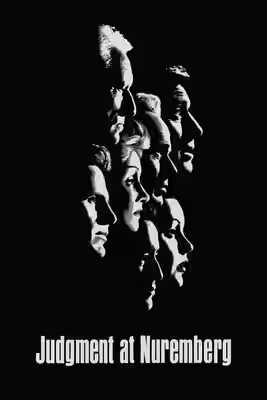
After Conspiracy, try 12 Angry Men (1957, Fi1m 91): One room, twelve men and an argument; the model for every film like this. Then The Zone of Interest (2023, Fi1m 91): The same horror from the garden next door, with the camp heard but never seen; and Judgment at Nuremberg (1961, Fi1m 82): Stuckart’s kind of lawyer in the dock, and a courtroom that refuses easy answers.

Cast

If you liked this, try…

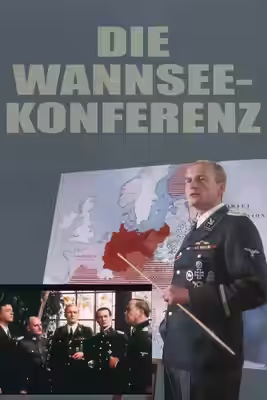
  1. The Wannsee Conference (1984) · not reviewed yetThe German version of the same meeting, drier and closer to the minutes.

  2. 12 Angry Men (1957, Fi1m 91)One room, twelve men and an argument; the model for every film like this.

  3. The Zone of Interest (2023, Fi1m 91)The same horror from the garden next door, with the camp heard but never seen.

  4. Hannah Arendt (2012) · not reviewed yetThe woman who watched Eichmann on trial and coined the phrase for what he was.

  5. Judgment at Nuremberg (1961, Fi1m 82)Stuckart’s kind of lawyer in the dock, and a courtroom that refuses easy answers.

Free account

Know what to watch tonight

Two lists that know where things are streaming, collections you can share, your own score beside ours, and Discover that remembers what you have seen.

  • Want to see, sorted by what is streaming now
  • Seen, with your score out of ten
  • No adverts, ever