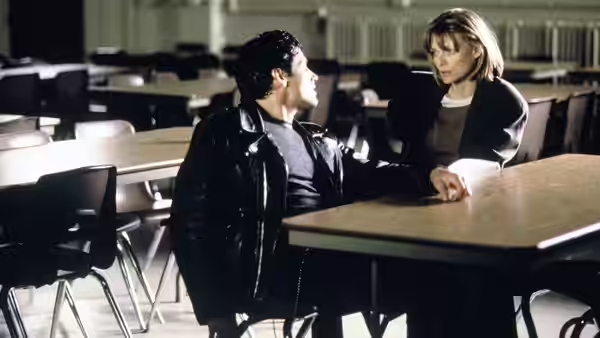
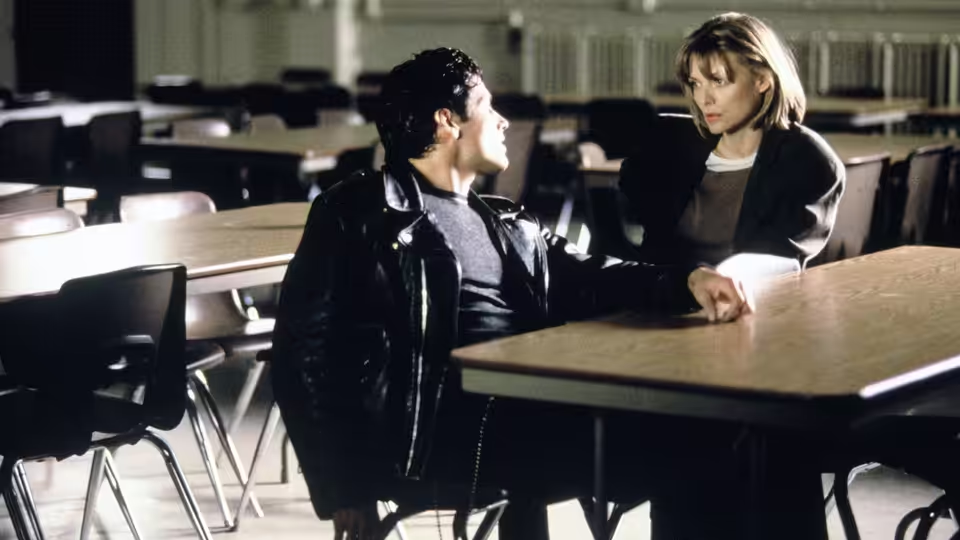
Louanne Johnson (Michelle Pfeiffer) sits with a student among desks in an empty classroom
Film review

Dangerous Minds

1995 · Directed by John N. Smith · 1h 39m

In a sentenceMichelle Pfeiffer wins a classroom with a leather jacket and a promise of straight As, and the film never doubts her

Louanne Johnson (Michelle Pfeiffer), newly out of the Marines and out of a marriage, takes a teaching job at a Californian high school through her friend Hal Griffith (George Dzundza). The class she inherits is the one nobody else wants: Emilio Ramirez (Wade Dominguez) runs the back row, Raul Sanchero (Renoly Santiago) does the talking, and Callie Roberts (Bruklin Harris) hides a gift for words. On her first day they talk over her, laugh at her tweed jacket and send her home shaken. She comes back in a leather jacket, promises the whole class an A to start with and sets about teaching them English her own way, while the principal, George Grandey (Courtney B. Vance), reminds her of the rules. The film is drawn from Johnson’s own account of the year.

Fi1m review

Michelle Pfeiffer is calm and likeable as the ex-Marine who tames a class of difficult teenagers, and almost nothing around her is believable: the school is too clean, the pupils too thinly drawn, the lessons too easy. A true story sanded down to a formula.

Louanne Johnson (Michelle Pfeiffer) has left the Marines, is out of a marriage and needs a job. Her friend Hal Griffith (George Dzundza) finds her one: a class of teenagers at a Californian high school whom the rest of the staff have given up on, and a year to teach them English. John N. Smith directs from a screenplay by Ronald Bass, taken from Johnson’s own book, and the film fits her year into the shape the classroom drama has had since The Blackboard Jungle: hostile class, unlikely teacher, one breakthrough, one setback, a speech. It runs 99 minutes, Pfeiffer is good in it, and almost nothing around her rings true.

On her first day she turns up in a tweed jacket and a long skirt, and the class has her measured before she has written her name on the board. She goes home, comes back in a leather jacket, and announces that she knows karate. We laughed, and then felt a little embarrassed, because the film means this to be the moment the class comes round, and the class comes round. Bobbie Read’s costumes are doing most of the character work here, and they do it in a day. Pfeiffer gets away with the rest by refusing to push. She plays Johnson as someone faintly amused by her own methods, never raising her voice, treating every insult as a question worth answering, and she is the one thing in the picture that feels like a person rather than a device.

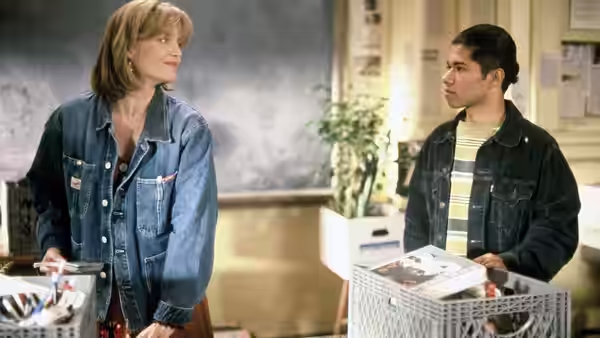
The pupils fare worse. Emilio Ramirez (Wade Dominguez) scowls from the back row and is the one she has to win. Raul Sanchero (Renoly Santiago) is the joker, Callie Roberts (Bruklin Harris) the clever girl who writes poems, Gusmaro Rivera (Roberto Alvarez) and Cornelius Bates (Marcello Thedford) the chorus. Bass gives each of them one trait and one grievance, and no life beyond the school gates. Dominguez has real stillness and Santiago has charm, and both are made to deliver speeches explaining themselves where a better script would have let us work it out. Johnson’s method, which is to promise everyone an A to start with and let them keep it, is presented as a revelation. We kept waiting for the film to notice that this is a trick, and that tricks run out.

Pierre Letarte lights the school in clean, even California sunshine, and Donald Graham Burt’s production design gives it bright corridors, unscratched lockers and a classroom with tall windows. It is a well-kept building full of children the film insists are beyond reach, and the two facts are never made to meet. Tom Rolf cuts the lessons into montage, so that weeks of teaching pass in a verse of whatever is on the soundtrack, and the hard part is skipped. Lisa Coleman and Wendy Melvoin’s score is soft keyboards under the quiet scenes, and the songs do the louder work.

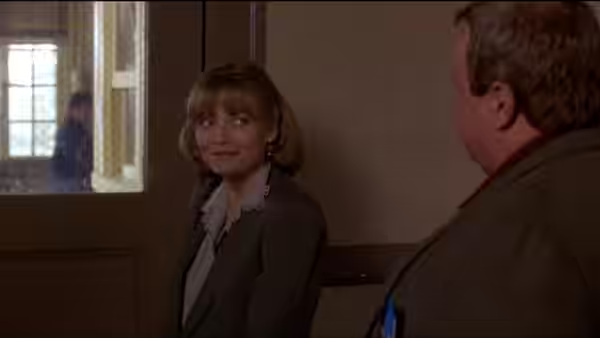
The adults are sketches. Courtney B. Vance plays the principal, George Grandey, as a man more exercised by whether people knock on his door than by what they have come to say, and it is one note held for the length of the film. Robin Bartlett’s Carla Nichols is the colleague who doubts, and Lorraine Toussaint’s Irene Roberts gets even less. Then Beatrice Winde arrives as Mary Benton, a grandmother who tells Johnson flatly that her boys have no use for poetry and that she should find some other poor children to save. It is the only moment the film’s argument is answered back, and we sat up. The film moves on and never asks the question again.

Don Simpson and Jerry Bruckheimer produced it, with Pfeiffer, and it carries their habits: a problem stated, a montage, a triumph. Set beside Stand and Deliver (1988), which let its teacher be tedious and its pupils bored for weeks before anything changed, it looks in a hurry to be finished. It is not cynical; it plainly wants these children to do well. It cannot imagine that wanting might not be enough.

It opened in Britain on 17 January 1996. Watch it for Pfeiffer, who is better than the material and never lets on, and for Dominguez, who holds a back row with a look. The rest is a lesson plan.

Critical consensus AI synthesised

37
Positive
0
Mixed
2
Negative
3
The New York Times
11 August 1995 · Janet Maslin
64*

The page identifies this as a film review, but its text is unavailable. The critic’s verdict and any specific praise or complaint cannot be verified.

Read the full review →
Radio Times
★★★ · David Parkinson
60

Parkinson finds the classroom drama too intense and says it loses a needed release after a romantic subplot was cut. He praises Michelle Pfeiffer’s solid performance, despite finding her unconvincing as an ex-marine and teacher.

Read the full review →
Variety
9 August 1995 · Todd McCarthy
30*

McCarthy finds the film too soft and simplistic to confront the urban school crisis it claims to address. He praises the promise of three young actors but says the characters lack dimension and the film avoids their wider social context.

Read the full review →
Empire
1 January 2000 · Caroline Westbrook
20*

The critic finds the film formulaic and burdened by clichés, despite its true-story origins. Pfeiffer’s relaxed, comforting performance is singled out as the bright spot.

Read the full review →
Los Angeles Times
11 August 1995 · Kenneth Turan
10*

Turan finds the film simplistic, predictable, and a disappointing distortion of the real events. He praises Michelle Pfeiffer’s believable performance, while faulting the contrived plot and unconvincing classroom scenes.

Read the full review →

Straight answers AI written, from our review

Is Dangerous Minds worth watching?
Dangerous Minds is worth watching only for Michelle Pfeiffer, and we scored it 42. She plays the ex-Marine who tames a hostile class with calm and a faint amusement at her own methods, and she is the one person in the film who feels real. Around her the pupils are thinly drawn, the school too clean and the lessons too easy.
How long is Dangerous Minds, and what is it rated?
Dangerous Minds runs 1h 39m. It is a drama film.
Where can I watch Dangerous Minds in South Korea?
Dangerous Minds is streaming on Disney+ in South Korea. Availability is checked daily; the links above go straight to each service.
How violent or frightening is Dangerous Minds, and is it suitable for children?
Dangerous Minds carries a UK 15 certificate, so it is not for younger children, though it is a classroom drama rather than a frightening one. The pupils are rude, the insults fly and the atmosphere of the first day is hostile, but the film is more interested in a teacher winning a room than in anything graphic. Older teenagers will find little to trouble them.
How does Dangerous Minds compare to Half Nelson?
Dangerous Minds is the slicker and shallower of the two, and Half Nelson is the better film. The earlier picture never doubts its teacher, hands her a montage and a triumph, and skips the hard part; the later one gives Ryan Gosling a teacher with an addiction whose pupils are coping better than he is. Viewers wanting comfort should choose Pfeiffer, viewers wanting honesty should choose Gosling.
Is Dangerous Minds based on a true story or a book?
Dangerous Minds is drawn from a true story, LouAnne Johnson's own book about her year teaching a difficult class at a Californian high school. The film fits her account into the familiar shape of the classroom drama, and in our view sands the real year down to a formula. Knowing the book is not needed to follow it.
What should I watch after Dangerous Minds?
After Dangerous Minds, try Half Nelson (2006, Fi1m 81): Ryan Gosling as a Brooklyn teacher whose pupils are coping better than he is. Then Kes (1969, Fi1m 88): Ken Loach on a Yorkshire boy and a school that has already given up on him.

Cast

If you liked this, try…

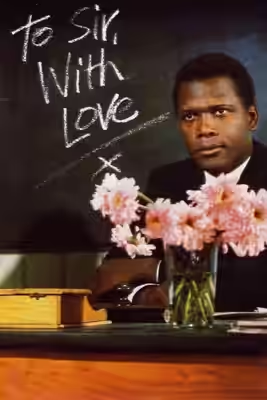
  1. To Sir, with Love (1967) · not reviewed yetSidney Poitier in an East End classroom; the same formula, with more patience and a better song.

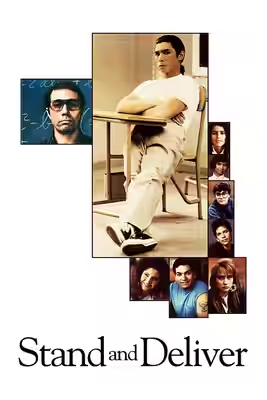
  2. Stand and Deliver (1988) · not reviewed yetA maths teacher in East Los Angeles who is allowed to be boring before he is inspiring.

  3. The Class (2008) · not reviewed yetA Paris classroom filmed over a year, where the teacher loses as often as he wins.

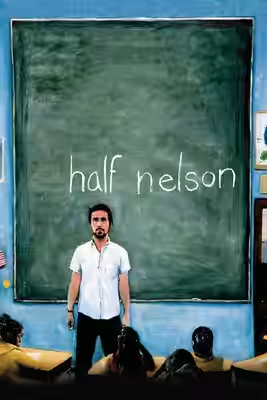
  4. Half Nelson (2006, Fi1m 81)Ryan Gosling as a Brooklyn teacher whose pupils are coping better than he is.

  5. Kes (1969, Fi1m 88)Ken Loach on a Yorkshire boy and a school that has already given up on him.

Free account

Know what to watch tonight

Two lists that know where things are streaming, collections you can share, your own score beside ours, and Discover that remembers what you have seen.

  • Want to see, sorted by what is streaming now
  • Seen, with your score out of ten
  • No adverts, ever