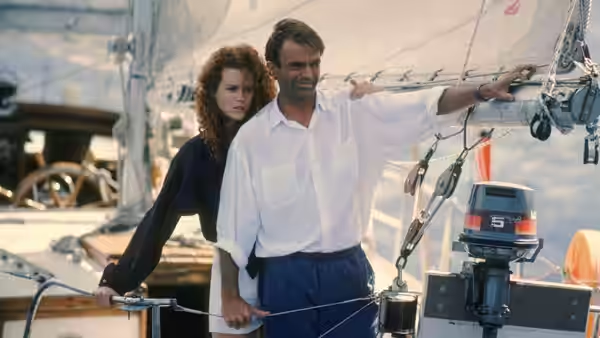
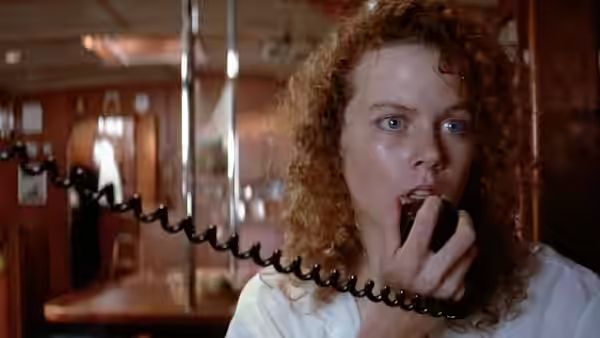
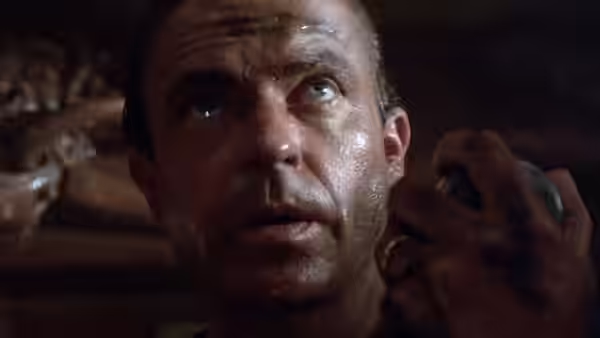
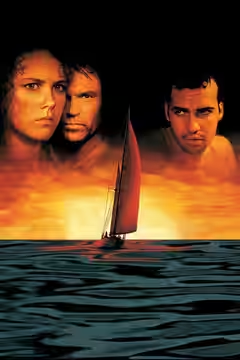
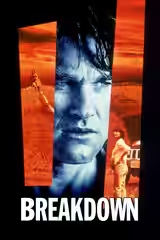
Rae Ingram (Nicole Kidman) stands beside John Ingram (Sam Neill) aboard their sailboat
Film review

Dead Calm

1989 · Directed by Phillip Noyce · 1h 36m

In a sentenceA grieving couple, an empty ocean and the one man they should have left in his dinghy

John Ingram (Sam Neill) comes home to find his wife Rae (Nicole Kidman) in hospital and their small son Danny (Joshua Tilden) dead. To get away from the house and the grief, the two of them take their yacht out into the Pacific with only the dog for company. On a windless morning they sight a schooner, the Orpheus, lying low in the water, and a man rowing towards them as if his life depended on it. Hughie Warriner (Billy Zane) climbs aboard and says everyone else on the Orpheus is dead. John rows across to see for himself. What he finds below deck, and what Hughie does while he is gone, leaves husband and wife on different boats with the sea widening between them.

Plays from YouTube when you press play; nothing loads from them until then.

Fi1m review

Phillip Noyce’s thriller has three people, two boats and 96 minutes, and it wastes little of any of them. Nicole Kidman carries it; Billy Zane keeps it uneasy. Some of the shocks are cheap, and the final minute should not be there.

Dead Calm is a thriller with three people, two boats and a great deal of water, and Phillip Noyce has the discipline to leave it at that. It runs 96 minutes, nearly all of them in hard daylight on an empty sea, which removes the two things a thriller leans on: the dark, and the chance that someone might come. Terry Hayes adapts Charles Williams’s novel into two plain questions. Can the woman on the yacht get the better of the man who has taken it? Can her husband keep a sinking schooner afloat long enough to catch up?

Noyce gets the grief over quickly. John Ingram (Sam Neill) comes home to a hospital, a wife in a bed and a small son, Danny (Joshua Tilden), who has not survived. Soon after, Rae (Nicole Kidman) and John are on their yacht with their dog and nothing on any horizon, at sea because they cannot stand to be at home. Then a schooner called the Orpheus appears, listing, and Hughie Warriner (Billy Zane) rows across in a panic and says everyone else aboard is dead.

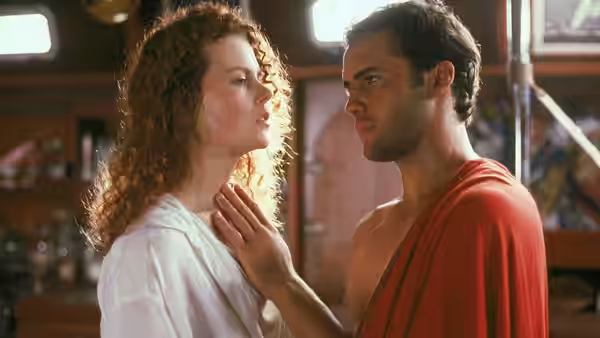
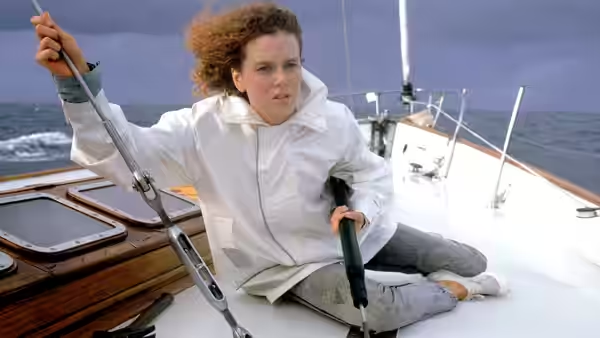
Kidman holds the film by thinking on camera. Once Hughie has the yacht and Rae is alone with him, the script gives her no gun and no help, only a radio he can hear, a sail she can trim and a man whose mood changes by the minute. She plays Rae as frightened and calculating at once, choosing when to be pleasant and when to hit. Zane’s Hughie is handsome, polite, quick to laugh and plainly unwell, and the frightening thing is that he behaves like a guest who has decided he lives there.

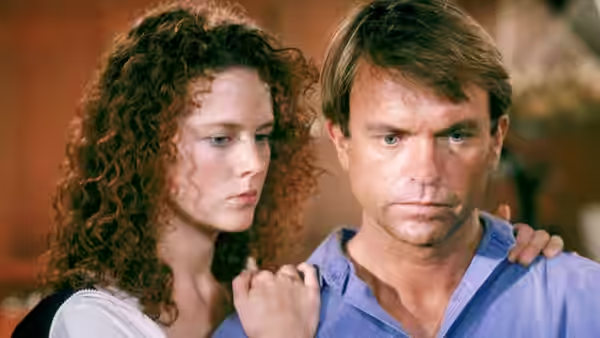
Neill has the duller job and does it honestly. John spends most of the film below decks on the Orpheus with a bilge pump, rising water and the bodies Hughie did not mention. Some critics have found him stiff; we would say a man alone on a sinking boat has nothing to be loose about. Richard Francis-Bruce cuts back to him whenever Rae seems to be coping, so that each time one boat goes quiet the other floods. Graham “Grace” Walker dresses the Orpheus as a wreck, dark timber and water over the floorboards, so that the white yacht a few miles off looks like safety.

Dean Semler shoots the sea as a flat, bright plate and keeps the yacht small in it. Aboard, he puts the camera low so the cabin ceiling presses down and Zane has to stoop, and lets the sun do the lighting. Graeme Revell’s score is a low synthesiser hum with something like breathing in it, sparing for most of the film and turned up too far for the jumps. Norma Moriceau puts Rae in cut-off vests and swimwear that look lived in rather than chosen.

The moment that got us is the simplest one. John is below on the Orpheus, hears an engine, comes up and sees his own yacht turning away with his wife on it, the gap too wide to swim. Neill does nothing but stand there, and Noyce holds the shot. We felt the floor go, and it stayed gone for half an hour, because the film had turned the distance between two boats into something we could feel in our stomach.

What does not work is mostly borrowed. Two or three shocks of the body-lurches-upright kind are stock horror, and they cheapen the quiet around them. The final minute adds a jolt the film does not need. We will not describe it, except to say the film has earned a quiet ending by then and chooses a loud one, and we were still cross about it in the car park.

Noyce went on to larger films, including Patriot Games (1992) and The Quiet American (2002), and none is as spare as this. The nearest relative is Polanski’s Knife in the Water (1962), another couple, boat and stranger who should not have been let aboard. See this one at night with the sound up. If you can bring yourself to switch off ninety seconds early, it is a better film. We have never managed it.

Critical consensus AI synthesised

71
Positive
3
Mixed
3
Negative
0

The reviews lean favourable without tipping into enthusiasm: three positive, three mixed, none hostile. Where the critics agree is on Nicole Kidman. Every review that commits to a verdict singles her out, variously calling the performance intelligent, energetic, tenacious and imaginative. Several also admire how much tension the film wrings from so little, two boats, open water and three people, and Billy Zane’s menace earns a mention of its own.

The reservations cluster around plausibility and the later stretches. Variety notes implausibilities but forgives them for the sake of the suspense; Empire is harder, finding the shocks increasingly desperate and one performance far-fetched. Eye for Film thinks the ideas familiar and Sam Neill somewhat stiff. The spread is moderate rather than wide, running from a strong recommendation at the Los Angeles Times down to lukewarm. Two of the six reviews, from The New York Times and Time Out, cannot be read in full, so their verdicts remain unknown.

Los Angeles Times
7 April 1989 · SHEILA BENSON
90*

Benson calls the film a smart, seductive, tightly controlled thriller and strongly recommends it. She praises Nicole Kidman’s intelligent performance and the director’s inventive use of the boats, sea and limited locations to build tension.

Read the full review →
Variety
31 December 1988 · Variety Staff
75*

The review finds the film an engrossing suspense picture despite some implausibilities. It especially praises Nicole Kidman’s energetic, tenacious performance.

Read the full review →
The New York Times
7 April 1989
64*

The URL identifies a review of Dead Calm, but the page is inaccessible. Its verdict and any specific praise or complaint cannot be established from the available text.

Read the full review →
Time Out
· NF
64*

The page is identified as a film review, but no verdict is available in the accessible text. No element singled out for praise or complaint is visible.

Read the full review →
Empire
1 January 2000 · William Thomas
60*

The review finds the film a decent, if flawed, suspense thriller. It praises its initially tense atmosphere but criticizes the far-fetched performance and increasingly desperate shocks.

Read the full review →
Eye for Film
11 November 2006 · Angus Wolfe Murray
70*

The critic finds it a tense thriller built from familiar ideas. He praises Billy Zane’s menacing performance and Nicole Kidman’s solid, imaginative acting, while describing Sam Neill’s performance as somewhat stiff.

Read the full review →

Straight answers AI written, from our review

Is Dead Calm worth watching?
Dead Calm is worth watching for anyone who likes a thriller stripped to essentials, and we scored it 73. Three people, two boats and 96 minutes of open sea, with Nicole Kidman thinking her way through every scene and Billy Zane keeping the mood uneasy. A few cheap shocks and a needless final minute keep it from being better.
How long is Dead Calm, and what is it rated?
Dead Calm runs 1h 36m. It is a thriller and drama film.
Where can I watch Dead Calm in Peru?
Dead Calm is not on any streaming or rental service in Peru at the moment. It is available in 23 other countries; change your country at the top of the page to see where. Availability is checked daily.
How violent or frightening is Dead Calm, and is it suitable for children?
Dead Calm is a 15 in the UK and an R in the US, and it is not for children. The threat is mostly dread rather than gore, a woman alone on a yacht with a man who is plainly unwell, but there are bodies below deck, two or three jolting horror shocks and a sustained sense of menace. Teenagers used to thrillers will manage; the squeamish may not.
How does Dead Calm compare to Misery?
Dead Calm and Misery are both two-handers about being trapped with someone who should not be there, but one is set on a bright open sea and the other in a single room. Noyce's film is the sparer and more physical, driven by sailing and distance; Reiner's is funnier and leans harder on its two performances. Pick Dead Calm for tension in daylight, Misery for dark comedy with its dread.
Is Dead Calm based on a true story or a book?
Dead Calm is based on a novel by Charles Williams, not a true story. Terry Hayes adapts it into two plain questions, whether the woman can retake her yacht and whether her husband can keep a sinking schooner afloat, and the film works entirely on its own terms. You do not need to know the book.

Cast

Awards

AACTA Award for Best Adapted Screenplay, 1989

Nominated
AACTA Award for Best Adapted Screenplay

AACTA Award for Best Cinematography, 1989

Won
AACTA Award for Best Cinematography

AACTA Award for Best Direction, 1989

Nominated
AACTA Award for Best Direction

AACTA Award for Best Editing, 1989

Won
AACTA Award for Best Editing

AACTA Award for Best Film, 1989

Nominated
AACTA Award for Best Film

AACTA Award for Best Original Music Score, 1989

Won
AACTA Award for Best Original Music Score

AACTA Award for Best Production Design, 1989

Nominated
AACTA Award for Best Production Design

AACTA Award for Best Sound, 1989

Won
AACTA Award for Best Sound

If you liked this, try…

  1. Knife in the Water (1962) · not on Fi1m yetPolanski’s couple, boat and stranger; the same triangle, with words doing the damage.

  2. The Hitcher (1986) · not on Fi1m yetRutger Hauer as the lift you should not have given, on an endless desert road.

  3. Misery (1990, Fi1m 83)Kathy Bates keeps a man in one room and smiles; two-hander dread, done indoors.

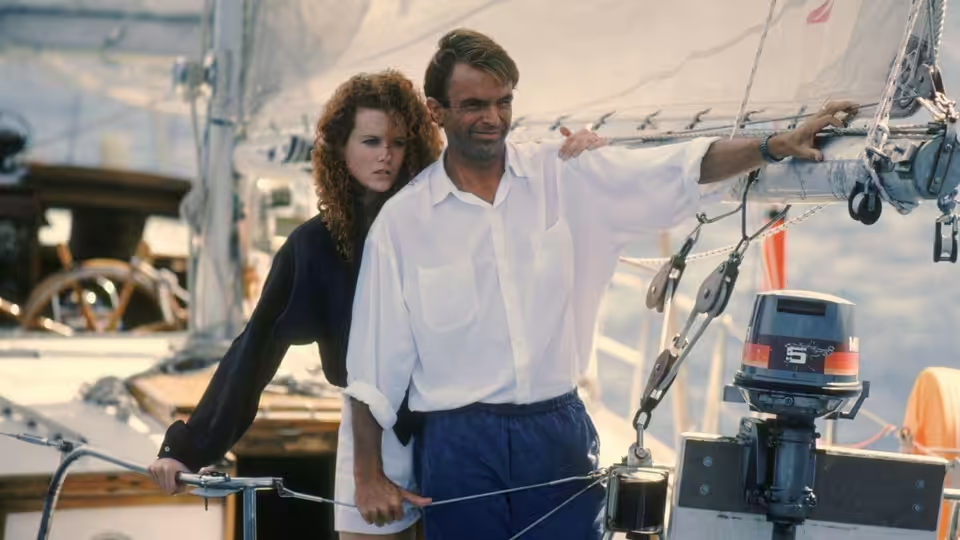
  4. Breakdown (1997) · not on Fi1m yetKurt Russell loses his wife on a highway; lean, plain and quick about it.

  5. Hush (2016) · not on Fi1m yetOne deaf woman, one house, one intruder; a thriller that runs on what she can see.