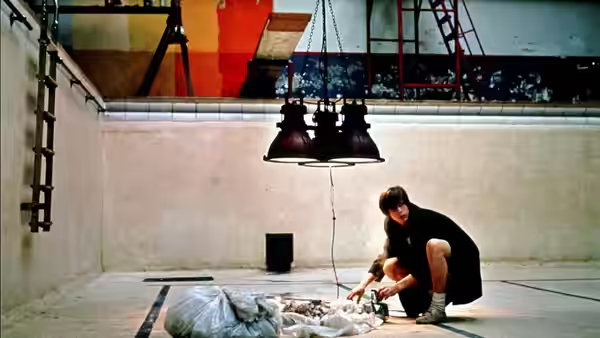
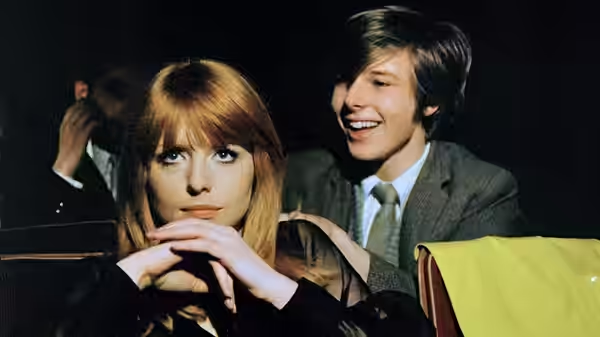
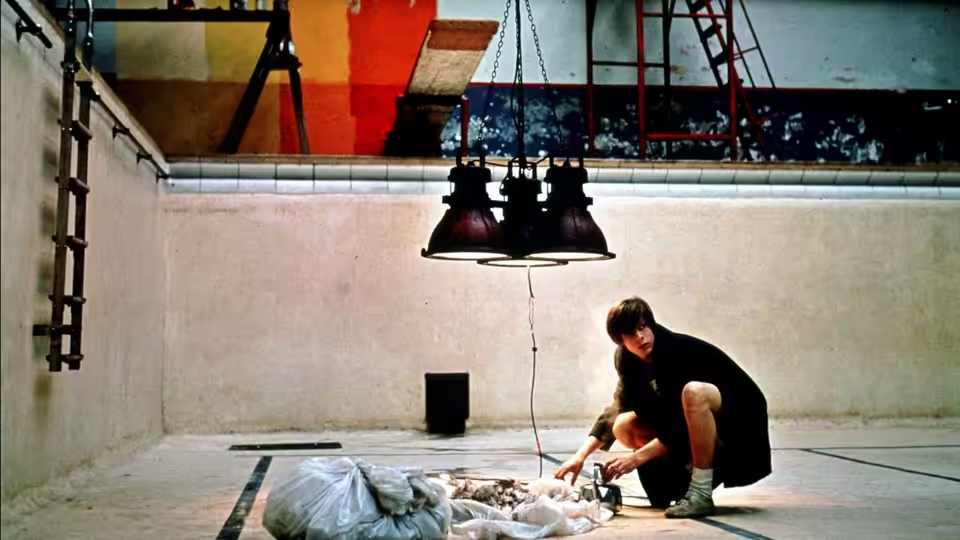
A young man kneels beside a person lying beneath a hanging lamp in an indoor pool
Film review

Deep End

1971 · Directed by Jerzy Skolimowski · 1h 32m

In a sentenceA swimming pool is an awkward place to keep your longing to yourself

Mike (John Moulder-Brown) and Susan (Jane Asher) are at the centre of a story of youthful longing, with a swimming pool providing the setting for desire and discomfort. The Gym Teacher (Karl Michael Vogler) is among the adults in their orbit. Bodies are on display, but other people remain difficult to understand. Sexual curiosity brings embarrassment as well as possibility, and the surroundings give private feelings an awkwardly public setting. Comedy sits alongside drama as the wish to get close to someone becomes harder to separate from the fear of being exposed.

Plays from YouTube when you press play; nothing loads from them until then.

Fi1m review

Jerzy Skolimowski makes youthful longing uncomfortable in a film whose swimming-pool setting is more persuasive than some of its strangeness. The uneasy humour works; the dreamlike atmosphere occasionally keeps the people at a distance.

Deep End is good at making desire feel embarrassing, and less consistently good at making its strangeness feel necessary. Jerzy Skolimowski approaches youthful longing with a willingness to let comedy become uncomfortable before we have finished enjoying it. The swimming-pool setting gives that approach somewhere specific to work: a place where physical exposure need not bring any greater understanding of another person. We recommend it, with a warning that its oddness can sometimes make the feelings harder to reach.

John Moulder-Brown’s Mike and Jane Asher’s Susan give us people to attend to amid that uncertainty. The interest lies in watching them without assuming that youth makes someone innocent or that attraction makes someone understandable. Asher is particularly well suited to a film that resists making another person entirely available to us. The performances benefit from our uncertainty, though there are stretches when we want more ordinary human contact and less unease.

Charly Steinberger’s cinematography makes the swimming-pool setting important to how we experience the film, rather than merely somewhere for it to happen. The images encourage us to notice the discomfort of bodies occupying a shared space. We felt uneasy watching the pool scenes because that physical openness offers so little reassurance about what anyone feels. The dreamlike atmosphere works most effectively when it sharpens this recognisable embarrassment; it is less helpful when we become chiefly conscious of the film being peculiar.

Barrie Vince’s editing has a difficult balance to maintain between comedy and disturbance. The shifts can be disarming, denying us the comfortable pause in which to decide that something was only a joke. That uncertainty is productive for much of the film, but it also asks us to keep adjusting our response. At times the changes of tone become more absorbing than the people experiencing them, which is a limitation in a story so dependent on longing.

The music credited to Cat Stevens and Can belongs to the same unsettled experience. It contributes to the sense that the film will not settle into a single comfortable mood, and that restlessness generally serves it well. Yet the atmosphere is already forceful enough without every element needing to reinforce its peculiarities. We found the film more affecting when we could concentrate on the embarrassment between people rather than on the combined insistence of its effects.

The screenplay by Jerzy Skolimowski, Jerzy Gruza and Bolesław Sulik deserves credit for allowing comedy and sexual discomfort to occupy the same scene without tidying either away. A more reassuring coming-of-age drama might make each awkward encounter a useful lesson. Here, youthful feeling remains difficult, sometimes ridiculous and not automatically deserving of indulgence. The cost is that the writing can seem more interested in sustaining discomfort than in giving us sufficient access to the people involved.

At 92 minutes, this is a compact but demanding choice, especially for anyone expecting the warmth usually offered by stories of youthful discovery. Its humour does not reliably provide relief, and its atmosphere requires some patience. There is enough feeling beneath the strangeness to make that patience worthwhile. Choose it for an evening when an awkward silence afterwards would not be a problem.

Critical consensus AI synthesised

2 of 6
Positive
1
Mixed
1
Negative
0
Time Out
3 May 2011 · ★★★★ · Dave Calhoun
80

The review is positive about Skolimowski’s film. It singles out the swimming pool as a vivid setting for youthful longing and discovery.

Read the full review →
The Guardian
8 May 2011 · Philip French
65*

French sees the film as a bizarre, disturbing coda to the swinging sixties. He singles out its dreamlike atmosphere and extraordinary climax in the empty swimming pool.

Read the full review →

Straight answers AI written, from our review

Is Deep End worth watching?
Deep End is worth watching for its uncomfortable humour and perceptive treatment of youthful longing; we score it 76 out of 100. We recommend it to viewers willing to sit with embarrassment and uncertainty, though its dreamlike strangeness sometimes makes the characters’ feelings harder to reach.
How long is Deep End, and what is it rated?
Deep End runs 1h 32m. It is a drama and comedy film.
Where can I watch Deep End in Iceland?
Deep End is not on any streaming or rental service in Iceland at the moment. It is available in 4 other countries; change your country at the top of the page to see where. Availability is checked daily.
How violent or frightening is Deep End, and is it suitable for children?
Deep End has a UK 15 certificate and is not suitable for children under 15; its sexual curiosity and uneasy treatment of desire make it an uncomfortable watch. We find the pool scenes unsettling because physical exposure offers little emotional reassurance, but that discomfort alone does not establish how graphic any violence is.
How does Deep End compare to The Piano Teacher?
Deep End is the gentler, more comic choice beside The Piano Teacher, though neither offers much reassurance about intimacy. We find The Piano Teacher more precise in its handling of discomfort, with Isabelle Huppert’s controlled performance giving its harshness a human centre; Deep End suits viewers drawn to youthful embarrassment and dreamlike unease rather than a punishing examination of humiliation.

Cast

If you liked this, try…

  1. The Shout (1978) · not on Fi1m yetAnother Skolimowski film in which ordinary surroundings become difficult to trust.

  2. The Loneliness of the Long Distance Runner (1962) · not on Fi1m yetFor youthful frustration expressed through bodies, enclosed spaces and resistance to authority.

  3. A Swedish Love Story (1970) · not on Fi1m yetAdolescent attraction observed closely, with adults providing remarkably little useful guidance.

  4. Water Lilies (2007) · not on Fi1m yetSwimming pools and uncertain desire, with particular attention to looking and being watched.

  5. The Piano Teacher (2001, Fi1m 82)A harsher examination of desire, humiliation and the difficulty of intimacy.